Three of the searches that bring people to this site are about September and October, and one of them asks whether September is the worst time to come. It is a fair question, and the honest answer is more specific than most travel writing allows.
September is not Varanasi's worst month. May and June are hotter and harder. But September carries a risk the hot months do not, and it has nothing to do with weather in the ordinary sense. It has to do with the river.
The thing nobody tells you about September
September is the tail of the monsoon, and the Ganga is at or near its annual peak. In many years the river rises high enough to submerge the lower ghats entirely.
When that happens, the city does not stop. It relocates. The stone steps disappear under brown water. The continuous riverside walk between the ghats — the thing most visitors imagine when they picture Varanasi — becomes impassable, broken into disconnected sections you cannot move between on foot.
The Ganga Aarti at Dashashwamedh moves to higher ground or onto rooftops, performed on a smaller platform to a tighter crowd. At Manikarnika, cremations shift upward to elevated terraces. Boating is frequently restricted or suspended outright by the district administration when the current runs strong, and those restrictions are not negotiable or predictable more than a few days out.
None of this makes September a bad month. A flooded Varanasi is a genuine sight, and the city adapting around the water is something most visitors never see. But if your reason for coming is a sunrise on the river and a slow walk along the ghats, September may not deliver it, and no operator can promise otherwise.
What September looks like otherwise
- Temperature — roughly 26 to 34°C, with humidity that makes it feel heavier
- Rain — declining through the month, but afternoon downpours remain common
- Crowds — among the thinnest of the year
- Rates — hotels are at their most reasonable
If you are flexible about the river, September buys you a quiet city at low cost. If you are not, wait.
Pitru Paksha changes who is here
Pitru Paksha, the fortnight for ancestral rites, falls in September or early October depending on the lunar calendar. Varanasi fills with families arriving specifically for pind daan and ancestral ceremonies, and the character of the city shifts accordingly — more ritual, fewer sightseers.
Two practical consequences. Priests and ritual arrangements are heavily booked, sometimes weeks out. And if you are coming for these rites yourself, this is the period when the observance carries its fullest weight. Dates move each year, so confirm before fixing travel. We handle these arrangements as part of our ritual and pilgrimage services.
October is when the season actually begins
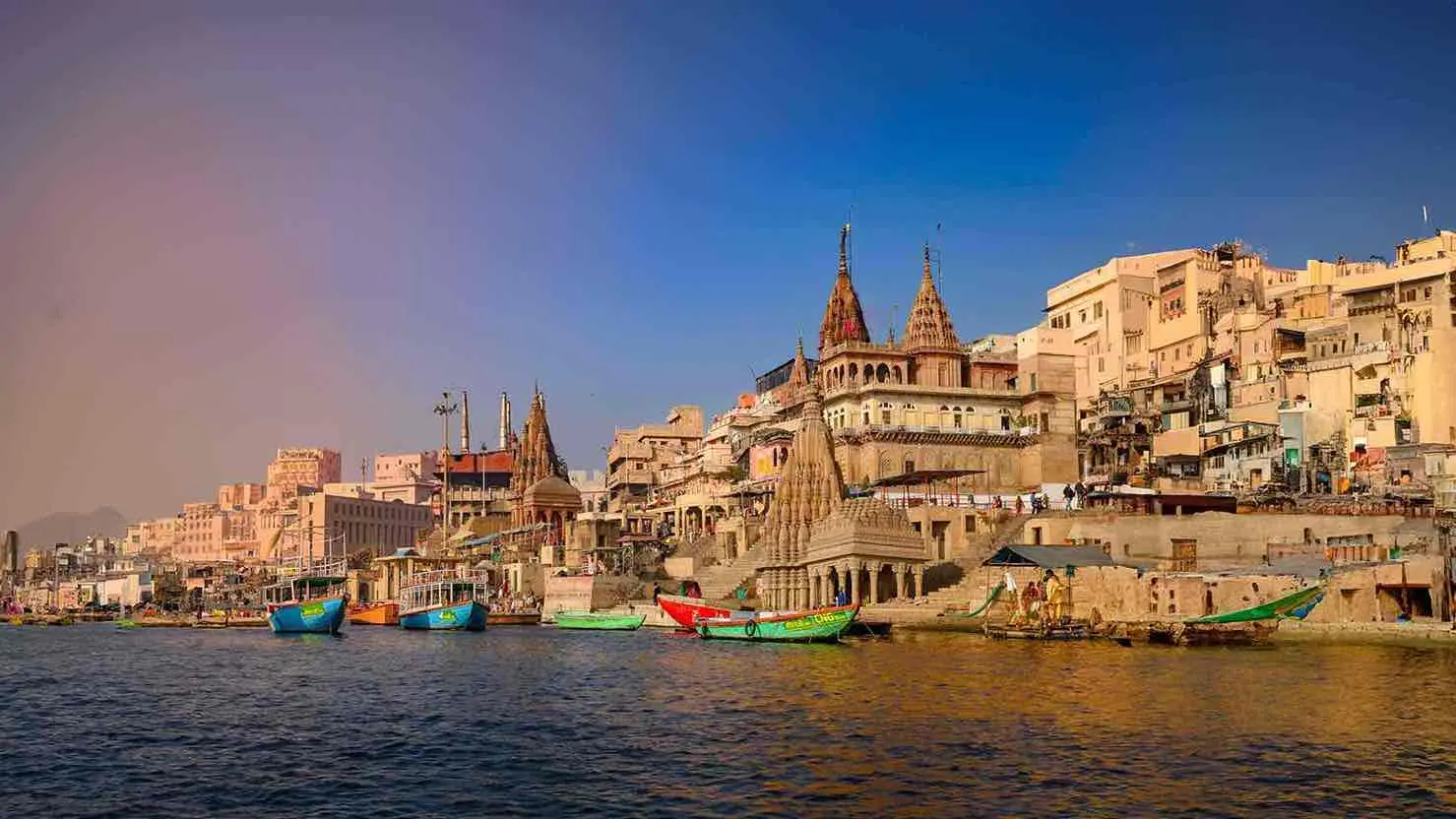
October is the turn. Early in the month the monsoon is still withdrawing and the river is still high. By the second half, the water has usually receded, the ghats have been cleaned of silt, and the city looks like the photographs again.
The weather improves faster than the river does. Temperatures ease from around 32°C at the start of the month toward the mid-twenties by the end, humidity drops sharply, and the light turns clear.
So the honest answer to whether October is a good time is: the second half is very good, the first half depends on the year. If you have latitude in your dates, weight them late.
What October brings
- Ghats reopen — the full riverside walk becomes possible again as the water drops
- Boating normalises — sunrise rides resume reliably once the current settles
- Navratri and Dussehra — the city's temples are at their most active, with the Durga and Vishalakshi temples drawing serious crowds
- Ramnagar Ramlila — the month-long cycle staged across Ramnagar, performed without amplification and without a fixed stage, running into October in most years
Ramlila is worth planning around. It is not a tourist production. It is a 200-year-old civic ritual that moves the audience physically between locations across Ramnagar, and it requires transport and someone who knows the schedule.
Choosing between them
Come in September if you want the city cheap and empty, you are interested in Varanasi as a living place rather than a set of views, or you are here for ancestral rites during Pitru Paksha.
Come in late October if you want the ghats walkable, the boats running, comfortable weather, and the festival calendar at full strength. It is close to the best time of year, and the crowds have not yet reached their November peak.
Consider waiting past October if Dev Deepawali is what you want. That falls on Kartik Purnima in November, when the ghats are lit end to end with lamps. It is the most spectacular night in the city's year and needs booking months ahead.
Planning around uncertainty
The variable you cannot control is the river, and it resolves late. Some practical positions worth taking:
- Book accommodation that is walkable to a ghat but not dependent on ghat access
- Treat a September boat ride as conditional rather than fixed, and hold an alternative
- If the ghats are submerged, redirect toward the temples and Sarnath, which are unaffected by water levels
- Ask before you pay whether a boat booking is refundable if the administration suspends boating
That last point matters. When boating is suspended, the money should come back. We arrange river services through contracted boatmen under fixed, printed pricing, and a suspended service is not a service rendered.
For a full year view rather than these two months, see our month-by-month guide to visiting Varanasi. For what to actually do once you are here, our guide to experiences across the city covers the ground.
Common questions
Is September the worst time to visit Varanasi?
No. May and June are hotter and more difficult. September's specific risk is high water on the ghats, which affects boating and riverside walking rather than the trip as a whole.
Will the ghats be flooded when I arrive?
It varies year to year and cannot be predicted far ahead. Water levels are usually highest in August and early September, and recede through late September into October.
Can I take a boat ride in September?
Often yes, but not guaranteed. Boating is restricted or suspended by the district administration when the current is strong, and those decisions are made locally and at short notice.
Which is better, October or November?
November is more reliable and more spectacular, particularly around Dev Deepawali. Late October is nearly as pleasant, meaningfully less crowded, and easier to book.