Artwork from the Bharat Kala Bhavan collection, via Wikimedia Commons
Banaras Hindu University & Bharat Kala Bhavan
BHU is one of Asia's largest residential universities, founded in 1916 by the educationist and independence leader Pandit Madan Mohan Malviya — its sprawling, tree-lined campus is worth a slow walk on its own. Inside it sits Bharat Kala Bhavan, the university's museum, holding one of India's finest collections of miniature paintings, sculpture, and archaeological finds, alongside galleries devoted to Varanasi's own history.
Pair this with the New Vishwanath Temple, also on campus — see our temples guide.
 Photo via Wikimedia Commons
Ramnagar Fort & Museum
The 18th-century sandstone fortress-palace of the Maharaja of Benares, standing on the opposite bank of the Ganga from the main ghats. It's still the residence of the former royal family, and part of it is open as a museum — vintage cars from the 1920s–40s, royal weaponry, palanquins, elephant howdahs, and ivory carvings that trace the history of Varanasi's princely state.
The fort feels lived-in rather than restored — which is precisely what makes it worth crossing the river for. Every October, the surrounding town hosts the month-long Ramnagar Ramleela, one of India's oldest theatrical traditions.
 Photo via Wikimedia Commons
Man Mandir Observatory
An 18th-century open-air astronomical observatory built by the Rajput king Sawai Jai Singh II, sitting right on Man Mandir Ghat — one of five such observatories he built across India, most famously the much larger Jantar Mantar in Jaipur and Delhi. Varanasi's version, smaller and less visited than its famous cousins, has instruments for tracking celestial positions and calculating time using nothing but geometry and stone.
An easy, quick stop if you're already walking the ghats near Dashashwamedh.
 Photo via Wikimedia Commons
Bharat Mata Mandir
An unusual temple by any standard — inaugurated by Mahatma Gandhi in 1936, it holds no deity idol at all. Instead, the entire floor is a giant marble relief map of undivided India, carved to scale with mountains, rivers, and plains rendered in three dimensions. It sits within the Kashi Vidyapith college campus and was conceived as a monument to the idea of the nation itself, not a place of ritual worship.
A quick, thought-provoking stop that's unlike anything else on this list.
Sarnath
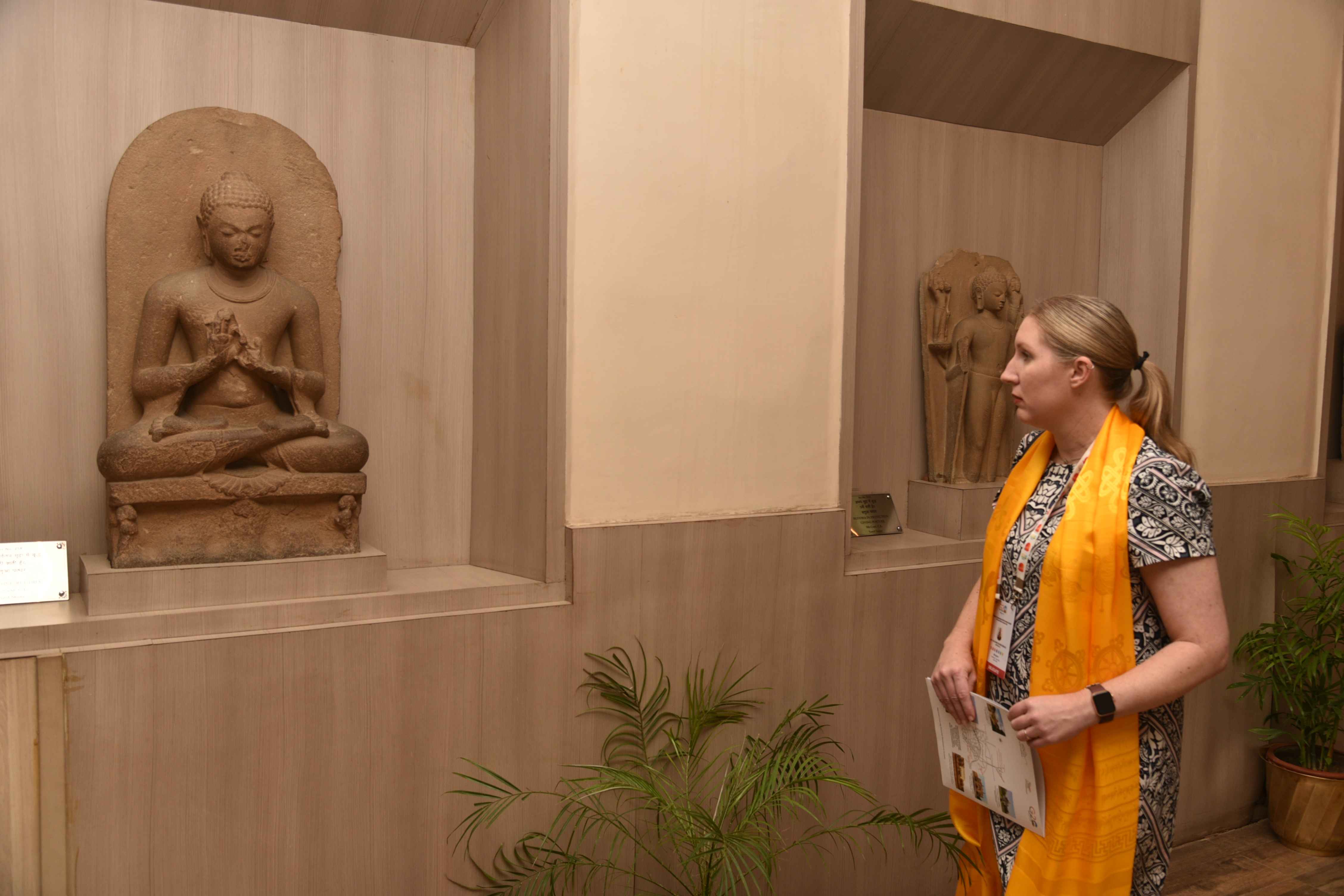
Ten kilometres northeast of Varanasi, Sarnath is where the Buddha delivered his first sermon after attaining enlightenment — setting in motion a tradition followed by hundreds of millions of people today. In July 2026, it was inscribed as India's 45th UNESCO World Heritage Site.
The site holds the Dhamek Stupa (43 metres, 5th century CE), the original Lion Capital of Ashoka — now India's national emblem — and one of the finest Buddhist museums in Asia. A half-day from Varanasi; most visitors combine it with a morning on the ghats.

Chunar Fort
Twenty-three kilometres southwest of Varanasi, Chunar Fort stands on a sheer sandstone bluff above the Ganga. It was held by Sher Shah Suri before his conquest of Delhi, besieged by Humayun, garrisoned by Akbar, and later turned into a British military prison — few forts in India have changed hands as many times or carry as many layers of history in one place.
The Chunar sandstone quarried here was used in Mughal-era buildings across the region. The town is also a centuries-old centre for terracotta and stoneware pottery. A comfortable half-day from Varanasi.