Why Sarnath matters
After attaining enlightenment at Bodh Gaya, the Buddha walked to Sarnath — then called Isipatana, the Deer Park — and found five ascetics he had previously known. To them, he delivered the Dhammachakkappavattana Sutta: the first turning of the wheel of Dharma. This moment is considered the birth of the Buddhist Sangha — the community of monks and lay followers that spread Buddhism across Asia and eventually the world.
That single event, and this single place, is why Sarnath is one of the four holiest Buddhist pilgrimage sites on earth — alongside Lumbini (birth), Bodh Gaya (enlightenment), and Kushinagar (death). For practising Buddhists, visiting Sarnath carries the same weight that a visit to Mecca carries for Muslims or Jerusalem for Christians.
In July 2026, UNESCO formally inscribed Sarnath on its World Heritage List — making it India's 45th World Heritage Site and the fourth in Uttar Pradesh. The inscription recognised the site's Outstanding Universal Value as the place where one of the world's major religions was set in motion.
What to see at Sarnath
The centrepiece
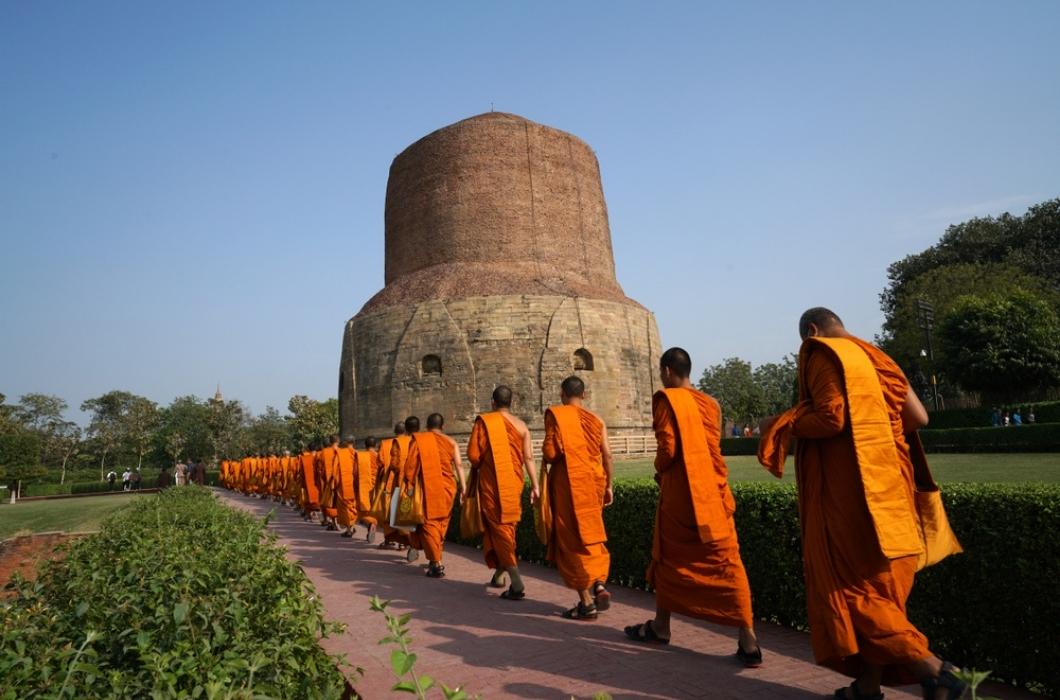
Dhamek Stupa
Standing 43.6 metres high, the cylindrical Dhamek Stupa marks the precise location where the Buddha delivered his first sermon. The lower half is encrusted with finely carved geometric and floral patterns in the Gupta style — among the most delicate stonework surviving from 5th-century India. The upper section was added later, giving the stupa its characteristic two-phase silhouette. You can circle it, but not enter it — the interior is solid masonry.
India's national emblem — in its original form
The Ashoka Pillar & Lion Capital
Emperor Ashoka visited Sarnath in the 3rd century BCE and erected a sandstone pillar topped with four back-to-back lions — a symbol of the Buddha's Dharma radiating in all four directions. The shaft of the pillar still stands in the excavation area. The Lion Capital itself — now India's national emblem, reproduced on every passport, banknote and official seal — was excavated in 1904 and is housed in the Sarnath Museum. Seeing the original, at full scale, is something else entirely.
Don't skip this
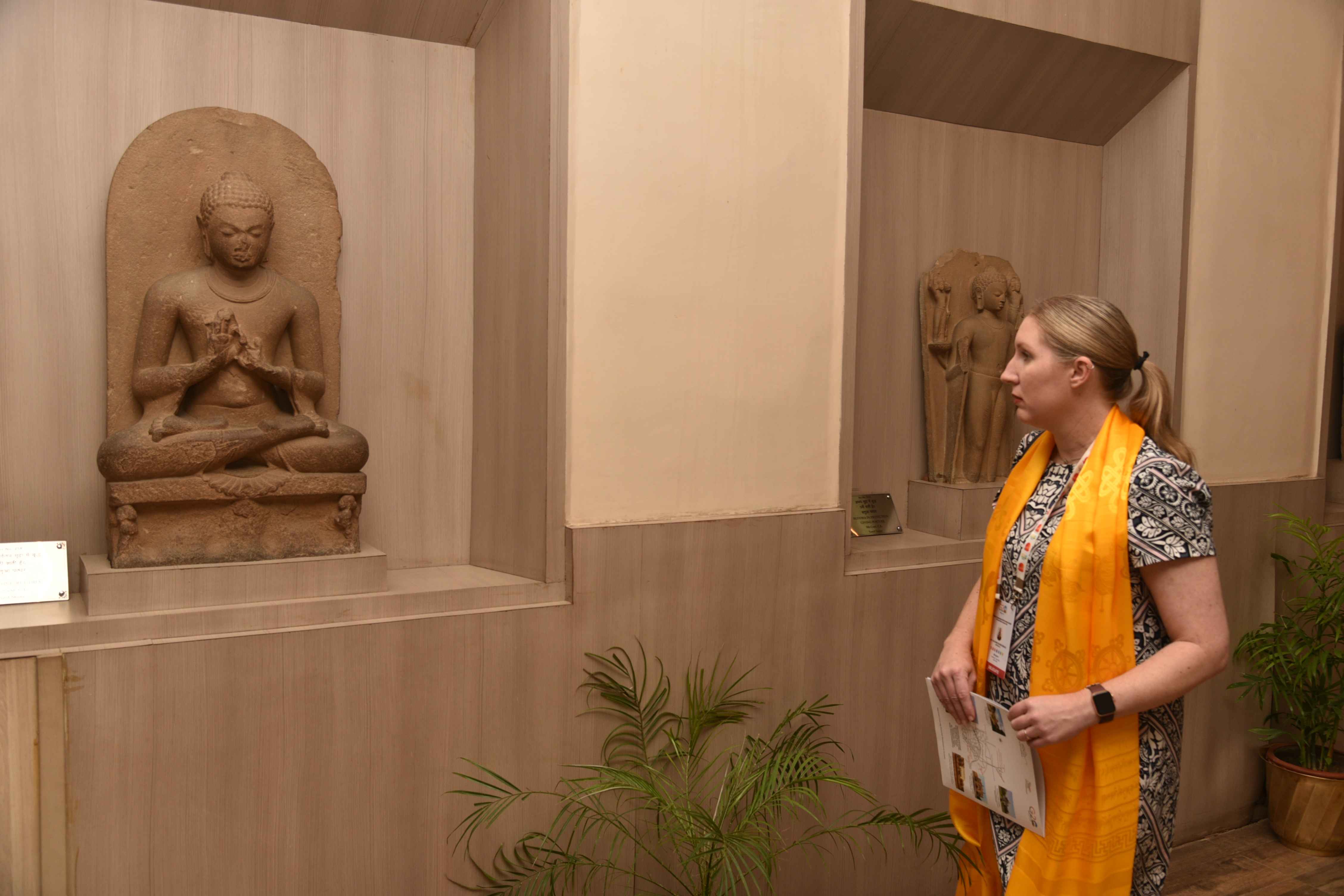
Sarnath Museum (ASI)
Considered one of the finest archaeological museums in Asia, the Sarnath Museum houses the Lion Capital, a collection of Gupta-period Buddha sculptures, Bodhisattva figures, and carved railings from various stupas. The building itself — built in 1910 — is modest from the outside. Inside, it contains objects that belonged to the Buddhist civilisation that once made Sarnath one of the great centres of learning in the ancient world. Allow at least an hour.
Active Buddhist temple
Mulagandhakuti Vihara
Built by the Mahabodhi Society in 1931, this temple marks the site where the Buddha is believed to have resided during his first rainy season at Sarnath. The interior walls are covered in frescoes by the Japanese artist Kosetsu Nosu, depicting scenes from the Buddha's life. Morning and evening prayers are held daily. Entry is free.
Oldest surviving structure
Chaukhandi Stupa
Dating back to the Gupta period (4th–6th century CE), Chaukhandi Stupa marks the spot where the Buddha first met his five disciples before leading them to the Deer Park. The octagonal Mughal tower on top was added in 1588 CE to commemorate Humayun's visit — an unusual architectural combination that tells you something about the layered history of this place. It sits just before you reach the main Sarnath complex as you come from Varanasi.
Practical information
| Location | Sarnath, 10–13 km northeast of Varanasi city centre |
| By car | 30–45 minutes from Godowlia / the ghats area, depending on traffic |
| Time needed | 2.5–3.5 hours for a thorough visit including the museum |
| Best time | Early morning (opens at 9 AM) — cooler and less crowded than afternoon |
| Stupa complex entry | ₹40 Indians / ₹600 foreign nationals (ASI ticket) |
| Museum entry | ₹20 Indians / ₹250 foreign nationals (separate ASI ticket) |
| Mulagandhakuti Vihara | Free entry |
| Photography | Permitted in stupa complex; not in museum galleries |
| Closed | Museum closed on Fridays; stupa complex open daily |
How to pair Sarnath with Varanasi
The most natural pairing is a morning on the Varanasi ghats followed by an afternoon at Sarnath — or Sarnath in the morning (arrive at 9 AM when it opens) followed by an evening Ganga Aarti at Dashashwamedh. Both combinations work cleanly in a single day.
Sarnath is a tonal shift from Varanasi. Where Varanasi is dense, loud, and overwhelming in the best sense, Sarnath is green, ordered, and quiet. Many visitors find this contrast — Buddhist calm set against Hindu intensity — to be one of the most memorable parts of a trip to this part of India. The two cities are ten kilometres and two thousand years of tradition apart, yet inseparable.
If you're planning a multi-day trip, we'd suggest not combining Sarnath with Ramnagar Fort on the same day — they are in opposite directions from Varanasi, and rushing both means doing neither well.
Frequently asked questions
Is Sarnath a UNESCO World Heritage Site?
Yes. Sarnath was inscribed on the UNESCO World Heritage List in 2026, becoming India's 45th UNESCO World Heritage Site. It had been on UNESCO's tentative list for 28 years before receiving the inscription.
How far is Sarnath from Varanasi?
Approximately 10–13 km northeast of central Varanasi — 30 to 45 minutes by car depending on traffic. It is easily combined with a Varanasi visit in the same day.
How long does a visit to Sarnath take?
Allow 2.5 to 3.5 hours for a thorough visit — an hour for the stupa complex and excavations, an hour for the museum, and time for Mulagandhakuti Vihara. A 90-minute rushed visit is possible but misses the museum entirely, which is the highlight for many visitors.
What is the entry fee for Sarnath?
The ASI charges ₹40 (Indians) / ₹600 (foreigners) for the stupa complex. The Sarnath Museum has a separate ticket: ₹20 (Indians) / ₹250 (foreigners). Mulagandhakuti Vihara is free.
Do I need a guide at Sarnath?
The site makes sense without one, but a guide adds significant depth — particularly at the museum, where the Gupta sculptures and the Lion Capital are easy to walk past without understanding what you're looking at. A Sāthi from Kashi & Kin accompanies you through both the complex and the museum and handles all the practical logistics.