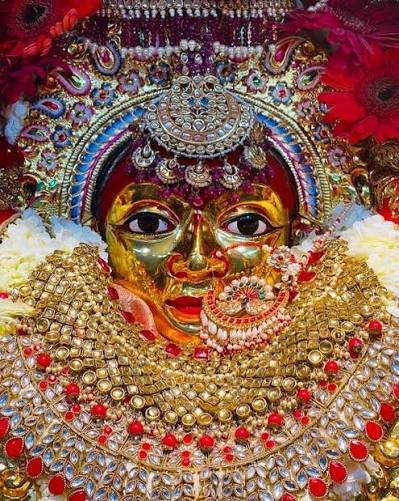
During Navratri, Varanasi keeps a pilgrimage that almost no visitor knows exists. Over nine days, devotees visit a different temple of the Goddess each day, in a fixed order, matching the nine forms of Durga worshipped on each of the nine nights.
The temples are not clustered. They are scattered from the far north of the city to Bhelupur in the south, in lanes, on ghats, and tucked beside buildings you would otherwise walk past. Following the circuit properly means crossing Varanasi nine times in nine days, and the people doing it are almost entirely local.
It is the most interesting thing happening in this city in October, and it is invisible from a hotel.
Navratri 2026
Sharad Navratri runs from Sunday 11 October to Monday 19 October 2026, with Vijayadashami on Tuesday 20 October.
Tithis occasionally merge or extend, which can shift a day's observance. The temples themselves will know, and the order never changes even when the dates do.
The nine, in order
Each form is worshipped on its own night, and in Kashi each has its own temple.
Day 1 — Shailputri. The daughter of the mountain, the Goddess in her first form, newly born. Her temple is in the far north of the city, near Marhia Ghat in the Alaipur area, reached through narrow lanes. It is a small complex holding several shrines rather than a single building, and it is quiet.
Day 2 — Brahmacharini. The Goddess as ascetic, in penance. Her temple is on the riverfront at Durga Ghat, in the northern stretch of ghats.
Day 3 — Chandraghanta. Named for the crescent moon shaped like a bell upon her brow. Her temple stands in the Chowk area, in the dense commercial heart of the old city.
Day 4 — Kushmanda. She who is said to have created the cosmos with a laugh. In Kashi this is Durga Kund — the red-ochre temple beside the tank at Bhelupur, built in the eighteenth century by Rani Bhabani of Natore, and the best known Goddess temple in the city. It is crowded throughout Navratri rather than only on its own day.
Day 5 — Skandamata. The mother of Skanda, shown with the child Kartikeya in her lap. Her temple is in the Jaitpura area to the north.
Day 6 — Katyayani. Named for the sage Katyayana, who is said to have been the first to worship her. Her temple is in the lanes near Sindhia Ghat.
Day 7 — Kalratri. The Goddess in her darkest and most fearsome form, black as night, garlanded in lightning. Her temple gives Kalika Gali its name — the lane running parallel to Vishwanath Gali, a short walk from Dashashwamedh Ghat. It is regarded as a Shakti Peetha and it is the most atmospheric of the nine.
Day 8 — Mahagauri. The Goddess in her most benevolent form, fair as the conch and the moon. In Kashi, Mahagauri is Annapurna — the Goddess of nourishment, whose temple stands immediately beside Kashi Vishwanath. You cannot miss it and you should not, whatever time of year you come.
Day 9 — Siddhidatri. The giver of siddhis, the final form. Her shrine is within the Kashi Vishwanath complex.
Locations are given as they are commonly followed. The Uttar Pradesh government maintains an official listing of the circuit, and the temples themselves are the final word — worth confirming if you intend to follow the full order.
The other circuit: Nav Gauri
Kashi keeps a second, parallel pilgrimage during the same period — the Nav Gauri Yatra, visiting nine temples of Gauri rather than nine of Durga.
Both are ancient, both are followed by different families according to their own practice, and between them they cover a considerable portion of the old city. Very little about either is written down in English.
Doing it as a visitor
The honest position: unless you are here for the full nine days, you are not going to complete the circuit, and attempting to compress it into two days misses the point of it entirely. The yatra is one temple per day because the day is the observance.
What works instead:
Visit the temple whose day it is. Go on the morning of whichever day you are in Varanasi. That temple will be alive — full, noisy, garlanded, with a queue down the lane — while the other eight are quiet. Seeing one temple on its own day is worth more than seeing four on the wrong ones.
Add the two that are always worth it. Durga Kund and Annapurna are both major temples in their own right, visited by people who are not following any circuit at all.
Go early. Queues on a temple's own day build from first light and do not ease until late. Six in the morning is a different experience from ten.
Expect the lanes. Shailputri, Kalratri and Katyayani are all reached on foot through narrow lanes that no vehicle enters. This is normal here and it is part of it.
What it is actually like
Not a tourist circuit. There is no signage in English, no ticketing, no guide standing outside offering a tour. You will be among residents doing something their families have done for generations, and the only reason you will know which day belongs to which Goddess is that someone has told you.
Several of the nine are small — a shrine in a courtyard rather than a temple in any grand sense. Arriving expecting architecture is the wrong frame. What is on offer is the sight of a city observing something very old, in its own lanes, without any of it being staged.
The rest of Navratri in Varanasi
The Nav Durga circuit runs alongside everything else happening in this period.
Durga Puja in the Bengali quarter around Bengali Tola, with pandals through the neighbourhood and immersion in the Ganga on Vijayadashami.
Ramlila across dozens of neighbourhoods, and at Ramnagar, where the thirty-one-night cycle is running by lamplight throughout.
Ravan Dahan on 20 October, and the Bharat Milap at Nati Imli a day or two after, which draws a larger crowd than anything else in the season.
Practical matters
Dress modestly — covered shoulders and knees, and shoes that come off easily, because they will come off nine times.
Carry little. Several of these temples restrict what may be taken inside, and the lanes are crowded.
Photography is restricted or forbidden inside most of them. Ask rather than assume.
Book accommodation early. October is peak season in Varanasi before Navratri and Dussehra are added to it.
How we can help
This is the kind of thing local knowledge exists for. The temples are scattered, several are hard to find, none are signposted in English, and which observance falls on which day shifts with the tithi rather than the calendar.
We arrange the car and the route for whichever days you are here, and a Sāthi who knows the lanes and can tell you what is being observed and why — which matters more on this circuit than almost anywhere else, because none of it explains itself.
Our guides work across fifteen languages. Prices are printed before you book, GST included, and settled in advance, so nothing is asked for at any temple gate. There are no commission stops on the route.
See our services or packages. If you are in Varanasi during Navratri and want to know which temple is on today, ask us.
Temple locations and observances are as commonly followed and may vary by tradition. Confirm locally before planning around a specific day.