For thirty-one nights every autumn, the town of Ramnagar across the river from Varanasi becomes the Ramayana. Not a stage version of it — the town itself. Its fields become Panchavati, a tank becomes the ocean crossed to Lanka, a walled enclosure becomes Ashok Vatika, and the audience walks from one to the next behind the actors, on foot, in the dark, by lamplight.
There are no microphones. There is no electric light. There has been no interruption to this in nearly two hundred years. It is the most remarkable thing that happens near Varanasi and most visitors to the city in October have no idea it is going on six kilometres away.
When is Ramnagar Ramlila 2026?
The Ramlila begins on Anant Chaturdashi, which falls in late September 2026, and runs for thirty-one consecutive nights into late October.
The exact schedule is set by the Ramnagar Fort and announced locally rather than published in advance, and dates circulating on travel sites are frequently wrong. Confirm before planning around it.
What makes it different from every other Ramlila
Ramlila is performed across northern India each autumn, usually over ten days, usually on a stage, usually with amplification and lighting. Ramnagar shares almost none of this.
It runs thirty-one nights instead of ten. The whole epic is performed, at length, without compression. Episodes that elsewhere take twenty minutes take an entire evening here.
There is no stage. Permanent sites are scattered across Ramnagar, each standing for a location in the story — Ayodhya, Janakpuri, Chitrakut, Panchavati, Lanka, Ashok Vatika. The performance moves between them across the run, and the audience moves with it. Some nights involve walking a considerable distance.
There is no electricity. The performance is lit by petromax lanterns carried by attendants who walk alongside the actors. When the actors move, the light moves. Nothing is illuminated that is not being looked at.
There is no amplification. The dialogue is spoken unaided, and the Ramcharitmanas is chanted by the Ramayanis, a group of reciters who carry the text through the whole month. In an audience of thousands, silence is a practical requirement rather than a courtesy.
The tradition is unbroken. It was begun in the early nineteenth century under Maharaja Udit Narayan Singh of Banaras, and the same families have organised and performed it for generations since. The Vyas family has directed it for over two centuries.
Ramlila is inscribed on the UNESCO list of Intangible Cultural Heritage, and Ramnagar's is the version most often cited as its fullest surviving form.
The swaroops
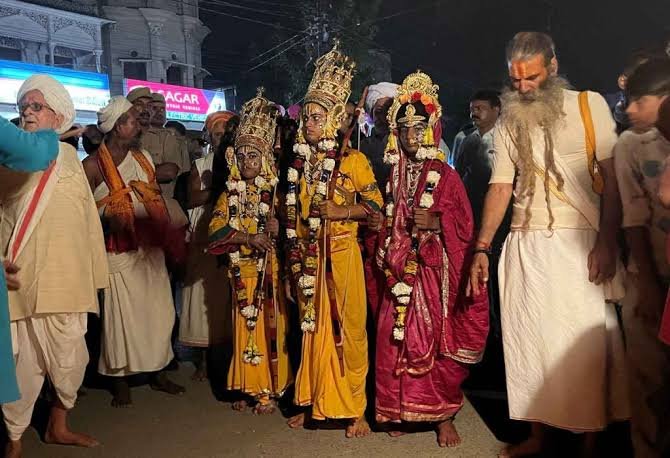
The parts of Rama, Sita, Lakshmana, Bharata and Shatrughna are played by boys, selected each year, always young, traditionally from brahmin families. They are called the swaroops — the forms.
For the duration of the run they are not treated as actors playing gods. They are treated as the gods. They are garlanded, they are given darshan by the audience, people touch their feet, and they observe restrictions on their conduct and diet throughout the month. When they appear, the crowd calls out to them as devotees rather than as spectators.
This is the thing that most distinguishes Ramnagar from theatre. The audience is not watching a story. It is attending an event that it holds to be real for as long as it lasts.
The nemis
A body of regular attenders, called nemis, follows the entire cycle — all thirty-one nights, every year, some of them for forty or fifty years running. Many carry their own copies of the Ramcharitmanas and follow the text as the Ramayanis chant it.
They are the reason the performance has not drifted. They know it line by line, and they will correct it.
What an evening is like
The performance begins in the late afternoon and runs into the night. Entry is free and open to anyone.
You sit on the ground. There is no seating, no ticketing and no reserved area. The audience is largely local, the language is Awadhi and Hindi, and there is no translation, no programme and no announcement of what is being performed on a given evening.
The crowd is large, especially on the well-known episodes, and it moves as the performance moves. It is dusty. It goes on for hours.
It is also genuinely unlike anything else, and people who go for one night frequently go back for a second.
The nights worth choosing
If you can only attend one evening, some episodes draw much larger crowds and are more spectacular than others.
- Rama's wedding at Janakpuri, early in the cycle, is celebratory and richly staged
- The exile from Ayodhya is the emotional centre of the first week
- The building of the bridge to Lanka and the Lanka episodes draw the largest audiences
- The killing of Ravana and the Dussehra performance is the best known night of the run
- The coronation at Ayodhya closes the cycle
The Maharaja of Banaras attends on certain nights, traditionally arriving by elephant, which is itself part of the spectacle.
Bharat Milap at Nati Imli
Related, and worth knowing about separately: the Bharat Milap at Nati Imli, in the city rather than at Ramnagar, is held a few days after Dussehra and enacts the meeting of Rama and Bharata on Rama's return.
It lasts a matter of minutes. It draws an enormous crowd, and the Maharaja attends. If you are in Varanasi in that week and cannot get to Ramnagar, this is the one to see.
Getting there
Ramnagar sits directly across the Ganga from the ghats. It is barely three kilometres in a straight line and around eight or nine by road from Assi Ghat, since you must go south to the bridge and back up the far bank. Allow half an hour each way, and longer on the busy nights.
Practical matters worth planning:
Go with transport arranged. The performance ends late, Ramnagar is not a place to find a ride at eleven at night, and the return crosses the bridge back into the city.
Carry a mat or a cloth to sit on. Everyone else will have one.
Wear shoes you can walk in and do not mind getting dusty. You may cover a fair distance between locations.
Bring water, and a torch for walking back.
Dress modestly and remember this is a devotional occasion, not a performance staged for visitors. Photography is restricted in places and is not welcome around the swaroops.
Eat before you go. Food near the ground is limited and the evening is long.
Should you go?
Honestly: it depends on what you want from Varanasi.
If you want a comfortable cultural evening with a clear beginning and end, this is not it. There is no seating, no English, no schedule you can rely on, and it goes on for hours in the dark.
If you want to see something that has been done the same way since before photography existed, in front of an audience that believes it, by lamplight, in a language you may not follow — then there is nothing else like it in India, and you are unlikely to get another chance.
Many visitors find that going with someone who can explain what is being performed changes it entirely, because the difficulty is not the language so much as not knowing which part of the story you have walked into.
If you would like this arranged
We can put together an evening at the Ramlila: the car across to Ramnagar and back, a Sāthi to sit with you and tell you what is being enacted, and advice on which night to choose based on the schedule for that year.
The transport is the part that matters most here. The performance finishes late, the crowd leaves at once, and Ramnagar at that hour is not a place to be looking for a vehicle. Prices are printed before you book, GST included, and settled in advance.
Our guides work across fifteen languages. If you are combining the Ramlila with the fort, note that Ramnagar Fort is worth a separate daytime visit rather than a rushed hour before the performance.
See our services or packages. If you are in Varanasi during the Ramlila and want to know which night is worth your one evening, ask us — the schedule changes and we follow it.
Dates and schedules are set by the Ramnagar Fort and announced locally. Confirm before travelling.