Short answer: yes to both, but they are not the same trip.
November is the best month of the year to be in Varanasi and also the most crowded and expensive. December is comfortable, quiet and considerably cheaper, and it carries one specific risk that most pages about it do not mention.
November
Weather. Days between about 15°C and 28°C, roughly ten hours of sunlight, no rain to speak of. Warm enough at midday to walk the ghats comfortably, cool enough at night for a light jacket. It is genuinely close to ideal.
Festivals. This is the fullest month in the Varanasi calendar. Diwali falls on Sunday 8 November 2026, with Dhanteras on the 6th and Annakut on the 9th, when the golden Annapurna idol is shown for the only days of the year. Dev Deepawali follows on Tuesday 24 November, when the whole riverfront is lit with over a million lamps. The Ganga Mahotsav runs in the days before it.
If you have any choice about when to come, this is the month.
The cost of that. November is peak season, and the festival weeks are peak within peak. Riverfront rooms that go for a normal rate in September run several times that around Dev Deepawali, with minimum-stay conditions attached. Boats are capped in number and sell out months ahead. Flights fill.
None of this is a reason to avoid November. It is a reason to book it in August rather than October.
December
Weather. Days around 22 or 23°C, nights down to 8 or 10°C, occasionally colder. Sunny and pleasant through the middle of the day, genuinely cold before dawn and after sunset — considerably colder than the numbers suggest when you are sitting still on a river at six in the morning.
Crowds. Much thinner than November, with the exception of the week between Christmas and New Year, when domestic tourism fills the city again.
Prices. Reasonable for most of the month. Accommodation is easier to find and costs a fraction of the Dev Deepawali rate.
Atmosphere. Many people who know Varanasi well prefer December to November for exactly these reasons. The ghats at dawn with few people on them, in cold air, is a different city from the ghats in festival week.
The fog, honestly
This is the part worth reading carefully, because it is the one thing that can cost you the trip you came for.
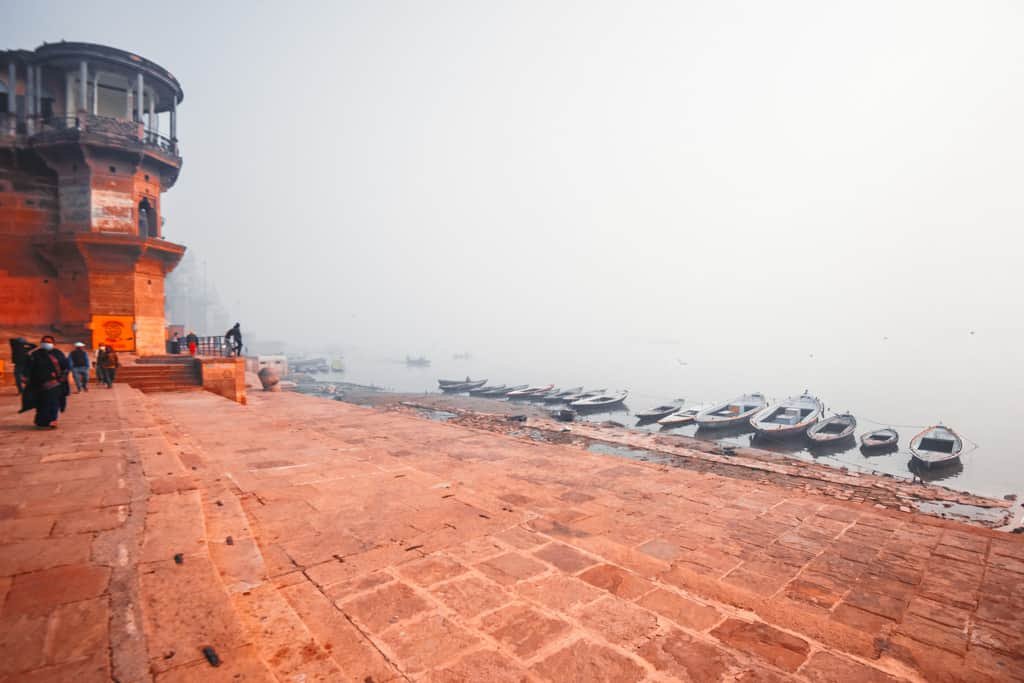
From roughly mid-December through January, the Indo-Gangetic plain fills with dense morning fog. In Varanasi it typically forms overnight and sits until eight or nine in the morning, sometimes later.
Three practical consequences.
Your sunrise boat ride may not have a sunrise. You will be on the water at six, and you may see fifty metres of grey. Some people find this beautiful and photograph it happily. Others feel they were sold something they did not receive. Both reactions are reasonable, and you should know which you are before you book a December morning.
Flights are delayed and cancelled. This is not hypothetical — Varanasi airport saw repeated fog cancellations through December last year, and it happens most winters. Early morning departures are the most affected.
Trains run late. Sometimes by many hours, on the Delhi and eastern routes especially.
How to plan around it rather than hope: early December is markedly safer than late December. The fog builds through the month and peaks from mid-December into January. Build a buffer day before any onward flight. Do not schedule a dawn departure from Varanasi if you can take a midday one. And if the sunrise on the river is the reason you are coming, give yourself two or three mornings rather than one.
Air quality
Worth stating plainly, because almost no travel page does.
The Indo-Gangetic plain has poor air from October through February, when cold stagnant air traps everything at ground level. In Varanasi this is at its worst around Diwali, when several nights of citywide fireworks land on top of it, and it stays poor through the winter.
For most healthy adults this is an unpleasantness rather than a problem. If you are bringing elderly parents, small children, or anyone with asthma or a respiratory condition, it is worth knowing in advance and packing accordingly.
What to pack
November — light layers, a jacket or shawl for evenings, something warm for the boat before dawn. Covered shoulders and knees for temples.
December — genuinely warm layers. A proper jacket, and thermals if you feel the cold. The boat at six in the morning in late December is colder than anything the daytime temperature prepares you for. A shawl for temples and for warmth both.
Both — shoes you can slip off repeatedly, and that you do not mind getting wet at the steps.
Which should you choose?
Come in November if you want the festivals, the illuminated ghats at Dev Deepawali, or the golden Annapurna darshan at Diwali. Accept crowds and pay peak rates. Book three months out.
Come in early December if you want the city quiet, the weather comfortable, the prices sensible, and a reasonable chance of clear mornings. This is the underrated window and it is what we would suggest to most people who are not tied to a festival date.
Think twice about late December and January if the sunrise on the river is the main thing you are coming for, or if your itinerary has no slack for a delayed flight.
Consider both if you have the time. The stretch from Diwali on 8 November to Dev Deepawali on 24 November is the fullest sixteen days in the Varanasi year, and people who stay through it see the city at something close to its maximum.
What does not change
Some things are constant across both months and worth knowing.
The river is settled and boating runs normally, which is not reliably true in August and September. The Ganga Aarti happens every evening at dusk, moving slightly earlier as the winter deepens. Kashi Vishwanath, Sarnath, Ramnagar Fort and BHU are all open and at their best in cool weather. And malaiyo — the winter-only milk foam sold from carts in the early morning, which does not exist outside the cold months — is available through both.
How we help
Winter in Varanasi is easier than the monsoon and harder than it looks. Festival weeks close roads unpredictably in November. Fog moves timings in December. Both months put pressure on darshan queues and on the arrival and departure days at either end.
We arrange the transport, the boat, the darshan timing and a Sāthi who can tell you what you are looking at, priced before you book with GST included and settled in advance. If fog cancels a boat, we do not keep the money for a boat that did not sail — we reschedule within your stay or refund that portion, and we tell you which before you pay.
We will also tell you honestly what your dates can and cannot deliver. If you are arriving on 26 December wanting a clear sunrise, we will say that it is a gamble rather than sell you the picture.
If you are planning for November, our guide to booking for Dev Deepawali covers what runs out and in what order. See our services or packages for the wider trip.