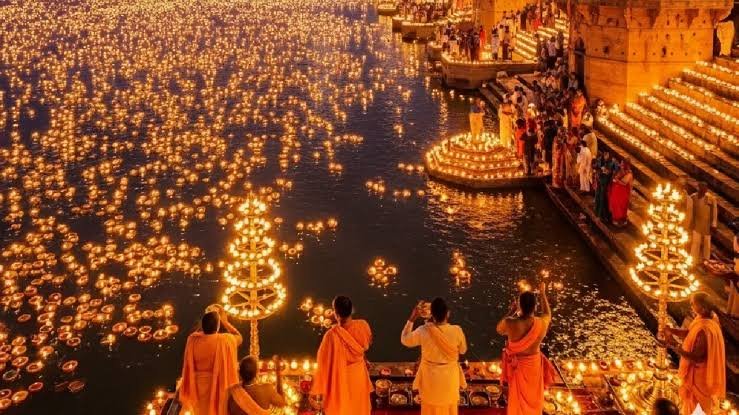
Dev Deepawali 2026 falls on Tuesday, 24 November. It is one night. Not a week, not a season — a single evening when the ghats of Varanasi are lit end to end with earthen lamps, and roughly a million people come to see it.
That combination, one night and very large numbers, is why booking for Dev Deepawali works differently from booking for any other time of year. This guide sets out what to arrange and when, in the order things run out.
When is Dev Deepawali 2026?
Tuesday, 24 November 2026, on the full moon of Kartik. It falls fifteen days after Diwali.
The lamps are lit at dusk, and the main viewing window runs from roughly half past five to eight in the evening. The special Ganga Aarti at Dashashwamedh Ghat and the fireworks over the river follow. If you are coming for Dev Deepawali specifically, this is the evening you are coming for.
The festival marks Lord Shiva's victory over the demon Tripurasura, which is why the day is also called Tripurari Purnima. Devotees believe the gods themselves come down to bathe in the Ganga at Kashi on this night, and the lamps are lit to welcome them. That belief is the reason the whole riverfront is illuminated rather than a single temple or a single ghat.
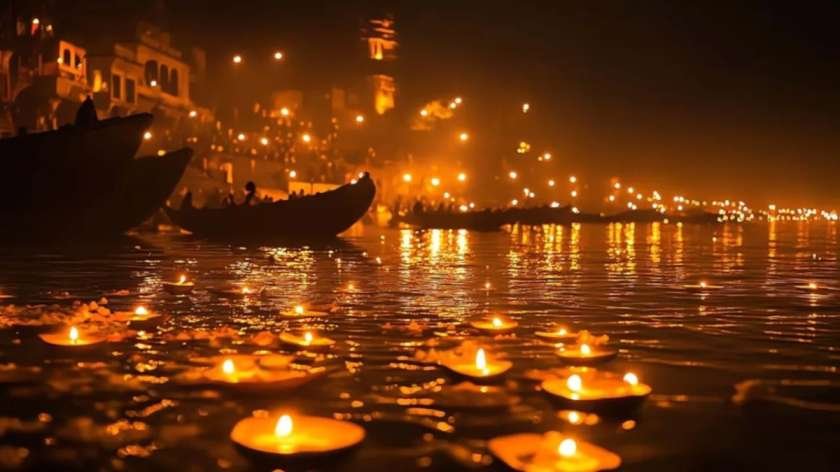
Dev Deepawali falls on Tuesday, 24 November 2026. The lamps are lit at dusk.
How far ahead should you book?
The short answer: four to six months for accommodation, two to three months for everything else.
If you are reading this in August or September, you are in good time. If you are reading this in the first half of November, you can still come, but your choices will be narrower and your costs higher. What follows explains why.
What runs out, and in what order
Riverfront hotels — four to six months ahead
Rooms with a view of the Ganga at the ghat-side properties go first. Many are taken by June for a November festival, and by September there is usually nothing left facing the river at any sensible price. Hotels also apply festival rates, often two or three times the normal tariff, and many insist on a minimum stay of two or three nights around the date.
If riverfront matters to you, this is the one decision you cannot postpone. If it does not, staying in the Cantt or Sigra area is perfectly workable and considerably cheaper, though you will need transport arranged for the evening itself.
Boats — two to three months ahead
From the ghats, you see the ghat you are standing on. From the water, you see the whole illuminated riverfront at once, which is the sight people travel for.
Boats for Dev Deepawali are limited, the administration caps numbers on the night, and prices on the day itself run many times the ordinary rate. Booking opens in practice from around August, and the better options are gone by late September or early October. Arranging a boat two weeks before Dev Deepawali means paying a great deal for whatever is left.
Guides — two to three months ahead
The supply of guides is fixed and does not expand for the festival. Guides working in languages other than Hindi and English are the first to be taken, often months ahead, because there are only so many of them in the city.
Trains and flights — as soon as your dates are fixed
Indian Railways opens reservations sixty days before the date of travel, which for 24 November means late September. Popular trains into Varanasi are full within hours of opening. Flights do not sell out in the same way, but fares climb steeply from about two months out and again in the final fortnight.
A month-by-month plan
- Four to six months before (June to August) — fix your dates, book accommodation, decide whether you want to be on the riverfront
- Three months before (late August) — book flights; begin arranging your boat and guide
- Two months before (late September) — train reservations open; confirm boat and guide if not already done
- One month before (late October) — arrange transport for the evening itself, and for airport or station transfers
- Two weeks before — confirm every booking in writing; ask what time you need to be where
Consider the day before and the day after
Most visitors arrive on the 24th and leave on the 25th, which concentrates the crowds and the prices into a single day. Two adjustments are worth thinking about.
Arriving two or three days early costs less, gives you the city at something closer to its normal rhythm, and means you are not travelling on the most congested day of the year. It also protects you against a delayed flight costing you the entire reason for the trip.
Staying on for a day afterwards is worth more than it sounds. The morning after Dev Deepawali on the Ganga is quiet in a way that is difficult to describe, and the ordinary sunrise boat ride is at its best.
Getting to the ghats on the night
This is the part that catches people out, and it is worth understanding before you book anything.
On Dev Deepawali the police close roads across the old city. Vehicles cannot approach the ghats. Routes that are open one year are shut the next, and the closures are announced late. Depending on where you are staying and which ghat you are heading for, expect to walk the final stretch, sometimes a kilometre or more, through dense crowds.
Boats also have boarding cut-off times that are much earlier than people expect. On a normal evening you might step onto a boat at six. On Dev Deepawali you may need to be aboard by three or four in the afternoon, because after that the ghat steps are impassable and the boats are already positioned.
None of this is a reason not to come. It is a reason to have someone who knows the city arranging your evening rather than working it out on the day.
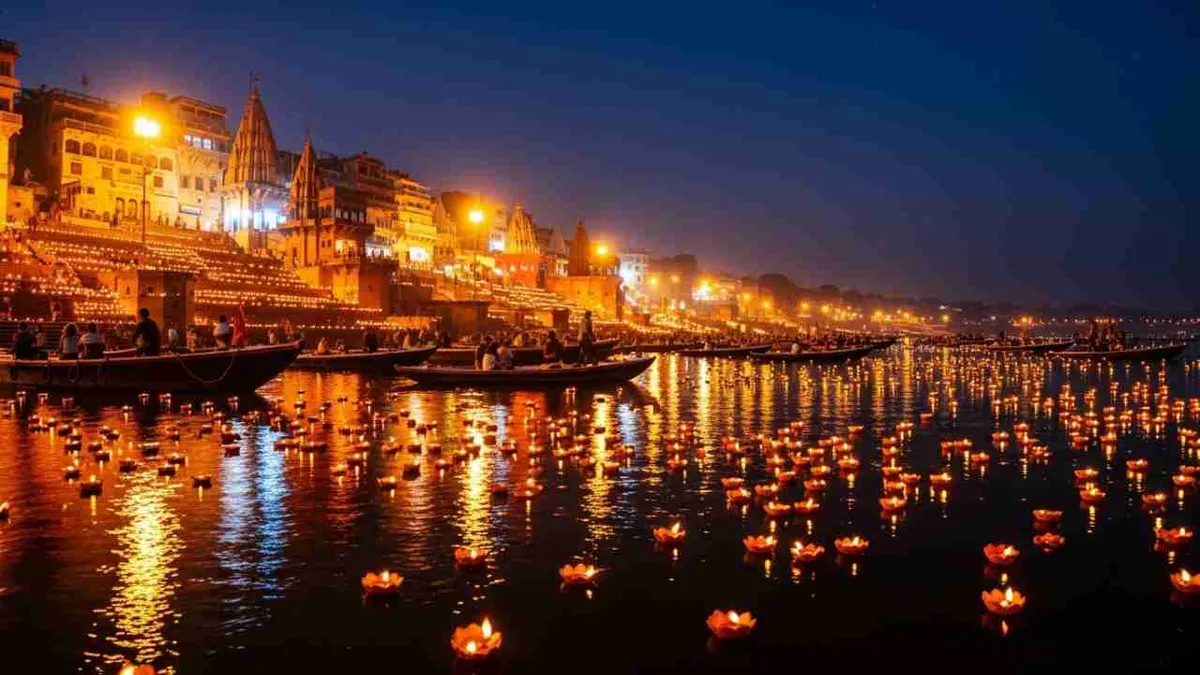
The full sweep of the riverfront is only visible from the water.
What Kashi and Kin arranges for Dev Deepawali
We put together the evening as one arrangement, so you are not coordinating three separate bookings on the most crowded night of the year.
A place on a boat. Booked in advance with the boatmen we work with, positioned to see the illuminated ghats and the aarti from the water. You are told your boarding time and your boarding point when you book, not on the day.
A Sāthi to explain what you are looking at. Our guides work across fifteen languages. Dev Deepawali is not a light show, and without someone to tell you why the lamps are lit, what the aarti is doing, and which ghat you are passing, a great deal of it goes by unexplained. This is the difference between watching something and understanding it.
Pickup and drop at your hotel. A driver collects you from where you are staying and returns you there afterwards. Because roads close and closures shift, the drivers we work with know which approaches are open on the night and where the walking begins. This is the single most useful thing we do on Dev Deepawali.
Everything is priced before you book. The figure you are quoted includes GST and is the figure you pay. Nothing is collected on the ghat, no one asks for more on the boat, and there are no stops at shops on the way. Payment is settled before you arrive in Varanasi, so the evening itself involves no money changing hands at all.
Details of what we offer through the year are on our services page, and our packages cover longer stays around the festival.
If you take one thing from this
Book your accommodation now, and your boat and guide within the next month. Everything else can wait. The people who have a difficult Dev Deepawali are almost always the people who arranged it in November.