Dussehra in most Indian cities is an evening. A large effigy of Ravana is burned, there are fireworks, and everyone goes home. In Varanasi it is a season, and the effigy is close to the least interesting part of it.
The city keeps a Ramlila tradition unlike anywhere else in India, spread across dozens of neighbourhoods and running for weeks rather than days. It also keeps a nine-temple pilgrimage during Navratri that almost no visitor knows about, a Bengali Durga Puja in its own quarter, and a five-minute event the day after Dussehra that draws a larger crowd than the burning does.
The dates for 2026
Sharad Navratri runs from Sunday 11 October to Monday 19 October 2026.
Vijayadashami, or Dussehra, falls on Tuesday 20 October 2026.
Bharat Milap at Nati Imli follows a day or two after Dussehra. The exact day is set locally and announced close to the time.
The Ramnagar Ramlila, which begins in late September, is still running through all of this and continues past Dussehra.
Navratri: the nine Durga temples
This is the part of the season that visitors miss almost entirely, and it is the most rewarding.
Across the nine nights, Kashi keeps a pilgrimage circuit in which devotees visit a different temple of the Goddess each day, in a fixed order, matching the nine forms of Durga worshipped on each night — Shailaputri, Brahmacharini, Chandraghanta, Kushmanda, Skandamata, Katyayani, Kalratri, Mahagauri and Siddhidatri.
The temples are scattered across the whole city rather than clustered, so following the circuit properly means covering considerable ground over nine days. Queues at each are long on its designated day and short on every other, which is worth knowing if you are here for only part of the period.
There is a parallel circuit of nine Gauri temples kept in the same season. Between them these are among the oldest continuous practices in Varanasi, and they are almost entirely local — you will be among residents rather than tourists.
Durga Kund, with its red-ochre walls and the tank beside it, is the best known of the Durga temples and is worth a visit at any time in this period whether or not you follow the circuit.
Durga Puja in the Bengali quarter
Varanasi has had a substantial Bengali population for centuries, settled largely around Bengali Tola and the ghats near Dashashwamedh, and Durga Puja here is a proper Bengali Durga Puja rather than a token one.
Pandals go up through the neighbourhood, the idols are made locally, and from Saptami through Navami the quarter is busy every evening. On Vijayadashami the idols are taken to the Ganga for immersion, with sindoor khela before they go.
It is a completely different register from the Ramlila — Bengali rather than Awadhi, Goddess rather than Rama, community rather than epic — and both are happening in the same city in the same week.
Ramlila, everywhere
Varanasi does not have one Ramlila. It has dozens, staged by neighbourhood committees across the city, some running ten days and some considerably longer, in maidans and lanes and open grounds.
The most famous is at Ramnagar, across the river, which runs thirty-one consecutive nights by lamplight with no stage, no electricity and no amplification, and has done so for nearly two hundred years. It is the fullest surviving form of the tradition anywhere in India and deserves an evening of its own.
The city Ramlilas are shorter, more accessible and easier to drop in on. If you are staying near the ghats, ask locally what is being performed nearby that evening — there will be something.
Dussehra day: the Ravan Dahan
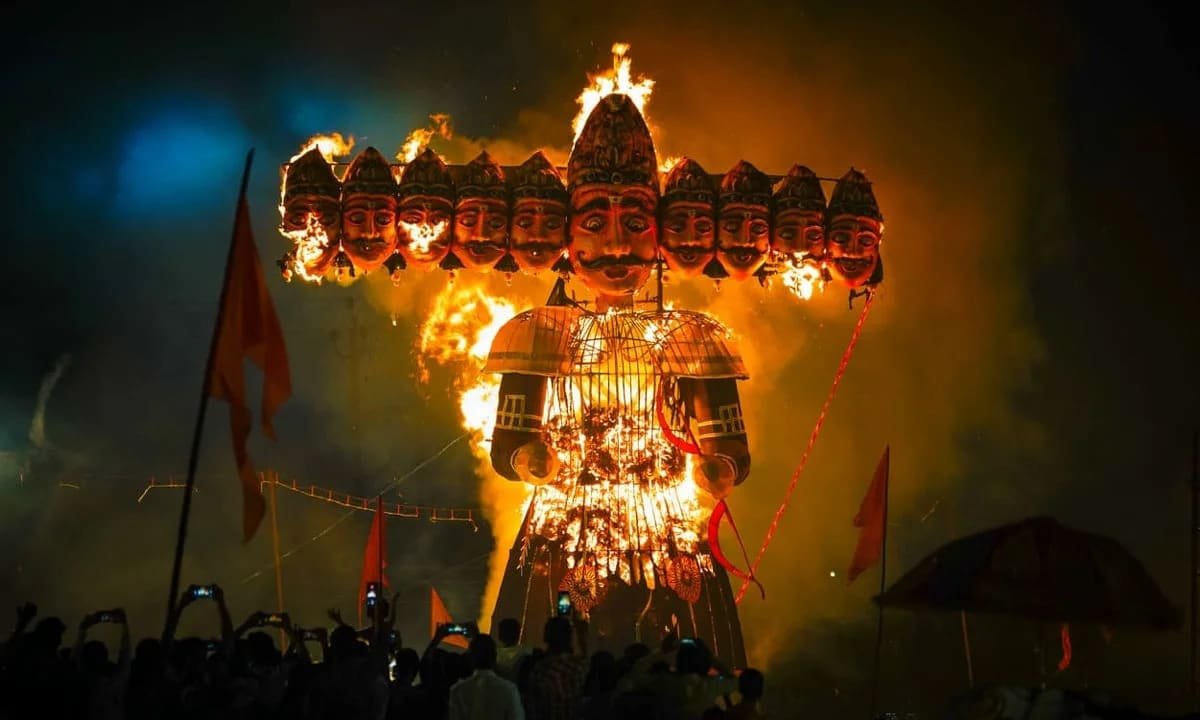
On the evening of 20 October, effigies of Ravana, Kumbhakarna and Meghnad are burned at grounds across the city. The largest are at Lanka, near the university, and the effigies can reach considerable height.
The burning happens after sunset, usually somewhere between six and eight. Crowds are large, the grounds fill early, and traffic around them is difficult for a couple of hours either side.
It is a spectacle and worth seeing once. It is also the part of Varanasi's Dussehra that is most like Dussehra everywhere else, which is why what follows matters more.
Bharat Milap at Nati Imli
If you can only attend one thing in the whole season, attend this.
A day or two after Dussehra, at Nati Imli in the city, the meeting of Rama and Bharata is enacted — the moment when the brothers are reunited after fourteen years and Bharata prostrates himself. It has been performed on the same ground for over four hundred years.
The whole thing lasts a matter of minutes. Several hundred thousand people come to watch it. The Maharaja of Banaras attends, traditionally arriving on an elephant, which is itself part of what the crowd has come for.
The disproportion is the point — an event of a few minutes, four centuries old, drawing a crowd that fills the surrounding lanes for hours beforehand. Nothing else in the Indian festival calendar works quite like it.
Go very early. The ground fills long before anything happens, and there is no getting closer once it has.
What else is worth doing this week
The city is at its best in October generally. The monsoon has passed, the air is clear, the heat has broken, and the river is full.
Boating runs normally by this point in the season, which is not reliably true in September. The sunrise ride is at its finest in October, and the evening Ganga Aarti continues through the festival period as usual.
Sarnath, Ramnagar Fort and BHU are all unaffected by the festival crowds and make good use of the daylight hours, since most of what is worth seeing at Dussehra happens after dark.
Practical matters
Book early. October is high season in Varanasi before you add a festival to it. Accommodation near the ghats fills well in advance.
Expect road closures. Around the Ravan Dahan grounds and around Nati Imli on Bharat Milap day, traffic is diverted and vehicles cannot get close. As with every crowded evening in this city, the car stops at the edge and the rest is walking.
Arrive far earlier than seems necessary for Bharat Milap and for the Ramnagar Ramlila. Both fill hours ahead.
Carry very little in the crowds, and agree a meeting point with your group before you set out. Mobile networks in the old city struggle under festival loads.
Dress modestly and remember that the Ramlilas are devotional occasions rather than performances staged for visitors. Photography is restricted in places, particularly around the boy actors playing the divine roles.
Nothing here is ticketed. The Ramlilas, the Ravan Dahan and Bharat Milap are all free and open to anyone. What you are paying for, if you pay for anything, is getting there and back and knowing what you are looking at.
How we can help
The festival season is the one time of year when local knowledge is worth more than a guidebook, because almost none of it is published. Which Ramlila is performing which episode tonight, which day Bharat Milap falls on, which approach to Nati Imli is open, which Durga temple is on the circuit today — this is information that circulates in the city rather than online.
We arrange the transport, which matters most when roads close and events end late, and a Sāthi to sit with you and tell you what is being enacted. Our guides work across fifteen languages, and at a Ramlila performed in Awadhi that is the difference between watching and following.
Prices are printed before you book, GST included, and settled in advance. Nothing is asked for on the day and there are no commission stops on the route.
See our services or packages. If you are in Varanasi during the festival and want to know which evening is worth your time, ask us — the schedules change and we follow them.
Festival dates and timings are set locally and announced close to the time. Confirm before travelling.