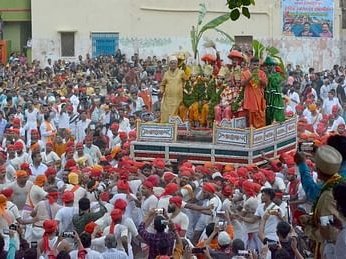
Several hundred thousand people gather in a cramped ground in the middle of Varanasi, having arrived hours early and stood in the sun. What they have come to see lasts about five minutes.
The Bharat Milap at Nati Imli has been performed on the same patch of earth every year since 1543. It is not the largest Ramlila in the city, nor the longest, nor the most elaborate. It is the one that empties Varanasi into a single lane, and the one the Maharaja of Banaras leaves his own Ramlila to attend.
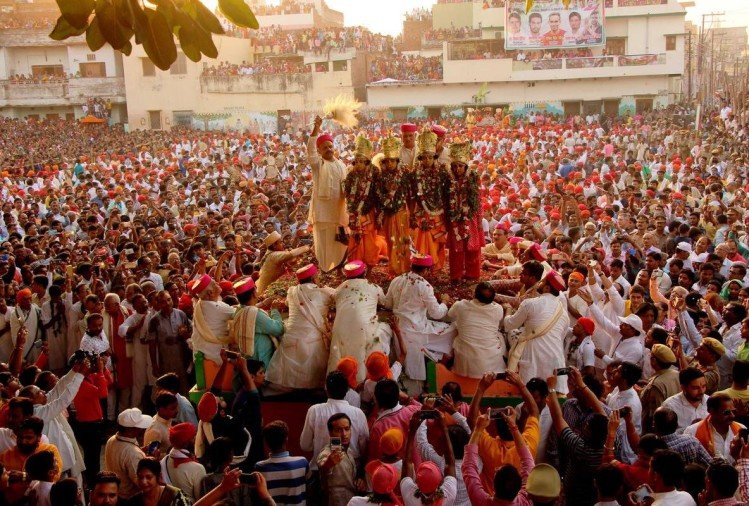
The lanes around Nati Imli seal up hours before anything happens.
What is being enacted
The moment comes near the close of the Ramayana, in the Uttar Kand of Tulsidas's Ramcharitmanas.
Fourteen years earlier, Rama had gone into exile. His brother Bharata, who had never wanted the throne and was not in Ayodhya when it was offered to him, refused to take it. He went instead to Rama in the forest and begged him to return. When Rama would not break his father's word, Bharata took his brother's sandals — the paduka — carried them back, placed them on the throne, and ruled for fourteen years as their regent rather than as king.
He did not live in the palace. He lived at Nandigram, outside the city, as an ascetic, in the clothes of a hermit, waiting.
The fourteenth year ends. Rama returns. And Bharata, who has counted the days, sees his brother coming.
What is enacted at Nati Imli is that recognition — the running, the prostration at Rama's feet, and Rama raising him up and holding him. In Tulsidas's telling it is the most emotionally unguarded passage in the whole work, and it is the reason the crowd comes.
It is worth distinguishing this from the earlier meeting at Chitrakoot, where Bharata went to plead with Rama during the exile. Both are called Bharat Milap. The one at Nati Imli is the reunion at the end, not the appeal at the beginning.
Megha Bhagat and the first performance
The tradition is traced to Megha Bhagat, a disciple of Goswami Tulsidas, and to the year 1543.
Tulsidas composed the Ramcharitmanas in Awadhi rather than Sanskrit, so that the Ramayana could be heard by people who would never read it. The Ramlila tradition grew directly out of that decision — if the text was for everybody, the performance would be too. Megha Bhagat's contribution was to take the reunion episode and stage it alone, as its own event, on its own day.
The account passed down in Varanasi is that he was instructed to do it in a dream. In some tellings it is Tulsidas who appears to him; in others, Lord Rama himself. He chose the ground at Nati Imli and staged the meeting there.
The legend of his death
Here the story turns, and it is the part that has kept the event alive for nearly five centuries.
As the first performance reached its climax — as Bharata fell at Rama's feet — Megha Bhagat is said to have collapsed on the spot and died.
The tradition holds that he was granted darshan of the four brothers as they truly are, not as boys in costume, and that having seen it there was nothing further for him to stay for. He had staged the reunion, and in the staging he was given the thing itself.
Whatever one makes of that, its consequence is concrete. Nati Imli is not merely where a scene is performed. It is held to be where something occurred. That is why the ground cannot be moved, why the timing cannot be adjusted for convenience, and why a five-minute enactment draws a crowd that a three-hour one does not.
The Kashi Naresh
The Maharaja of Banaras attends, in ceremonial dress, arriving in procession with the full royal paraphernalia — traditionally on an elephant, through lanes packed solid.
The detail that matters is what he is not doing. The Ramnagar Ramlila, the thirty-one-night cycle staged by his own family at his own fort across the river, is running that same evening. On this one day of the year, he leaves it and comes to Nati Imli.
The lila does not begin until he has arrived. His presence is not ceremonial decoration; the sequence waits for it.
The Pushpak Viman
Rama returns to Ayodhya in the Pushpak Viman, the aerial chariot taken from Ravana, and at Nati Imli a model of it is brought to the ground.
It weighs somewhere in the region of five thousand kilograms. It is carried on the shoulders of men of the Yadav community, along a route of several kilometres through the city, as it has been for generations. The right to carry it is inherited and it is not a light thing to be asked to do.
Bearing that weight through those lanes, in that crowd, is itself part of the observance. Nobody is paid for it.
Lakkha Mela
The event is also called the Lakkha Mela — the fair of lakhs — for the obvious reason.
The crowd is the thing everyone who has been remembers. Roofs are full. Balconies are full. Children ride on shoulders. The lanes around Nati Imli are impassable for hours before anything happens, and the ground itself is beyond reach long before that.
When the four brothers appear, people press forward to offer tilak and garlands to the boys playing them, who for that hour are not treated as boys.
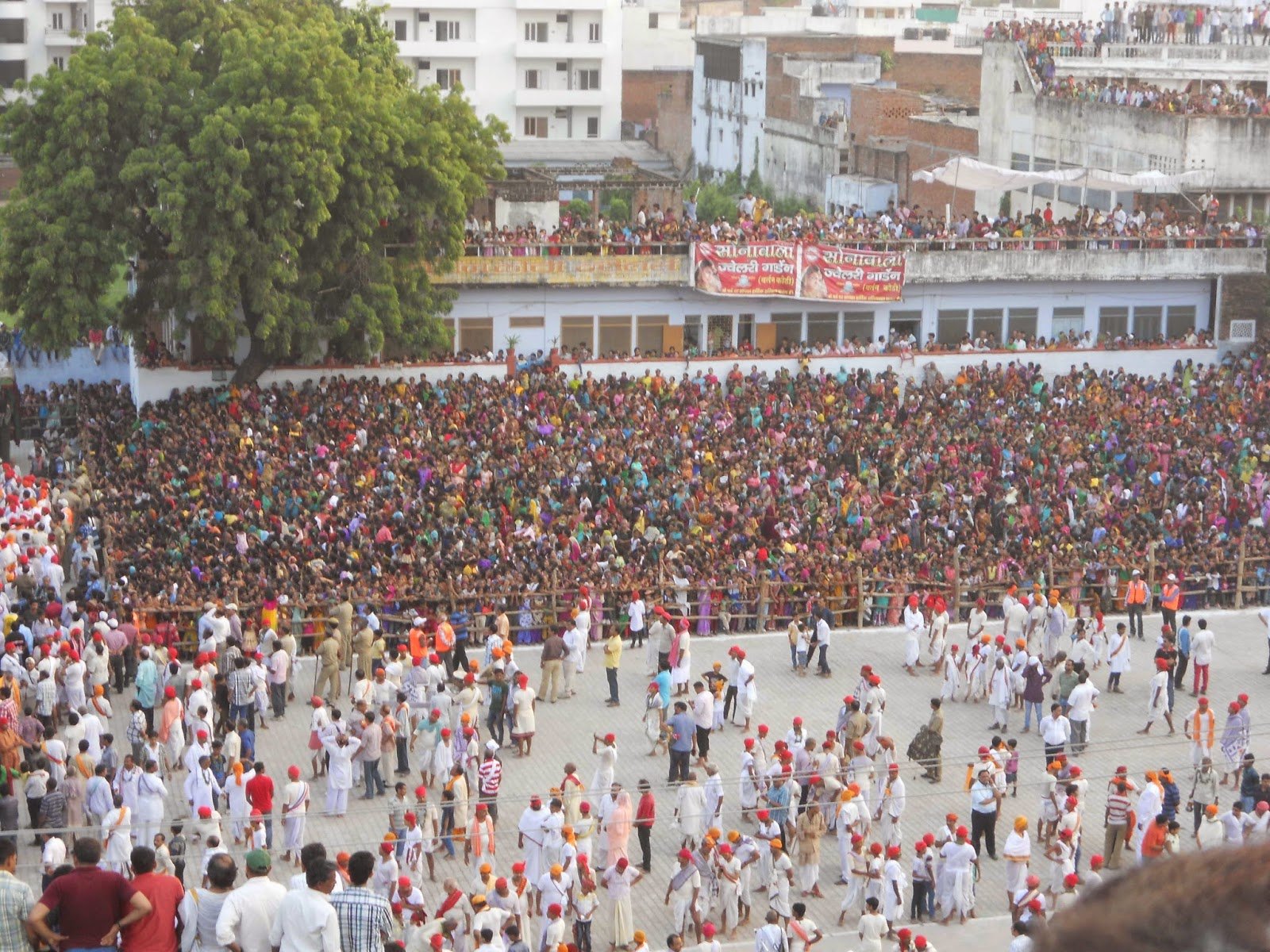
The reunion itself lasts about five minutes.
What happens afterwards
Firecrackers, and then the crowd disperses toward the river. Lamps are offered at the ghats. Bhandaras — community feasts, open to anybody — are held through the Nati Imli neighbourhood and beyond, and this continues into the night.
The Ramlila cycles across the city continue for days afterwards. Ramnagar runs on for weeks.
Bharat Milap 2026
Dussehra falls on Tuesday 20 October 2026, which places Bharat Milap at Nati Imli on 21 or 22 October. The exact day is fixed locally and announced close to the time, so confirm it rather than assuming.
The performance is timed to a precise moment in the late afternoon. It is not adjustable and it does not wait for latecomers.
If you want to see it
Arrive extremely early. Hours, not minutes. The lanes seal up long before the lila begins and there is no getting closer once they have.
Accept that you may not see much. This is the honest position. Hundreds of thousands of people are trying to watch something at ground level in a confined space. Many attend for the occasion rather than the sightline.
Entry is free. Nobody sells tickets to Bharat Milap. If someone offers you guaranteed viewing for a fee, they are selling something they do not have.
Vehicles cannot get near. Roads across that part of the city close, and the last stretch is on foot through a dense crowd.
Carry almost nothing, and agree a meeting point with your group before you set out. Phone networks fail under the load.
Not suitable for small children or anyone with limited mobility. The crush is genuine and there is no easy exit once you are in it.
Why it is worth the difficulty
Most festivals scale their spectacle to their audience. This one does the opposite. Five minutes, no stage machinery, no amplification, a scene everybody present already knows the ending of — and a crowd that has come every year for four hundred and eighty-three years to watch two brothers meet.
The Ramnagar Ramlila will show you the tradition at its fullest, across thirty-one nights, and it is the better introduction. Nati Imli shows you something else: what a city does when it believes a thing happened on a particular patch of ground.
Arranging it
The practical difficulty is entirely in getting there and getting back, and in knowing which day it falls on and which approach is open — none of which is published, all of which circulates locally.
We arrange the transport to the nearest point a vehicle can reach, and a Sāthi to walk you in and tell you what is happening as it happens. Our guides work across fifteen languages, and at an event lasting five minutes in Awadhi, that matters more than usual.
Prices are printed before you book, GST included, and settled in advance. Nothing is asked for on the day.
If you are in Varanasi for this period, the Ramnagar Ramlila is running alongside it and is worth a separate evening. See our services or packages for the wider stay.
Dates and timings are set locally and announced close to the time. Confirm before travelling.