Varanasi eats early. The best food in this city is served between seven and eleven in the morning, from shops that have been making one thing for four generations, and by midday much of it has sold out. Anyone who plans to have a leisurely breakfast at the hotel and go looking for street food in the afternoon will miss most of what is worth eating here.
It is also, largely, a vegetarian city. Much of the food near the temples is cooked without onion or garlic, in the satvik tradition, which is not a limitation so much as a different set of rules — the flavour comes from asafoetida, ginger, green chilli and a heavy hand with spice.
Here is what to eat, roughly in the order of the day.
Kachori sabzi, the Banarasi breakfast
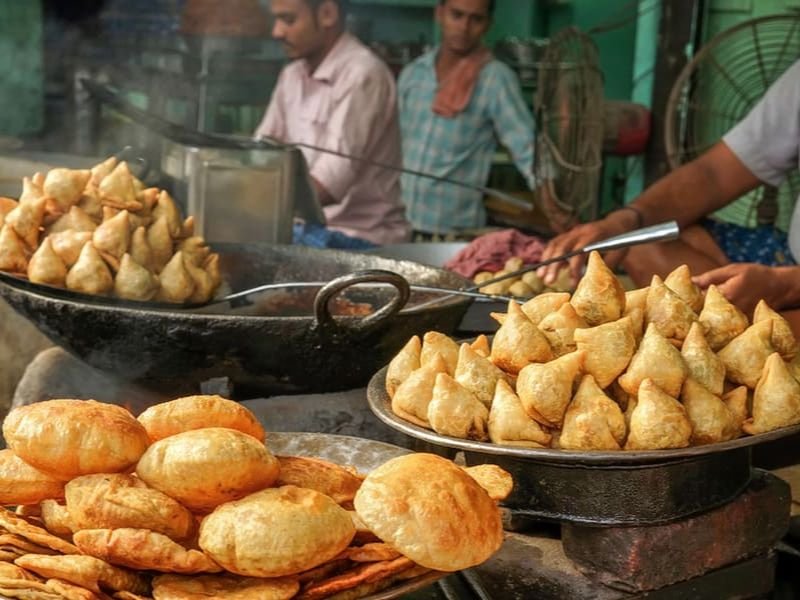
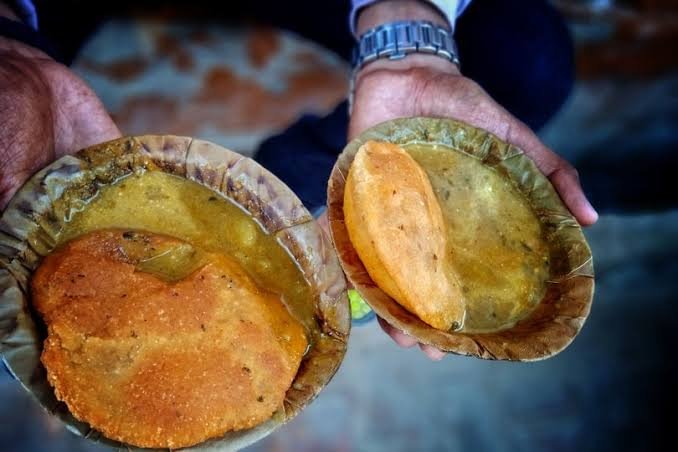
This is the meal the city runs on. A kachori is a deep-fried disc of dough stuffed with spiced lentils, served with a thin, fiery potato curry and often a piece of jalebi alongside — sweet and sharp on the same plate, first thing in the morning.
You eat it standing, off a leaf plate, at a shop with a queue outside. Kachori Gali, the lane running towards the Kashi Vishwanath temple, is named for this and lined with shops making nothing else. Ram Bhandar in Thatheri Bazaar is the name most locals give when asked, and has been at it long enough to have outlasted most of its competition.
Go early. Seven to nine is the hour. The good shops are finished by eleven.
Kachori sabzi, eaten standing, off a leaf plate. The queue outside is the quality signal.
Malaiyo — but only in winter
If you are in Varanasi between roughly November and February, this is the thing to eat, and it is the one thing here you genuinely cannot get anywhere else.
Malaiyo is milk foam. It is made overnight, left out under the winter sky so the dew settles on it, then whipped before dawn into something with almost no substance at all — a saffron-coloured cloud, dusted with pistachio, served in a small clay cup. It collapses on the tongue. Eating it is closer to eating air than eating a dessert.
It exists only in the cold months, because it needs the dew and the night temperature, and it is sold only in the early morning, because it does not survive the day. Vendors carry it on head trays and handcarts through Thatheri Bazaar and the Chowk area from soon after sunrise until it runs out, usually by mid-morning.
Visitors who come in December and leave without trying it have missed the most Banarasi thing in Banaras.
Chura matar, the other winter dish
Also seasonal, also mostly missed by visitors. Flattened rice cooked slowly in ghee with fresh green peas, which are only good in winter, finished with ginger and green chilli and sometimes a little paneer.
It is a simple thing that becomes very good in the hands of someone who has made it for thirty years. Sold from the same early-morning shops and carts as the kachori.
Tamatar chaat and the afternoon chaat
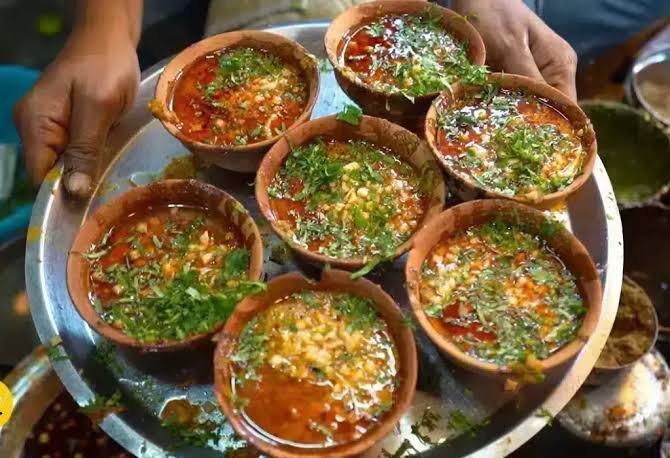
Banarasi chaat is its own school, and tamatar chaat is its signature — tomatoes cooked down with potato and spice into something almost stew-like, served hot in a clay cup with crushed crisp fried bread on top, sweet and sour and sharp at once. It is not the dry, assembled chaat sold elsewhere in India.
Try also palak chaat, spinach leaves fried in gram flour batter until crisp then dressed with yoghurt and chutneys, and chhena dahi vada, which is lighter than the usual lentil version.
Kashi Chaat Bhandar near Godowlia and Deena Chaat Bhandar near Dashashwamedh are the two names that come up most often. Both are busy, both are worth the wait, and the queue is a good sign rather than a reason to look elsewhere.
Banarasi chaat is served hot in a clay cup, not assembled dry like elsewhere in India.
Lassi in a clay cup
Thick enough that the spoon stands up in it, served in a small unglazed clay cup that you drop on the ground afterwards.
Blue Lassi Shop, in the lanes near Manikarnika Ghat, is the one every foreign visitor is sent to, and it has become as much a fixture as the lassi. Pehalwan Lassi near Godowlia is where more locals go. Both are good. The plain and the pomegranate are better than the elaborate fruit versions.
Thandai
A cold milk drink ground with almonds, fennel, black pepper, cardamom, rose and poppy seed. Cooling, faintly medicinal, and genuinely old — it is drunk here year-round and especially around Shivratri and Holi.
A word of caution: thandai is also sold prepared with bhang, a cannabis preparation, which is legal and openly available in Varanasi. If you do not want that version, say so clearly, and be aware that the effects arrive slowly and last several hours. It catches out a great many visitors who assume a milkshake cannot do much.
Baati chokha
Not street food but the regional meal of eastern Uttar Pradesh and Bihar. Baked wheat dough balls, cracked open and drowned in ghee, served with chokha — smoke-roasted aubergine, tomato and potato mashed with mustard oil, raw onion and green chilli.
Rustic, heavy, and the best cold-weather lunch in the city. Restaurants around Lanka, near the university, do it well.
Sweets
Launglata is the Banarasi one — a pastry parcel of sweetened khoya, sealed shut with a clove, deep fried and soaked in syrup. Rabri, thickened milk cooked down for hours, is everywhere in winter. Jalebi you will have already had with breakfast.
Banarasi paan
Not food exactly. The thing you do after eating.
Betel leaf folded around slaked lime, catechu, and a filling that varies from plain to elaborately sweet, then tucked into the cheek. Banaras is serious about paan in a way that other cities are not — it is a social ritual here, and the paan shop is where men stand and talk in the evening.
Ask for a meetha paan if it is your first time. Say no to tobacco unless you know what you are asking for. And ask for Magahi paan if it is available, which is the fine, soft leaf grown near Gaya that Varanasi paan makers regard as the best.
Keshav Tambul Bhandar is the address most often given.
Where to eat, by area
Kachori Gali and Vishwanath Gali — kachori, jalebi, lassi. Densest concentration of old shops, and the most crowded.
Thatheri Bazaar and Chowk — kachori, malaiyo in season, sweets. The morning food heartland.
Godowlia and Dashashwamedh — chaat, lassi, paan. Best in the late afternoon and evening.
Assi Ghat — cafés, breakfast places, more used to foreign visitors, gentler on an unaccustomed stomach.
Lanka — baati chokha, student food, cheaper and less touristed.
Eating here without getting ill
Most visitors who fall ill in Varanasi do so from water rather than food. The street food itself is generally safe if you choose sensibly.
Do eat where there is a queue of local people. High turnover means the oil is fresh and nothing has been sitting.
Do eat things that are fried or served hot in front of you.
Do drink only sealed bottled water, and check the seal is intact.
Don't take ice in drinks from stalls, or cut fruit that has been out on display.
Don't start with the hottest chaat on your first day. Banarasi spice levels are high even by Indian standards, and there is no advantage in finding out how high on the morning you have a boat booked.
Do use the clay cups rather than glasses where you have the choice. They are unglazed, used once and discarded, which makes them the most hygienic vessel on the street.
A morning worth planning
If you want one food morning that covers the best of it, this is the shape: sunrise boat ride, off at the ghats around seven, malaiyo from a cart if it is winter, kachori sabzi and jalebi standing up in Kachori Gali, lassi in a clay cup, and paan on the way out. You will be finished by ten and will not need lunch.
Doing that on your own is possible. It is also how most people end up at the shop that pays a commission rather than the shop with the queue, because the lanes are confusing and everyone in them has an opinion about where you should eat.
Going with someone who knows the lanes
A Sāthi can walk you through the old city in the morning and take you to the shops that are actually good rather than the ones that advertise. Our guides work across fifteen languages, and this is one of the few things in Varanasi where local knowledge translates directly into a better breakfast.
Where we take you is decided by what is good, not by who pays a commission — the drivers and guides we work with are paid properly by us, which is the whole reason we can say that. Prices are printed before you book, GST included, and settled before you arrive.
You can see what we offer on our services page, or our packages if you would like the food morning arranged alongside the rest of the city. Our guide to what to do and avoid in Varanasi covers the practical ground around eating, temples and getting about.