Dev Deepawali is the Diwali of the gods, and unlike the Diwali most people know, it belongs to one city. It is kept on the full moon of Kartik at Varanasi, when the ghats along the Ganga are lit end to end with more than a million earthen lamps, and it is not an ornamental version of the earlier festival. It marks a different event entirely.
This is what the festival commemorates, why it is held here, and how it differs from Diwali.
When is Dev Deepawali 2026?
Dev Deepawali 2026 falls on Tuesday, 24 November, on Kartik Purnima — the full moon of the month of Kartik, fifteen days after Diwali.
The lamps are lit at dusk. The main viewing window runs from around quarter past five to half past eight in the evening. It is one night only.
Why is Dev Deepawali celebrated?
Because, in the traditional account, this is the day Lord Shiva destroyed three flying fortresses and the gods came down to Kashi to celebrate.
The story is told at length in the Shiva Purana, in the Yuddha Khanda of the Rudra Samhita, across its first ten chapters.
After the demon Tarakasura was killed, his three sons — Tarakaksha, Vidyunmali and Kamalaksha — undertook severe penance and won a boon from Lord Brahma. They asked to be made immortal. He refused; nothing is immortal. So they asked instead for three fortress cities that could be destroyed only by a single arrow, and only when the three stood aligned in a straight line — a condition they believed impossible to meet.
Lord Brahma granted it. The asura architect Mayasura built the three cities: one of gold in the heavens, one of silver on the earth, one of iron in the world below. Together they were called Tripura, the three cities, and from them the brothers ruled and grew tyrannical.
When the gods could bear it no longer they went to Lord Shiva. A chariot was built for him from the world itself — the earth as its body, the sun and moon as its wheels, the seasons as the rims. Lord Vishnu took the form of the bull that drew it. Lord Shiva waited for the moment the three cities came into alignment, and released one arrow, and all three burned at once.
From this he is called Tripurantaka and Tripurari — the ender of the three cities. And the gods, in relief, are said to have descended to Kashi and lit lamps along the Ganga.
That descent is the whole festival. Dev Deepawali means the Deepawali of the devas: the lamps are not lit for the gods to see, they are lit because the gods are believed to be here.
What is the difference between Diwali and Dev Deepawali?
They are separate festivals, fifteen days apart, marking different events.
- Diwali falls on the new moon of Kartik, the darkest night of the month. It marks the return of Lord Rama to Ayodhya after fourteen years of exile. It is celebrated across India and by Indians everywhere, in homes, with family, and it lasts five days
- Dev Deepawali falls on the full moon of Kartik, fifteen days later. It marks Lord Shiva's destruction of Tripura. It is celebrated principally in Varanasi, on the ghats rather than in homes, and it is one night
The simplest way to hold the difference: Diwali is lit in the dark of the month and belongs to everyone. Dev Deepawali is lit under a full moon and belongs to a river.
Why Varanasi?
Kashi is Lord Shiva's own city in the tradition — held to be founded by him, held to rest on his trident, held to stand outside the ordinary destruction of the world. A festival celebrating his victory belongs here in a way it belongs nowhere else.
There is also the shape of the place. The ghats run in one continuous crescent for close to seven kilometres along the western bank, all facing east across the water. There is no other city in India with a single surface of that size on which a million lamps can be placed and seen at once. The geography makes the festival possible.
What else falls on this day
Kartik Purnima is among the most significant bathing days in the Hindu year. Pilgrims take the ritual dip at dawn, and the ghats are busy from well before sunrise — many hours before any lamp is lit. The whole month of Kartik is one of observance, and this full moon closes it.
Guru Nanak Jayanti falls on the same date, marking the birth of Guru Nanak, the first Sikh Guru. Varanasi's gurdwaras hold processions and langar, and Guru Nanak is recorded as having visited Kashi. On 24 November 2026 both observances fall together in the same city.
Vaikuntha Chaturdashi falls the day before, when Lord Vishnu is said to worship Lord Shiva and Lord Shiva to worship Lord Vishnu — a day marked in Varanasi's temples and often missed entirely by visitors who arrive for the lamps.
How the modern festival began
The belief is ancient. The spectacle is not.
The practice of lighting the ghats in the form seen today began at Panchganga Ghat in 1985, and spread from there along the riverfront over the following decades as other ghat committees, temples and families took it up. What was one ghat's observance is now the whole crescent, supported by the state tourism department, and it draws well over a million visitors on the night.
Panchganga still keeps a quieter and more devotional character than the ghats with staged events, which some people much prefer.
What happens on the night
Lamps are lit across all the ghats at dusk. A special Ganga Aarti is performed at several ghats simultaneously rather than only at Dashashwamedh. People float single lamps on leaf boats out onto the river, a practice called deep daan, the giving of light.
At Dashashwamedh the ceremony includes a tribute to fallen soldiers, with lamps lit in their memory — a modern layer added to a very old festival, and one of the more affecting parts of the evening.
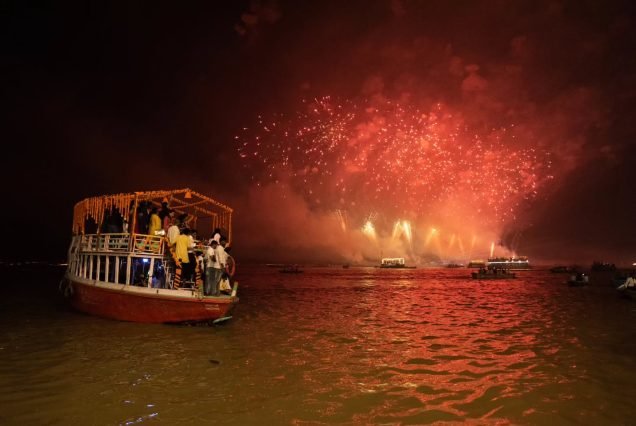
There are projection and laser displays at Chet Singh Ghat and near Lalita Ghat, and fireworks over the sands on the far bank at around eight.
The half hour while the lamps are still being lit is, for many people, better than anything staged that follows.
Why the lamps are placed facing the water
Worth noticing, because it explains the whole design of the evening.
The lamps are set in rows down the steps, facing the river. The aarti is performed towards the river. The floating lamps are on the river. Nothing about Dev Deepawali is arranged for the convenience of someone standing on the ghat — it is arranged for the Ganga, who is the one being welcomed.
Which is why the festival looks the way it is meant to look only from the water. From the steps you see the ghat you are standing on. From a boat you see what was actually made.
If you are planning to come
Two things are worth knowing early. Accommodation on the riverfront is taken four to six months ahead, and boats two to three. And the evening is logistically difficult in ways that are not obvious — roads close, vehicles cannot approach the ghats, and boats board hours before dusk.
Our guide to when to book for Dev Deepawali covers what runs out and in what order. Our guide to navigating the night itself covers where to watch, when to arrive, and why leaving is harder than arriving.
Kashi and Kin arranges the boat, a Sāthi to explain what you are seeing, and transport at both ends, priced before you book and settled before you arrive. You can see our packages for stays around the festival.