Prayagraj is the easiest trip out of Varanasi — around 120 kilometres of flat, straight highway, done in under three hours, with no difficult stretch anywhere on it.
It is also the trip people most often get wrong, and for one specific reason. They reach the Sangam, stand on the bank, take a photograph of the river and go home, without ever reaching the confluence itself.
The distance and the route
Around 120 to 125 km, two and a half to three hours by road.
You leave Varanasi through Mohansarai and pick up NH-19, the modern Grand Trunk Road, and the whole run is four-lane across the flat country of the doab. Gopiganj is roughly halfway, with the turn for Bhadohi and its carpet workshops, and the roadside dhabas there are the sensible tea stop. Then Handia, the Ganga crossing, and into the city.
Trains run frequently and take around two to three hours. Buses take three to four and leave often.
For most people a car makes sense here, because the sites in Prayagraj are spread out and the Sangam itself is around twelve kilometres from the railway station.
The thing people get wrong
The Triveni Sangam is reached by boat.
The confluence of the Ganga and the Yamuna — and of the Saraswati, which the tradition holds flows unseen — happens out in the water, not at the edge of it. From the bank you see a river. You cannot see the meeting of two rivers, which is the entire point, and it is genuinely visible once you are out there: the Ganga running paler and siltier, the Yamuna deeper and greener, and a distinct line where they meet that persists for some distance downstream.
Boats leave from the ghat and the ride takes twenty minutes or so each way. Pilgrims take their dip from the boat or from the platforms at the confluence point.
If a trip to Prayagraj does not include the boat, it has not included the Sangam. Check that it does before you book anything.
Why the Sangam matters
In the tradition, when the gods and asuras churned the ocean for amrit — the nectar of immortality — drops of it fell at four places on earth. Prayag is one. Haridwar, Ujjain and Nashik are the others, and this is why the Kumbh Mela rotates between those four cities and no others.
Prayag is also the site of veni daan and of tarpan for ancestors, and together with Kashi and Gaya it forms the Tri-sthali, the three-city circuit for ancestral rites. A great many families doing pind daan in Varanasi come here as part of the same journey.
What else to see
Allahabad Fort, built by Akbar in 1583, overlooking the confluence. Much of it remains under army control, but the section housing the Akshayavat is open — the immortal banyan tree, which tradition holds survives the dissolution of the world itself. An Ashokan pillar also stands within the fort.
Bade Hanuman Mandir, near the fort, where the image of Hanuman lies reclining rather than standing — unusual, and locally beloved. Each year when the Ganga rises in monsoon the water reaches the idol, which is understood as the river coming to bathe him.
Anand Bhawan, the ancestral home of the Nehru family, now a museum. India's independence was substantially planned in these rooms, and it is the most interesting non-religious building in either city.
Khusro Bagh, a walled Mughal garden holding the tombs of Prince Khusrau and his family, quiet and almost empty of visitors.
A day covers the Sangam, the fort and one or two of the rest without hurrying.
Magh Mela
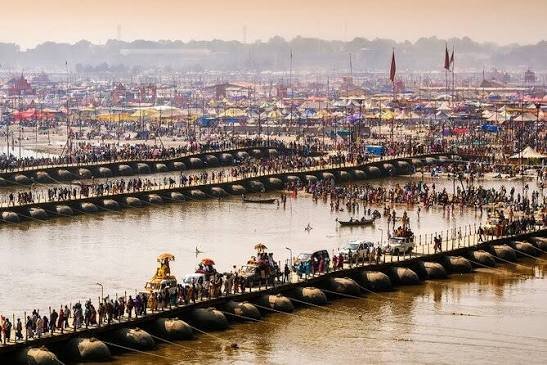
Every year through January and February, Prayagraj holds the Magh Mela at the Sangam — a temporary city of tents on the sands, and one of the largest annual religious gatherings anywhere in the world.
Pilgrims come for the ritual bath on specific dates, and a body of people called Kalpvasis stay for the entire period, living austerely on the sands for the full lunar month.
The main bathing days follow Paush Purnima, Makar Sankranti, Mauni Amavasya, Basant Panchami, Maghi Purnima and Maha Shivratri. For 2027 the Mela will run across late January and February, with Magh Purnima falling on 20 February. Exact snan dates are announced by the Mela administration and are worth confirming rather than assuming.
The Maha Kumbh was held here in 2025. The next Kumbh in the Prayagraj cycle is some years away, so the Magh Mela is what happens in the meantime — smaller than a Kumbh, which in this context still means millions of people.
Travelling during the Mela is a different proposition. The two-and-a-half-hour drive can become five or six. Approach roads back up for kilometres, the police open the bridges in rotation, and accommodation in Prayagraj is effectively unavailable without booking far ahead. Many people base themselves in Varanasi and travel in for a single bathing day, which works if you leave very early.
The fog
Worth knowing because it coincides exactly with the Mela.
From mid-December through January the doab fills with dense fog, often until late morning. This is the one weather condition that genuinely affects this road. Departures are delayed, drivers slow to a crawl, and a three-hour journey stretches.
If you are travelling for a January snan, build the fog into your plan rather than your optimism. Leaving at four in the morning for a Sangam bath is normal practice here and it is the reason people do it.
Day trip or overnight?
A day trip works well outside Mela season. Leave Varanasi at six, reach the Sangam by nine, take the boat, do the fort and Anand Bhawan, and be back by evening. This is the most commonly booked version and it is not rushed.
An overnight makes sense if you want the Sangam at sunrise, if you are performing rituals that take time, or if you are travelling during the Mela when everything takes longer.
Unlike Ayodhya, where the distance makes a day trip genuinely long, Prayagraj is comfortable in a day.
What it should cost
Published fares put a one-way cab from around ₹2,500 and a same-day return, with the driver waiting while you visit the Sangam, in the region of ₹4,500 to ₹5,000. A round trip costs considerably less than two one-way journeys because the driver does not return empty.
Before agreeing anything, ask:
- Is this one way or return, and does it include waiting time at the Sangam?
- Does the boat at the confluence come out of this, or is it extra?
- Are tolls, parking and the driver's allowance included?
- Is GST inside the figure?
- How many hours or kilometres before extra charges start?
The boat is the one most often left out, and it is the one thing you cannot do without.
The three-city circuit
Many people combine the two trips rather than doing them separately.
Varanasi to Ayodhya to Prayagraj and back is roughly 500 kilometres over three days — the Ram Mandir, the Sangam and Kashi in one run. Ayodhya to Prayagraj is around 170 km, and Prayagraj back to Varanasi around 125.
Done as separate day trips it means two long drives out and back. Done as a loop it means no repeated ground, and it is the better shape for anyone with three days.
How we arrange it
One figure, given before you book, with GST, fuel, tolls, parking and the driver's allowance inside it. Settled before you travel, so nothing is collected on the road and nothing is added at the end. No commission stops at carpet showrooms outside Bhadohi, which is the specific temptation on this particular route.
The boat at the Sangam is included, because a trip to Prayagraj without it is not a trip to Prayagraj.
During Magh Mela we plan the departure around the snan timing and the fog rather than around a convenient hour, and we will tell you honestly when a bathing date is going to mean six hours on the road each way.
A Sāthi can travel with you in any of fifteen languages. For families performing tarpan or veni daan at the Sangam as part of ancestral rites, tell us when you enquire and we will arrange the priest alongside the transport.
See our services or packages, and ask us to quote the three-city circuit if you want Ayodhya in the same trip.
Mela dates, snan timings and road restrictions are set by the district administration and change. Confirm before travelling.