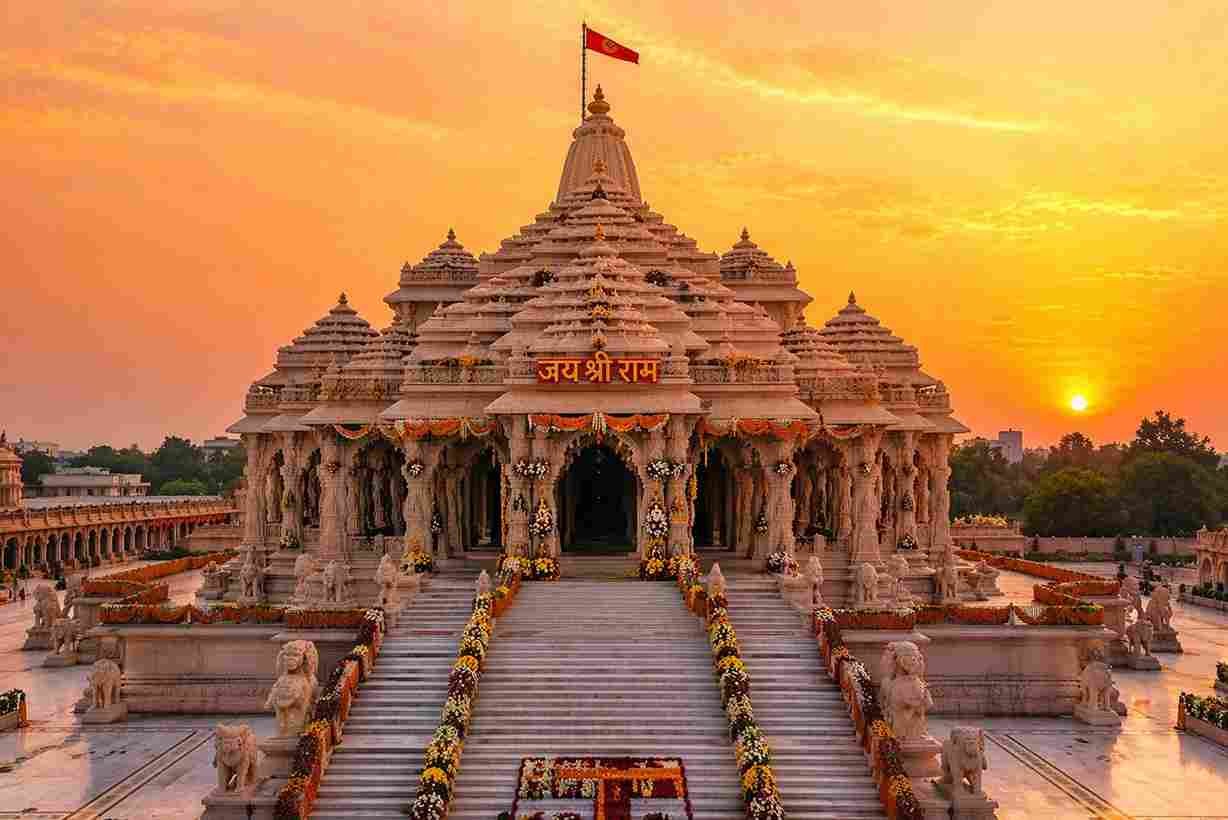
Since the Ram Mandir opened, Varanasi and Ayodhya have become a single trip for a great many pilgrims. The two cities sit about 200 kilometres apart, the road is decent, and the journey is straightforward.
What is not straightforward is the timing, because the temple closes in the middle of the day and almost nobody tells you that before you set off.
The distance and the route
Around 200 to 220 km by road, four to five hours each way. Published figures vary because the route does.
The usual road runs Varanasi to Jaunpur, then on through Sultanpur and Faizabad into Ayodhya. Most of it is four-lane and in reasonable condition. The parts that slow you down are the urban stretches — Jaunpur in the middle, and the final approach through Faizabad into Ayodhya city, which adds twenty to thirty minutes of local traffic at the end.
The temple itself sits a few kilometres inside the city from the highway, so add that too.
The fact that decides your whole day
Ram Mandir darshan runs roughly 7:00 am to 11:30 am, then closes until 2:00 pm, and reopens until about 7:00 pm. Timings extend on festival days and are set by the temple trust, so confirm for your date.
Work backwards from that and the plan writes itself.
Leave Varanasi between six and seven in the morning. You arrive somewhere between 10:30 and midday, which gives you a shot at morning darshan before the closure.
Leave at nine and you arrive after one o'clock — into the middle of the closure, with two hours to fill before the temple reopens. People do this constantly, and it is the difference between a good day and a frustrating one.
How to get there
By train. The Vande Bharat covers the route in around two and a half hours, which is considerably faster than driving. Ayodhya Dham station is about a kilometre and a half from the temple. Overnight trains leaving Varanasi late in the evening arrive in the small hours, which suits anyone wanting the early morning aarti.
If speed is your priority, the train beats the car on this route and we will say so.
By road. Four to five hours, door to door, on your own schedule, with the vehicle staying with you in Ayodhya. This is the sensible choice if you are travelling with family, with elderly parents, with luggage, or if you want to visit temples across the city rather than only the main one. Ayodhya's sites are spread out and a car waiting for you saves a great deal of negotiating.
By bus. UPSRTC runs services from Varanasi Cantt. Cheapest by a wide margin, five to six hours, and uncomfortable over that distance.
By air. Ayodhya now has its own airport with connections to several Indian cities, which matters more for people arriving from elsewhere than for anyone already in Varanasi.
Day trip or overnight?
The honest answer is that a day trip works, and an overnight is better, and most operators will not tell you the second part.
As a day trip you leave at six, arrive by eleven, do Ram Mandir and perhaps Hanuman Garhi, eat, and set off back by four to reach Varanasi around nine at night. That is fourteen hours, with nine of them in a vehicle. It is entirely doable for most people and it is a long day.
It is not a good idea with elderly parents or small children.
Overnight changes it completely. You arrive in the late morning, do the afternoon session without watching the clock, see the Saryu aarti in the evening, sleep, and take the temple again at seven the next morning when it is least crowded. Then you drive back at your own pace.
One extra night for roughly double the experience is the better trade for most families.
What to see in Ayodhya
Ram Janmabhoomi Mandir. The reason you came. Expect security comparable to an airport, expect a queue, and expect restrictions on what you may carry in.
Hanuman Garhi. A fort-like temple on a rise, reached by around seventy steps. Tradition holds that one should visit Hanuman here before Ram, and many pilgrims do exactly that.
Kanak Bhawan. Said to have been given to Sita by Kaikeyi as a wedding gift. Beautiful, and considerably quieter than the main temple.
Nageshwarnath Temple. The old Shiva temple of Ayodhya, traditionally attributed to Kush, son of Rama.
Ram ki Paidi and the Saryu ghats. The riverfront, with an evening aarti that will feel familiar if you have seen the one at Dashashwamedh. Deepotsav is held here, when the ghats are lit with lamps in enormous numbers.
Dashrath Mahal and Guptar Ghat, where Rama is said to have entered the water at the end of his life.
A day covers the first two properly. Two days covers the lot without hurrying.
Booking darshan and aarti
Book only through the temple trust's own website. There are a great many sites that resemble it and charge more for the same thing, and people outside the temple selling guaranteed immediate access are selling something they do not have.
Aarti participation is booked separately from darshan and has limited capacity. Arrive at least forty-five minutes before your slot.
As at Kashi Vishwanath, leave your phone and anything leather at the hotel. Carry photo identification.
When to go
October to March is the comfortable window for both cities.
Ram Navami in spring and Deepotsav in autumn are the two great occasions in Ayodhya. Deepotsav falls on the evening before Diwali — 7 November 2026 — when the Saryu ghats are lit with lakhs of lamps. It is spectacular and the city is entirely full; hotels and vehicles are booked weeks ahead and road traffic on the approach can add an hour or two.
The 14 Kosi and 5 Kosi Parikrama in November draws enormous numbers of pilgrims walking the circuit around the city, and roads are heavily affected for several days.
Avoid July and August if you can. The route sees waterlogging around Sultanpur in heavy monsoon.
Making it a circuit
Many people extend the journey rather than returning directly, and the geography makes it easy.
Varanasi to Ayodhya to Prayagraj to Varanasi is the common loop — roughly 500 kilometres over three days, taking in the Ram Mandir, the Triveni Sangam and Kashi. Prayagraj sits about 170 km from Ayodhya and 130 km back to Varanasi.
The Magh Mela at Prayagraj runs in January and February and is worth planning around if your dates allow.
Varanasi, Ayodhya and Bodh Gaya is the other combination, for travellers wanting both the Ramayana and the Buddhist circuit.
What it should cost
Published fares for a one-way cab on this route range from around ₹2,400 to ₹5,000 for a sedan, with larger vehicles and multi-day round trips considerably more. The spread is wide because operators include different things.
Before you agree anything, ask:
Those five questions are where the difference between a quoted fare and a final bill usually lives, and the driver's allowance and the night halt are the two most commonly left out.
How we do it
One figure, given before you book, with GST, fuel, tolls, state taxes, parking and the driver's allowance all inside it. It is settled before you travel, so nothing is collected on the road and nothing is added at the end. There are no commission stops at emporiums along the way.
We plan the departure backwards from your darshan slot rather than forwards from your breakfast, which is the single thing that determines whether the day works.
And we will tell you honestly when the car is not the right answer. If you are two people, travelling light, and speed matters, the Vande Bharat will get you there in half the time and we will say so rather than sell you a nine-hour round trip.
A Sāthi can travel with you, in any of fifteen languages, which for families arriving from abroad makes the difference between visiting the temples and understanding them.
See our services or packages, and tell us if you want the Prayagraj loop quoted alongside it.
Darshan timings, aarti slots and festival dates are set by the temple trust and the district administration and change. Confirm before travelling.