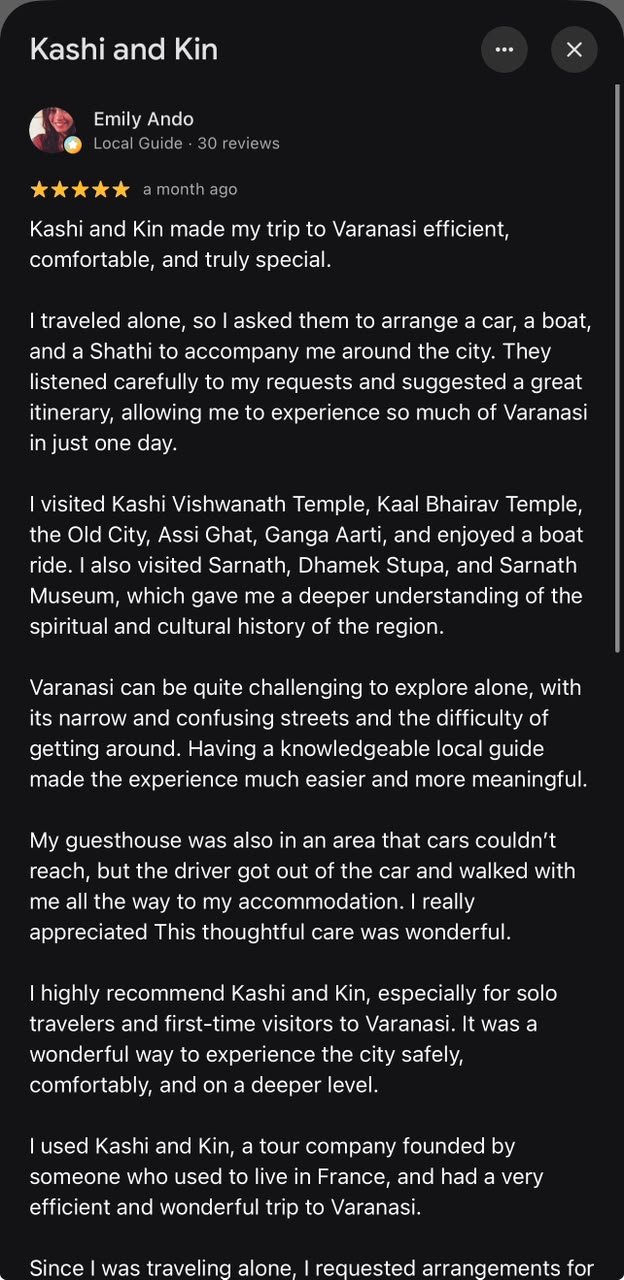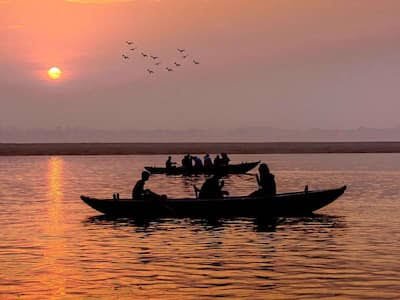
There is one thing the ghats of Varanasi will not do from the land: show themselves all at once. Stand on the steps and you see the ghat you are standing on and perhaps the two beside it. The riverfront runs close to seven kilometres, and the only place it exists as a single continuous thing is out on the water, a hundred metres from the shore, early in the morning.
This is a guide to that journey — the full stretch from Assi Ghat in the south to Adi Keshava in the north — and to the second journey, twelve hours later, when the same river is lit for the evening aarti.
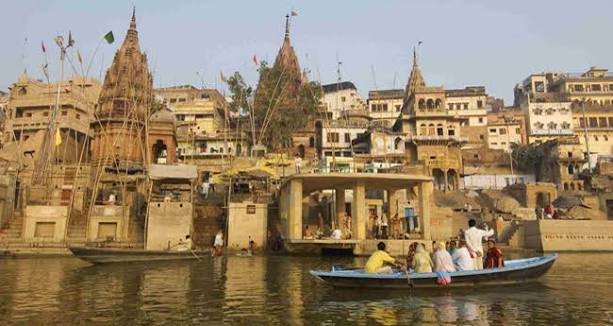
The ghats face east. At sunrise the light arrives across the water and strikes the whole riverfront at once.
Why eighty-four
The number is older than the count. There are eighty-eight named ghats along the western bank today, but eighty-four is the figure that has been carried in pilgrim memory for centuries, and it was chosen for what it means rather than for what it tallies.
Eighty-four is said to stand for the eighty-four lakh forms of life — the 8.4 million births through which a soul is believed to pass before reaching human form. It is also read as twelve multiplied by seven: the twelve signs of the zodiac against the seven planets, which is to say the whole of time crossed with the whole of the heavens.
So the number is a claim about completeness. To pass all eighty-four ghats is, in the traditional understanding, to pass the whole cycle of existence in a single morning. Whether or not you hold that belief, it explains why the full stretch is treated as a journey rather than a sightseeing route.
The five that matter most
Of the eighty-four, five form the Panch Tirtha — the five sacred crossings that pilgrims are meant to touch in order, moving south to north.
A full-length boat journey passes all five.
The sunrise ride
The boats push off before the light. In winter that means around six, in summer closer to five, and the timing shifts through the year with the sunrise itself — we confirm the hour for your date when you book.
What happens over the next two hours is difficult to describe without overstating it, so here is the plain version. There is mist on the water. The city is quiet in a way it will not be again all day. Along the steps people are bathing, washing clothes, doing yoga, sitting. Priests are performing morning rituals. Buffalo are in the shallows. The light comes up behind you across the river and moves along the buildings, and the whole seven kilometres of stone and temple and palace turns the colour of the sandstone it is built from.
None of this is arranged for visitors. It is the ordinary morning of a working city that happens to be four thousand years old, and you are passing alongside it.
What you pass, moving north
From Assi you go past Tulsi Ghat, where the poet Tulsidas is said to have written much of the Ramcharitmanas, and Chet Singh Ghat with its fort, where the Maharaja of Banaras fought the East India Company in 1781.
Then Harishchandra Ghat, the smaller of the two cremation grounds and the older one. Kedar Ghat in its red and white stripes, busy with South Indian pilgrims. Munshi Ghat and Darbhanga Ghat, where the palaces of former princely states rise straight out of the water.
Dashashwamedh, already filling with people even at that hour. Manikarnika, where the fires do not go out and have not for as long as anyone can account for. Panchganga, under the great mosque built by Aurangzeb on the site of an earlier temple.
And then the ghats thin out. North of Panchganga the crowds disappear, the buildings become plainer, and the last stretch to Adi Keshava is almost empty. Most boats turn back before this. It is the quietest part of the river and, for a certain kind of traveller, the best.
How long the full stretch takes
Assi to Adi Keshava is roughly six and a half to seven kilometres one way. Passing the complete run of eighty-four ghats and returning takes around two hours on the water.
Shorter rides are common and perfectly good — most cover Assi to Manikarnika and back in about an hour, which takes in the busiest and most photographed section. But a one-hour ride does not pass eighty-four ghats, whatever it says on the board at the steps, and it is worth knowing the difference before you book.
One rule on the water
Do not photograph or film at Manikarnika Ghat or Harishchandra Ghat. Being on a boat does not make it acceptable — you are still pointing a camera at a family's last rite for someone they have lost, and you are visible from the shore. Put the camera down as you approach and pick it up afterwards. Watching is welcome. Photographing is not.
The evening: Ganga Aarti from the water
This is a separate journey, and it is worth being clear about that. The sunrise ride ends by about eight in the morning. The Ganga Aarti at Dashashwamedh Ghat begins at dusk — around a quarter to seven in winter, around seven in summer — and runs for roughly forty-five minutes.
Two trips, then, at either end of the same day. Most people who do both say the day is the thing they remember rather than either half of it.
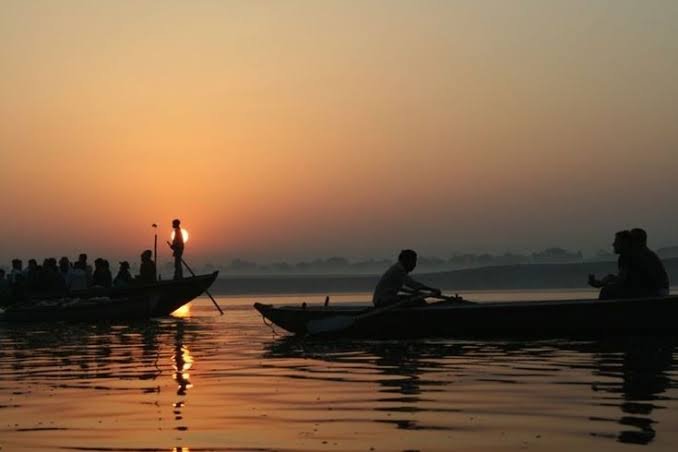
The aarti is performed facing the river. From the ghat you watch the priests from behind.
Why the boat is better than the steps
The aarti is performed by young priests on raised platforms, in synchrony, with tiered brass lamps, incense, conch and bell. It faces the river, because it is an offering to the river.
Which means that from the ghat, you are behind it. You are also in a crowd of several thousand people, standing, in the dark, unable to move — and the crowd is where the practical difficulties of the evening arise, from pickpocketing to being unable to leave when you want to.
From a boat you are in front of the ceremony, at the distance it was designed to be seen from, seated, with the whole ghat and all its lamps in your field of view. You can leave when you choose. Boats gather in a loose crowd on the water, which is itself part of the sight, and the small leaf-and-flower lamps that people float on the river drift past you as they go downstream.
Do arrive well before the start. Boats need to be in position before the ghat fills.
Don't expect quiet. It is a large public ceremony and it is loud.
When to come
October to March is the comfortable season, and the winter mornings on the river are the best of the year. Expect it to be genuinely cold on the water before sunrise in December and January — colder than the temperature suggests, because you are sitting still on a river.
The monsoon between July and September raises the river considerably. Boats are sometimes suspended entirely when the water is high, and the lower steps of many ghats disappear. April to June is very hot by mid-morning, though the sunrise hour itself is pleasant.
Bring a shawl or jacket in winter, something to cover your head in summer, and shoes you do not mind getting wet at the steps.
What we arrange
Kashi and Kin puts the day together as one booking: the sunrise boat, the evening aarti boat, a Sāthi to travel with you, and the car that gets you to and from your hotel at both ends.
The transport matters more than it sounds. Vehicles cannot enter the lanes near the ghats, and a five o'clock start in an unfamiliar city, in the dark, on foot, is where most people's morning goes wrong. Your driver knows where the car can actually reach and how far the walk is from there.
The Sāthi matters for a different reason. A boat ride without commentary is a beautiful hour on a river. With someone telling you which ghat you are passing, who built it, what the people on the steps are doing and why, it becomes something you understand rather than something you photographed. Our guides work across fifteen languages.
Prices are printed before you book, GST included, and settled before you arrive. Nothing is asked for at the steps, nothing is asked for on the boat, and the figure does not change once you are on the water — which, if you have read anything about boat hire in Varanasi, is the specific problem this is meant to solve.
You can book the sunrise boat ride and the evening aarti boat separately, or take a package that includes both alongside the rest of the city. If you would like the full eighty-four rather than the shorter run, say so when you enquire — it is a longer boat and an earlier start, and it is worth both.