For a great many Indian families, bringing a parent to Kashi is the point of the trip. It is a thing promised for years and finally arranged, and it carries weight that an ordinary holiday does not.
It is also, physically, one of the harder cities in India to bring an eighty-year-old to. Not impossible — thousands of families do it every year, and do it well. But it goes badly when nobody has told them in advance what the ghats are actually like.
This page is about what is genuinely possible here, what is not, and how to arrange the rest.
Start with the honest part
A wheelchair works in some places in Varanasi and not in others, and the difference matters more than anything else in planning.
Where it works: the Kashi Vishwanath corridor, which was rebuilt with wide paved approaches and is a genuine improvement for elderly visitors. Wheelchairs are available free at Gate 4 from the temple trust, with assisted entry, and there are also attendants with chairs near Godowlia crossing for a charge. Sarnath, which is flat and open. BHU, which is drivable. Hotel lobbies and main roads.
Where it does not work: the ghats. Every ghat is a flight of stone steps down to the river, worn smooth, uneven, often wet, with no ramps and no handrails. The old city lanes are too narrow, too crowded and too broken underfoot. A wheelchair cannot usefully be pushed along the riverfront, and anyone who tells you otherwise has not tried.
What works at the ghats is assisted walking — a steady person on each side, taking the steps slowly, with time to rest. That is how it is done, and for most people in reasonable health it is entirely manageable.
What does not work is arriving without having thought about it.
A companion from the moment you land
Our arrangement for elderly guests is built around one person rather than a schedule.
A Sāthi meets you at the airport or the station and stays with you for the whole visit. The same person each day. They know the plan, they know the medical situation, they carry the water and the medicines, they decide when it is time to sit down, and they are the one number the family calls.
Where we can, we match the language. Pilgrims come to Kashi from every part of India, and an eighty-year-old who is more comfortable in Tamil, Telugu, Marathi, Bengali or Gujarati should not have to manage in Hindi or English on the most important trip of their life. Our guides work across fifteen languages — tell us which you need and we will tell you honestly whether we can.
Darshan, planned around the queue rather than the clock
The queue is the hardest part of Kashi Vishwanath for an elderly pilgrim, not the walk.
We book Sugam Darshan, the temple trust's official paid queue. For a family bringing a parent in their eighties this is not an indulgence — it is the difference between forty minutes and four hours standing.
We use the assisted entry at the gate where wheelchairs and support are provided, and we go at first light, when it is coolest and emptiest.
We plan around the hard days. Mondays, Sawan, Maha Shivratri and festival weeks are when queues run for hours. If your dates are fixed and fall on one of those, we will say so plainly and plan accordingly.
The same approach applies at Annapurna, Sankat Mochan, Durga Kund and the other temples — timing first, everything else second.
The boat, and getting into it
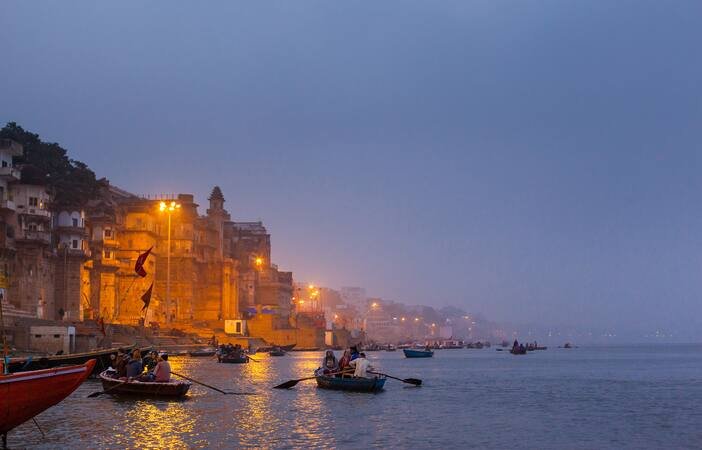
The boat is the best part of Varanasi for an elderly visitor, because it is the one experience where everybody sits down.
The difficulty is boarding — a few steps down wet stone and then a step across into a moving boat. We arrange boats that come in at the most manageable ghats, with the boatman and the Sāthi helping at both ends, cushions and backrests rather than a bare plank, and a later start than the standard dawn departure where the cold is a concern.
For the Ganga Aarti, the boat is the only sensible option. The crowd on the steps at Dashashwamedh is dense enough to be genuinely unsafe for anyone unsteady, and from the water you see the ceremony from the front, seated, and leave when you choose.
The Ganga snan
For many elderly pilgrims the dip in the Ganga is the entire purpose of coming, and it is also where falls happen.
The steps into the water are slippery with silt and algae, the depth changes without warning, and the current close to the bank is stronger than it looks. We take guests to ghats where the descent is gentler and there is something to hold, go at a quiet hour rather than into a crowd, and have someone in the water alongside.
Bring a change of clothes and expect it to take longer than you think. This is not a thing to rush.
Where you stay matters more than usual
The most common mistake families make is booking a beautiful heritage guesthouse on the ghats and discovering that it is up three flights of stone stairs with no lift, fifteen minutes' walk from where a car can stop, through lanes.
We advise on accommodation with a lift or ground-floor rooms, the shortest possible walk from a vehicle drop, a western toilet, and heating in winter, which many old city guesthouses do not have. Sometimes that means staying at the Assi end or in Cantt rather than in the middle of the old city, and accepting a short drive in exchange for a manageable arrival.
Pace, food and rest
Two sites a day. Not four. Varanasi defeats ambitious itineraries and it defeats them fastest when the travellers are seventy-five.
Mornings and evenings, with the afternoon off. The middle of the day is for lying down, not for temples.
Food arranged to suit. Satvik meals without onion or garlic where that is observed, low-oil cooking, diabetic-appropriate options, and boiled or sealed water throughout. Varanasi's street food is wonderful and it is not what we would feed an elderly guest on day one.
Toilets planned into the route, which sounds trivial and is not. It is one of the most frequent anxieties elderly travellers have and almost nobody plans for it.
An afternoon of rest rather than sightseeing, with an Ayurvedic massage at the stay if that suits — unhurried, at a reasonable hour, by practitioners used to older bodies. After two days of steps it does more good than another temple.
Medical and emergencies
Varanasi has serious hospitals — Sir Sunderlal at BHU among them, and several good private ones — and the practical issue is knowing which to go to and how to get there, not whether care exists.
We ask for the medical situation before you arrive: conditions, medications, allergies, the treating doctor's number. We keep a copy. The Sāthi carries it.
There is a number that is answered at any hour. We know which hospital suits which problem and which approach road is open. If something happens, the family is told immediately — including family who are not in India.
Two seasonal notes worth planning around. The winter air in this region is poor from November through February, which matters for anyone with a respiratory condition. The summer heat from April to June is genuinely dangerous for the elderly, and we would rather talk you out of those dates than manage the consequences.
For children arranging this from abroad
A great many of these trips are booked by a son or daughter in another country for parents travelling without them.
We send updates — where they are, how the day went, photographs. One point of contact, one number, in your time zone. The idea is that you do not spend the week wondering.
We can also arrange the rituals they have come to perform, seated and unhurried, and send you the recording.
Before anything is booked, we talk
We ask what your parent can actually do. How many steps. How long standing. Whether a half-hour walk is fine or out of the question. What happened the last time they travelled.
Families consistently overestimate this, kindly and understandably, and the cost of overestimating is a trip spent exhausted or a fall on wet stone.
From that conversation we build a plan that fits, and we tell you what to leave out. Sometimes that means skipping Manikarnika. Sometimes it means a boat instead of the lanes. Sometimes it means that a fourteen-hour day trip to Ayodhya is not a good idea, however much it is wanted.
We would rather say that in September than apologise in November.
What we would tell you not to attempt
Honesty is more useful here than enthusiasm.
- Manikarnika in a wheelchair — the approach is steps and narrow lanes, and it is not manageable
- The Ganga Aarti from the steps — the crush is real and an unsteady person should not be in it
- Four temples in a morning, however close together they look
- A day trip to Ayodhya — four to five hours each way, and a fourteen-hour day. Stay overnight or leave it
- Kashi Vishwanath on a Monday in Sawan, unless there is no alternative
- Varanasi in May and June, if the dates can be moved at all
What it costs
One figure, given before you book, GST included, settled in advance. Nothing is asked for at a temple gate, on a boat, or at the ghats. There are no commission stops at silk shops — which matters particularly here, because an elderly guest is the easiest person in Varanasi to steer into a showroom and the hardest to get out of one.
Arrange it
Tell us who is travelling, their ages, what they can manage, and what they most want to do in Kashi. We will come back with a plan, honestly scoped, and a price.
Or write to namaste@kashiandkin.com
See our services or packages for everything else we arrange.
Temple facilities and timings are set by the trusts and change. Confirm before travelling.