Varanasi is one of the most photographed cities in India and one of the most misrepresented. Not deliberately — the photographs are real. They are just taken on particular mornings, from particular angles, with particular things left outside the frame.
People arrive expecting the pictures and meet the city instead. Some are disappointed. Most of the disappointment is avoidable, and all of it comes from not being told in advance.
This is what is actually here.
The sunrise boat photograph
What you have seen: a wooden boat alone on still golden water, mist on the river, the ghats glowing behind.
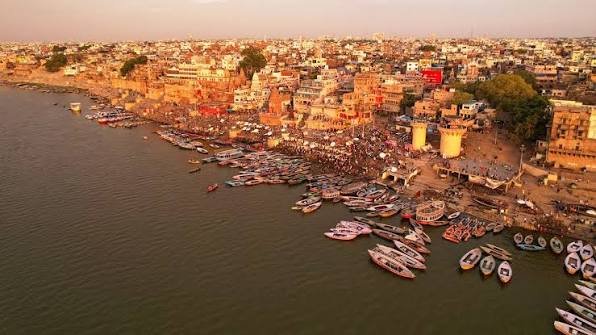
What is actually there: forty other boats. On a good morning the light is exactly as advertised, and the photographer simply framed out everyone else. You will be on a shared boat with strangers unless you have booked a private one, and there will be boats between you and the view.
Two further things. In December and January the fog frequently means there is no sunrise at all — you sit on grey water and see fifty metres. And in summer the sun is up by quarter past five, so a six o'clock start has already missed it.
The ride is still worth doing. It is the best hour in Varanasi. It just is not a private one.
The ghats are not clean
What you have seen: stone steps in warm light, a few figures in orange, wide and serene.
What is actually there: all of that, plus cows, dogs, goats, monkeys, laundry drying in enormous quantities, silt from the last flood, litter in the corners, and the river itself, which is not clear.
This is a working riverfront in a city of well over a million people, used every day for bathing, washing, praying, trading and cremation. It was never a monument and has never been curated as one.
People who arrive expecting tranquillity often need two days to stop seeing the mess and start seeing the place. People who arrive expecting a living city are fine from the first hour.
Manikarnika is not a viewing experience
What you have seen: dramatic photographs of fire and smoke, usually with a caption about confronting mortality.
What is actually there: a working cremation ground where several families are, at that moment, burning someone they loved. It is dense with woodsmoke. It smells of what it is. There are stacks of timber, ash underfoot, and people conducting the most difficult day of their lives in public.
Photography is forbidden — from the ghat, from the lanes and from a boat, at any distance. The photographs you have seen were taken by people who either had permission or should not have taken them.
You are welcome to stand and watch quietly at a distance. Nobody objects to your presence. It is the camera that causes offence, and it is the thing most likely to cause you a confrontation.
Expect also to be told that a donation buys firewood for the cremation of the poor. This is not how Manikarnika is funded.
The Ganga Aarti is not a candlelit ceremony
What you have seen: young priests in synchrony with tiered brass lamps, flames against darkness, apparently hushed.
What is actually there: all of that, in front of several thousand standing people, with loudspeakers, bells, hawkers and a great deal of pushing.
The important structural fact: the aarti is performed facing the river, because it is an offering to the Ganga. So from the ghat you are watching it from behind. Every good photograph of the aarti was taken from the water or from a terrace, because those are the only places you can see the front of it.
It is genuinely impressive. It is not serene, and it is not quiet.
Kashi Vishwanath is a security queue
What you expect: a beautiful golden temple you walk into.
What actually happens: you leave your phone at the hotel because they are not permitted. So is your camera, your leather belt, your leather wallet, your smartwatch and your shoes. You are frisked more than once. You queue — forty minutes on a quiet weekday, several hours on a Monday or during Sawan. You have a few seconds at the sanctum. You take no photographs at any point.
It is one of the most significant places in Hinduism and the darshan is meaningful to a great many people. It is not a sightseeing stop and it does not behave like one.
Your car cannot reach your hotel
This catches almost everybody and it has nothing to do with the operator.
Vehicles do not enter the lanes around the ghats. Your car stops at Godowlia, at the Assi end, or wherever the police have the barricades that week, and you walk the rest with your luggage. Anyone who tells you they will drive you to Dashashwamedh Ghat is not telling you the truth.
Ask your accommodation two questions before you travel: where exactly can a vehicle stop, and how far is the walk from there.
The lanes are not quaint
What you have seen: narrow blue-washed alleys, a cow, a shaft of light.
What is actually there: exactly that, plus motorbikes coming through at speed with the horn going, cow dung you will step in, lanes that all look identical, and no phone signal to rescue you.
You will get lost. Everybody gets lost. It is genuinely one of the better experiences in the city, provided you have nowhere to be.
The sadhus are not free
What you have seen: a magnificently painted ascetic staring into the middle distance.
What is actually there: some genuine renunciates who want nothing to do with your camera, and some men who dress for the tourist trade, pose willingly, and ask for money afterwards.
Neither is a scandal. The second is a transaction, and it is reasonable — just know it is coming before you raise the camera, and agree the amount first.
The same applies to the aghori content circulating online. Most of it is staged, much of it is exploitative, and the practice is not a visitor attraction.
Half the famous photographs are of one night
A great deal of the viral imagery of Varanasi — the entire riverfront lit with a million lamps, every step glowing — is Dev Deepawali. That is one evening a year, on the full moon of Kartik.
If you come in March expecting the illuminated ghats, they are not there. They are never there, except on that night and in a much smaller way at Diwali.
You may not have a spiritual awakening
This is worth saying plainly.
Varanasi has been written about for two centuries by visitors looking for transformation, and a lot of what you have read frames the city as a place that does something to you. Some people do have a profound experience here. Many people have a hot, tiring, fascinating, occasionally overwhelming few days and go home.
Both are fine. The city is not withholding anything from you and it is not a test you can fail. It is a working city of well over a million people that happens to be four thousand years old and sacred to a great many of them. Nobody on those steps is performing spirituality. They are washing, praying, selling, commuting and getting on with it.
Arriving to observe a living city is a better frame than arriving to be changed by one, and it tends, paradoxically, to produce the better trip.
A few smaller things
One day is not enough. Two is thin. Three is about right.
Drones are restricted over the ghats and around the temples. The aerial footage you have seen was either licensed or shot before the rules tightened.
Summer is brutal. May and June run past 45°C. This is not a shoulder season to gamble on.
Winter air is poor, particularly around Diwali and through the cold months.
Boating stops in the monsoon. When the river runs high the administration suspends it entirely, sometimes for weeks in August and September.
You will be approached constantly — boats, guides, silk, hashish, blessings. It is persistent rather than threatening. A firm, unexplained no works far better than politeness, which reads as interest.
What is better than the photographs
All of that said, some things here are genuinely undersold.
The scale. Photographs cannot hold seven kilometres of continuous stone riverfront. From the water at dawn, seeing the whole crescent at once, it is much bigger than you expect.
The continuity. The thing that actually affects people is not any single sight. It is the realisation, usually on the second morning, that all of this — the bathing, the fires, the chanting, the laundry — has been going on here without interruption for longer than most countries have existed.
The food. Almost nobody comes for it and it is one of the great eating cities in India. Kachori sabzi before eight in the morning, and malaiyo in winter, which exists nowhere else.
The ordinary mornings. Not the festival. Not the aarti. Six in the morning, on the water, with the city doing what it does. That is the thing people remember, and it is the least photographed part of Varanasi.
How we approach this
We would rather tell you what your dates can and cannot deliver than sell you the picture. If you are coming in late December wanting a clear sunrise, we will say it is a gamble. If you are coming in March expecting lit ghats, we will tell you that is a different festival.
The practical things — the boat and where it sits, the walk from wherever the car stops, the darshan timing, a Sāthi who can explain what you are looking at — are what we arrange. Prices are printed before you book, GST included, and settled in advance, so nothing is asked for at the ghat or on the boat.
See our services or packages. If you want an honest read on your specific dates, ask us before you book flights rather than after.