Ten kilometres from the ghats, the noise of Varanasi drops away and the road runs through quiet lanes into a park where deer still graze. Somewhere in the fifth century BCE, a man who had spent six years starving himself and had recently given it up sat down here with five companions and explained what he had worked out.
That conversation is the reason Sarnath exists. Most visitors give it forty-five minutes on the way to somewhere else.
What happened here
Siddhartha Gautama had left his home, studied under teachers, and then spent years in extreme asceticism — fasting to the point of collapse, in the company of five other ascetics who practised alongside him.
Eventually he concluded that starvation was teaching him nothing. He accepted food. The five companions took this as a betrayal of the discipline they shared and left him in disgust, walking north to the deer park at Isipatana.
Alone, he sat beneath a tree at what is now Bodh Gaya and reached what Buddhists call enlightenment. Then he went looking for the five men who had abandoned him.
They saw him coming and agreed among themselves not to rise, not to greet him, to show no respect to someone who had given up. By the time he reached them they had all stood up.
What he said to them that evening is recorded as the Dhammacakkappavattana Sutta — the Setting in Motion of the Wheel of Dharma.
What he actually taught
He began with the Middle Way: that the life of indulgence and the life of extreme austerity are both dead ends, and that the path runs between them. Coming from a man who had nearly died of fasting, addressed to five men still doing it, this was not an abstraction.
Then the Four Noble Truths. That suffering exists. That it has a cause, which is craving. That the cause can be ended. And that there is a path to ending it — the Eightfold Path of right view, intention, speech, action, livelihood, effort, mindfulness and concentration.
One of the five, Kondanna, understood it as it was spoken. The tradition holds that at that moment the Buddha said aloud that Kondanna had understood — and the Sangha, the community of Buddhist practitioners that has continued without interruption for two and a half thousand years, began with that one man in this park.
This is why Sarnath is one of the four great pilgrimage sites of Buddhism, alongside Lumbini where the Buddha was born, Bodh Gaya where he was enlightened, and Kushinagar where he died.
What survives
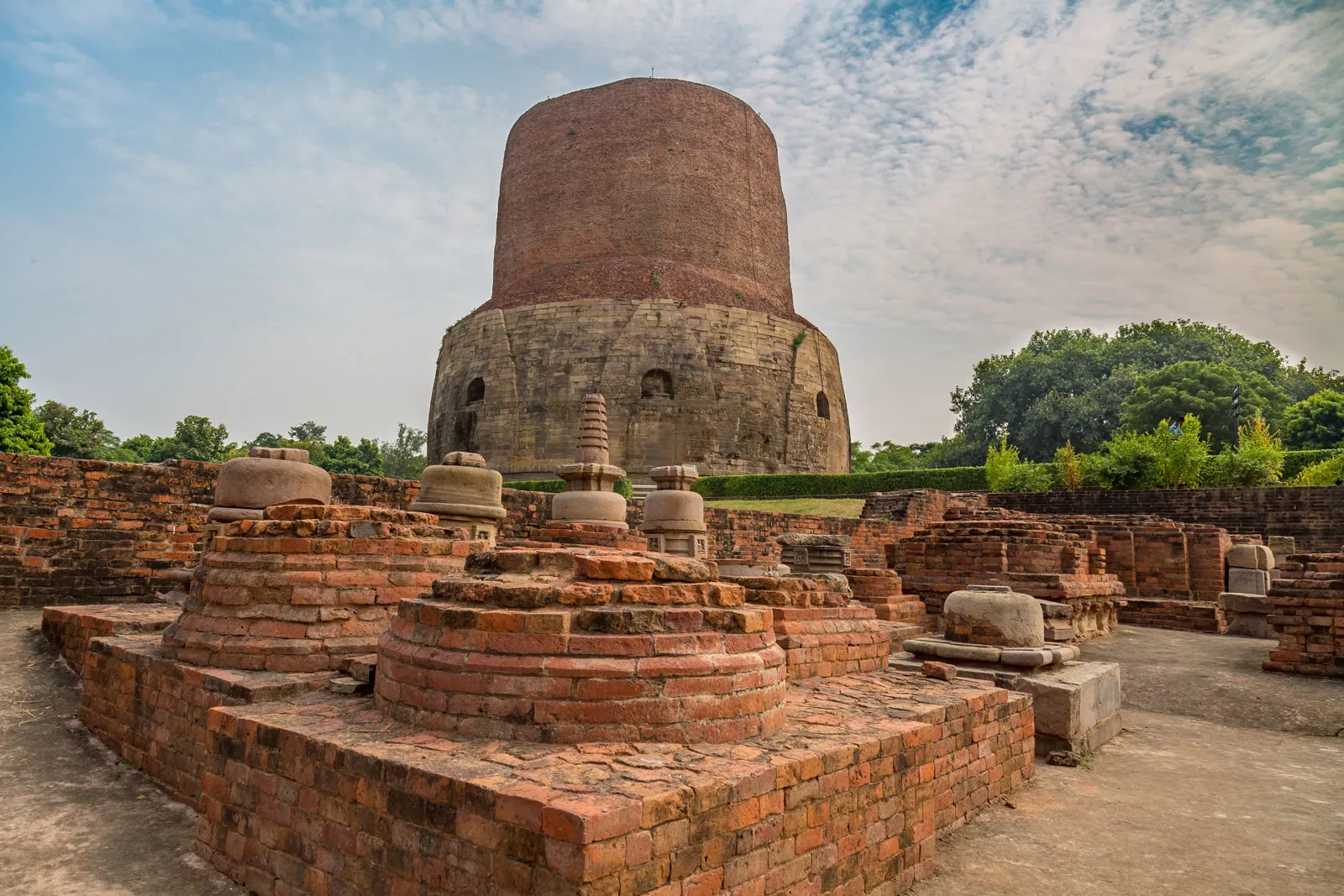
The Dhamek Stupa is the monument everyone photographs — a vast cylinder of brick and stone rising around 128 feet, standing at the spot traditionally identified with the first sermon. What you see dates largely from the Gupta period, around the fifth century CE, built over earlier structures. The lower courses carry carved floral and geometric bands of real delicacy, best seen in low morning light.
The Ashoka Pillar. In the third century BCE the emperor Ashoka came to Sarnath and raised a pillar here. Its broken shaft still stands in the archaeological area, fenced and unremarkable-looking.
What sat on top of it is the Lion Capital — four lions back to back above a wheel — and it is in the museum a few hundred metres away. It is also, since 1950, the State Emblem of India. It is on your passport, on the currency, on every government building in the country, and the wheel beneath it is at the centre of the national flag. Seeing the pillar site first and the capital afterwards makes the connection land properly.
The Dharmarajika Stupa ruins, the monastery foundations, and the shrines around the main site. Walk it slowly enough to read it as a settlement where people lived and studied for centuries, rather than a set of photo stops.
Chaukhandi Stupa, a short distance away, marks the place where the Buddha is said to have met the five ascetics. It carries an octagonal Mughal tower on top, added in the sixteenth century to commemorate a visit by Humayun — an odd and rather wonderful layering.
The long silence
Sarnath was a major monastic centre for well over a thousand years. It was destroyed around 1194, in the campaigns that swept through this region, and afterwards it was abandoned and forgotten.
In the late eighteenth century a local official quarrying for building material dismantled much of the Dharmarajika Stupa and found a relic casket inside. The stones went into Varanasi's buildings. Serious excavation began under Alexander Cunningham in the 1830s, and the Archaeological Museum — the oldest site museum of the Archaeological Survey of India — opened here in 1910.
So for roughly seven hundred years, the place where Buddhism began as a community held nothing but ruins under earth.
The return
What brought it back was largely one person. Anagarika Dharmapala, a Sri Lankan Buddhist reformer, worked from the 1890s onward to restore the Buddhist sites of India, founding the Maha Bodhi Society for the purpose.
Mulagandha Kuti Vihar, the temple at the centre of modern Sarnath, was built by that society and consecrated in 1931. Its interior walls carry frescoes of the Buddha's life painted by the Japanese artist Kosetsu Nosu. In the grounds stands a Bodhi tree grown from a sapling of the tree at Anuradhapura in Sri Lanka — which was itself grown from a cutting of the original tree at Bodh Gaya, taken over two thousand years ago. The tree here is a direct descendant of the one the Buddha sat under.
Evening chanting at the vihar, usually in the late afternoon, is worth timing your visit around.
The monasteries
Since Dharmapala, Buddhist countries have built temples at Sarnath — Thai, Tibetan, Japanese, Chinese, Burmese, Korean, Sri Lankan and others — each in its own national style, within walking distance of one another.
The Thai temple with its steep tiered roofs, the Japanese one in its restraint, the Tibetan with its colour and prayer wheels: walking between them in an hour is the clearest picture you will get anywhere of Buddhism as a living tradition that spread across Asia and has come back to the place it started. Most are free to enter.
This is the part of Sarnath that day-trippers skip and that pilgrims come for.
Visiting: the practical part
The Friday problem. The Archaeological Museum closes on Fridays. The archaeological site stays open. Arriving on a Friday without knowing this means seeing the pillar without seeing the capital, which is half the visit. Check the day before you plan.
Timings. The archaeological site runs roughly sunrise to sunset. The museum opens mid-morning and closes at five. Published hours vary between sources and have changed recently, so confirm rather than assume.
Entry. Modest ticketed fees for the archaeological site and the museum, with separate rates for Indian and foreign visitors, and free entry for children. Figures quoted online are frequently out of date. The monasteries are generally free.
How long. Three to four hours for the site, museum and Mulagandha Kuti Vihar. Add an hour or more for the international monasteries. The forty-five-minute version that most tours allow is not really a visit.
Best order. Archaeological site first while the morning is cool, then the museum once it opens, then Mulagandha Kuti Vihar, then the monasteries in the afternoon.
Best season. October to March. The site is open ground with little shade and is punishing in May.
Dress and conduct. Shoulders and knees covered, shoes off inside temples, quiet in the vihar where people are meditating. Photography is restricted inside the museum and in some temples.
Buddha Purnima
The Buddha's birth, enlightenment and death are all observed on the same full moon in Vaishakh, usually falling in May. At Sarnath it is the largest day of the year — processions, relics displayed, monks from every monastery, and pilgrims from across the Buddhist world.
It is also very hot. Come prepared for both.
Getting there
Sarnath is around 10 km from Varanasi Junction and about 13 km from the ghats — twenty-five to forty-five minutes depending on traffic. It is roughly 22 km from the airport, which makes it a sensible stop on the way in or out if you have hours to fill.
Auto-rickshaws will take you and will wait, though negotiating the return is a common irritation. A car with a driver is the straightforward option for a half day, particularly in the heat.
How we arrange it
Sarnath rewards a guide more than almost anywhere else in this region, because what is physically there is a stupa, a broken pillar and some foundations. Without someone to tell you who the five ascetics were, why they had walked away, and what was said to them, it is a pleasant park with old brickwork in it.
Our Sāthi guides work across fifteen languages, which matters here — Sarnath draws pilgrims from Sri Lanka, Thailand, Japan, Korea and Vietnam, and most guiding is available only in English or Hindi.
We arrange the car and the timing around the museum's hours and the Friday closure, and we build in enough time that you are not being hurried past the monasteries. Prices are printed before you book, GST included, and settled in advance. Nothing is asked for on the day and there are no commission stops on the road out.
See our services or packages. For groups travelling on a Buddhist pilgrimage circuit that includes Bodh Gaya or Kushinagar, tell us and we will quote the wider route.
Timings and entry fees are set by the Archaeological Survey of India and change. Confirm before travelling, particularly the museum's opening hour and Friday closure.