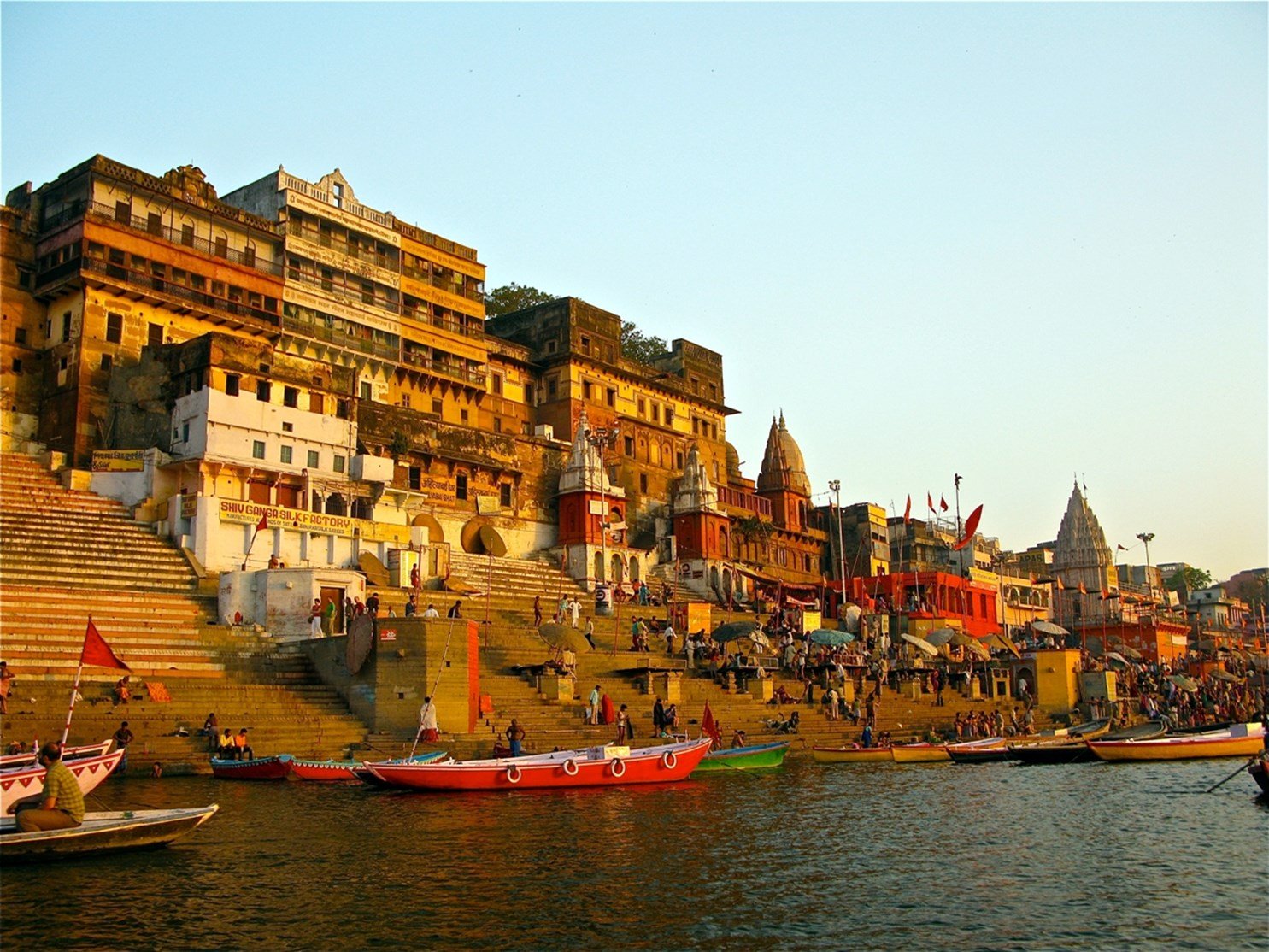
Varanasi is not an isolated holy city. It sits at the centre of a sacred geography that runs in every direction — Shakti Peethas to the south, the Buddhist circuit to the east, the Ramayana country to the north-west, and the confluence of rivers two hours upstream.
Most visitors see Sarnath and go home. If you have more than three days, a great deal more is within reach, and this is what is actually out there, arranged by how far you have to go.
Within an hour
Sarnath — 10 km
Where the Buddha gave his first sermon after his enlightenment, teaching the Four Noble Truths to the five companions who had abandoned him. The Dhamek Stupa, the Ashokan pillar whose Lion Capital became India's national emblem, an excellent museum, and monasteries built by Buddhist countries across Asia.
Half a day properly. Twenty-five to forty-five minutes from the ghats. Note the museum closes on Fridays.
Ramnagar — 15 km
Across the river, the fort of the Maharajas of Banaras, with its museum of vintage cars, palanquins and an astronomical clock. In autumn it hosts the Ramnagar Ramlila, a thirty-one-night enactment of the Ramayana by lamplight that is the fullest surviving form of that tradition in India.
Markandey Mahadev, Kaithi — 30 km
An ancient Shiva temple standing where the Gomti meets the Ganga, and one of the most important Shaiva sites in the region that visitors never hear of.
The temple is associated with the sage Markandeya, who is said to have won deliverance from death itself through devotion to Lord Shiva, and it is also called the Mahamrityunjaya temple for that reason. Families come here for rites concerning long life and healing. There is a quiet ghat beside it.
Easily combined with a journey towards Vindhyachal.
Chunar — 40 km
Not primarily a religious site but worth the detour — a fort on a rock above a bend in the Ganga, held in turn by Sher Shah Suri, the Mughals, the Nawabs of Awadh and the British. Chunar also gave its sandstone to the Ashokan pillars, including the one at Sarnath.
Within two hours
Vindhyachal — around 65 km
The most significant religious destination near Varanasi, and the one most under-visited by people who come to the city.
Vindhyachal is a Shakti Peetha. The tradition holds that after Goddess Durga destroyed the demon Mahishasura she established herself here in the Vindhya hills as Vindhyavasini — she who dwells in the Vindhyas. The temple is ancient, busy at all hours, and the atmosphere is quite unlike the Shiva-dominated temples of Kashi.
What makes it a journey rather than a stop is the Trikon Parikrama — the triangular circuit joining three temples:
- Vindhyavasini Devi, the main temple in the town
- Kali Khoh, the temple of Kali in a hollow of the hill, about 2 km away
- Ashtabhuja, the eight-armed Goddess, on a hilltop reached by a climb of steps
Pilgrims walk the full triangle, and doing so is understood as a single act of worship rather than three visits. Sita Kund, Brahmakund and Agastyakund lie along the way.
Navratri, twice a year, is when Vindhyachal is at its fullest and its most difficult — enormous crowds, long queues, and roads that back up for kilometres. October to March is the comfortable window otherwise.
A full day from Varanasi, and worth one.
Mundeshwari Temple, Bhabua — around 85 km
In the Kaimur hills in Bihar, Mundeshwari has a serious claim to being among the oldest functioning Hindu temples in India, with inscriptions dating it to the early centuries of the common era. It has been protected by the Archaeological Survey since 1915 and worship has reportedly never stopped.
An octagonal stone temple on a hill, dedicated to Mundeshwari Devi, with a Shivling at its centre. Very few visitors, which is part of the appeal.
A half day's drive
Prayagraj — around 120 km
The Triveni Sangam, where the Ganga and the Yamuna meet and where the Saraswati is held to join them unseen. One of the four sites where drops of amrit fell during the churning of the ocean, which is why the Kumbh Mela rotates between here, Haridwar, Ujjain and Nashik.
Prayagraj is also where veni daan and tarpan are performed, and together with Kashi and Gaya it forms the Tri-sthali, the three-city circuit for ancestral rites.
The Magh Mela runs here every January and February. One thing to know: the confluence itself is reached by boat, not from the bank.
Gupta Dham — around 150 km
A natural limestone cave in the Kaimur hills of Rohtas district, where water dripping through the rock has formed a Shivling nobody carved. Tradition holds that Lord Shiva hid here from the demon Bhasmasura — gupta means hidden.
This one is a trek rather than a temple visit, involving a hill climb and a dark, damp cave. Spectacular for those who are up to it, unsuitable for those who are not.
Overnight or longer
Ayodhya — around 200 km
The birthplace of Lord Rama, and since the opening of the Ram Mandir, the busiest pilgrimage destination in northern India. Hanuman Garhi, Kanak Bhawan, Nageshwarnath and the Saryu ghats with their evening aarti.
Four to five hours by road, around two and a half on the Vande Bharat. Doable in a long day; much better as an overnight, not least because the Ram Mandir closes between 11:30 and 2:00.
Bodh Gaya — around 250 km
Where the Buddha attained enlightenment beneath the Bodhi tree. The Mahabodhi Temple is a UNESCO World Heritage Site, and the tree standing there is a descendant of the original.
Gaya itself, nearby, is the principal site in India for pind daan, performed at the Vishnupad temple and on the Falgu river. A great many families combine rites at Gaya with rites in Kashi.
Five to six hours by road. Two nights to do properly.
Kushinagar — around 250 km
Where the Buddha attained parinirvana. The reclining Buddha in the Mahaparinirvana Temple, the Ramabhar Stupa where he was cremated, and monasteries built by Thailand, Japan, Myanmar and others.
Together with Lumbini in Nepal, Bodh Gaya and Sarnath, it completes the four principal sites of the Buddhist world.
Arranged by tradition
Shaiva. Kashi Vishwanath in the city, Markandey Mahadev at Kaithi, Gupta Dham in the Kaimur hills. Sawan in July and August is the great season for all of them.
Shakta. Vindhyachal above all, with its triangular parikrama, and the Durga temples of Kashi itself, where a nine-temple circuit is kept through Navratri.
Vaishnava and Ramayana. Ayodhya, with Chitrakoot further on for those following the exile route.
Buddhist. Sarnath, Bodh Gaya and Kushinagar form three of the four great sites, all reachable from Varanasi, with Lumbini across the Nepal border completing the circuit. Nalanda and Rajgir lie beyond Bodh Gaya for those going further into Bihar.
Jain. Less known, and significant: four Tirthankaras were born in and around Varanasi — Parshvanath at Bhelupur, Suparshvanath at Bhadaini, Shreyansanath at Simhapuri near Sarnath, and Chandraprabhu at Chandravati, around 23 km out. Bhelupur marks three of Parshvanath's five kalyanakas, which makes it a major tirtha rather than a minor stop.
Sikh. Guru Nanak and Guru Tegh Bahadur both visited Kashi, and the city's gurdwaras mark those visits. Takht Sri Patna Sahib, the birthplace of Guru Gobind Singh, is around 250 km east. The Guru Ravidas Janam Asthan at Seer Govardhanpur, behind BHU, draws devotees from Punjab and across the diaspora.
How to fit it into the days you have
Three days. Stay in Varanasi. Ghats, temples, Sarnath, Ramnagar. Nothing further.
Four days. Add one day trip — Vindhyachal if you lean towards the Goddess, Prayagraj if towards the rivers.
Five to six days. Varanasi, plus Ayodhya and Prayagraj as a loop rather than two separate out-and-back runs. Around 500 km over three days, with no ground repeated.
A week or more. Add Bodh Gaya, and Kushinagar if your interest is Buddhist. Or go the other way into the Kaimur hills for Gupta Dham, Mundeshwari and Rohtasgarh.
The common mistake is attempting too much. Four hours each way to Ayodhya is four hours each way whatever your itinerary says, and a day spent mostly in a vehicle is a day you did not spend anywhere.
Arranging it
Almost all of this needs a car. Public transport reaches the major towns but not the temples within them, and several of these sites — Vindhyachal's parikrama, Markandey Mahadev, Mundeshwari, Gupta Dham — are difficult to reach and leave without your own vehicle waiting.
We arrange outstation journeys at one price given before you book, with GST, fuel, tolls, state taxes, parking and the driver's allowance all inside it, settled in advance. Nothing is collected on the road, nothing is added at the end, and there are no commission stops at emporiums along the way.
A Sāthi can travel with you in any of fifteen languages, which matters more on these routes than in the city — outside Varanasi, English-speaking guidance at the temples themselves is rare.
Tell us how many days you have and what draws you, and we will build the route. See our services or packages.
Temple timings, fair dates and road conditions change. Confirm before travelling, particularly during Navratri and the Magh Mela.