If you have come to this page recently bereaved, and are trying to understand what needs to be done and where, this is written for you. It explains the rituals plainly, what each one is for, where they are performed in Varanasi, and what they should cost.
Nothing here is urgent in the way it may feel. Most of these rites have no deadline, and a family that takes a month to arrange things properly has done nothing wrong.
The rituals, and what each one is
These names are often used interchangeably, including by people arranging them. They are different things.
Asthi visarjan is the immersion of the ashes in the Ganga. It is the simplest of the rites and often the first. The remains are brought to the river, prayers are offered, and the ashes are released into the water, usually from a boat a little way out from the ghat.
Pind daan is the offering of pinda — balls of cooked rice, prepared without salt or spice, offered with black sesame and water — made on behalf of the departed. It is held in the tradition to provide the soul with a body for its onward journey, and to release it from attachment to the world it has left.
Tarpan is the offering of water mixed with black sesame to ancestors. It is the simplest of these rites and can be performed daily.
Shraddh is the broader ceremony of remembrance, performed on the lunar date of the death, and repeated annually.
Tripindi Shraddh is performed where ancestral rites have been neglected across generations, or where three generations of ancestors are to be propitiated together.
Narayan Bali is performed in cases of unnatural or untimely death — accident, suicide, drowning, or death away from home.
Which of these your family needs depends on your circumstances and your own tradition. A priest who asks about your situation before recommending a rite is doing the right thing. One who recommends the longest and most expensive ceremony before asking anything is not.
Where these are performed in Varanasi
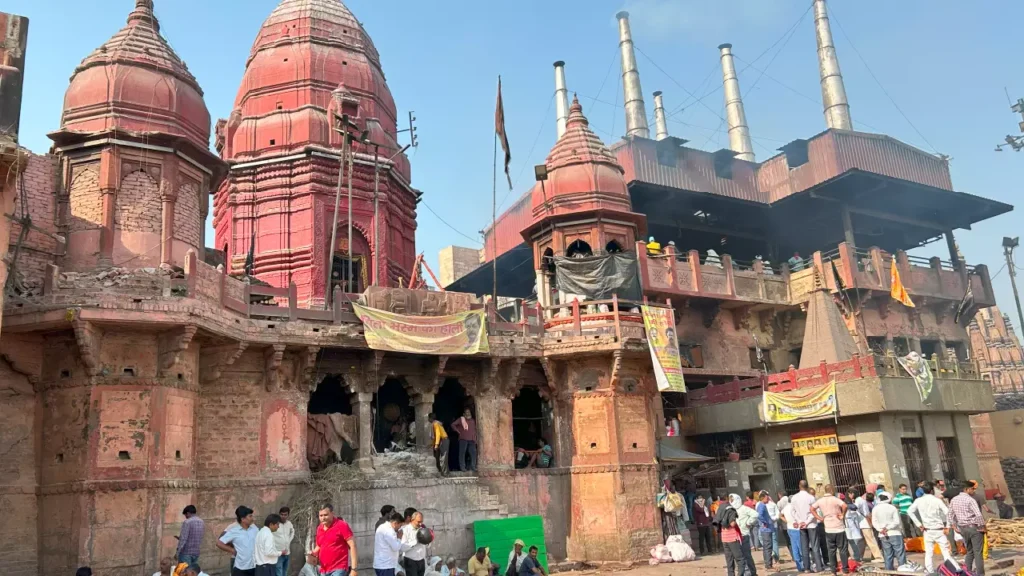
Manikarnika Ghat is the principal cremation ground and the most significant site for these rites. Kashi is held in the tradition to be the place where Lord Shiva speaks the taraka mantra into the ear of the dying, and Manikarnika is the centre of that belief.
Harishchandra Ghat is the older and smaller of the two cremation ghats, quieter, and used by many families for the same rites.
Assi Ghat at the southern end is calmer and more accessible than the cremation ghats, and is commonly used for pind daan and tarpan.
Panchganga Ghat, the mythical confluence of five rivers, is regarded as especially auspicious for ancestral offerings.
Pishach Mochan Kund is a tank away from the river, used specifically for rites concerning those who died an untimely or unnatural death — Tripindi Shraddh in particular. Families are often sent here without being told why. If a priest directs you to Pishach Mochan, it is reasonable to ask what rite is being proposed and what it addresses.
Not every ceremony belongs at Manikarnika. The appropriate site depends on the rite and on your family's practice, and a knowledgeable local priest will tell you which applies.
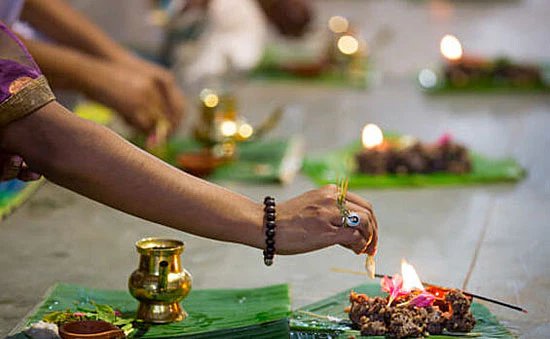
Most of these rites are performed at the ghats, seated by the river, in the morning.
Kashi, Gaya and Prayagraj
Three cities together form the traditional circuit for ancestral rites, called the Tri-sthali.
Gaya, in Bihar, is the principal site for pind daan, performed at the Vishnupad temple and the Falgu river. Prayagraj holds the Triveni Sangam, the confluence of the Ganga, Yamuna and the Saraswati, and is the traditional site for tarpan and for veni daan. Kashi is the city of liberation itself.
Many families do all three across a few days. Many do only one. Doing one is not a lesser observance, whatever anyone tells you at the ghat.
When these rites are performed
Asthi visarjan is traditionally done within about ten to thirteen days of the cremation. In practice it is frequently done much later, particularly by families abroad, and this is neither unusual nor improper. There is no window that closes.
Shraddh is performed on the lunar tithi corresponding to the day of death, not the calendar date. Find out this tithi before you travel — it is the single most useful piece of information for planning, and families frequently arrive without it.
Pitru Paksha is the fortnight most associated with these rites. In 2026 it runs from 26 September to 10 October, concluding with Sarva Pitru Amavasya on 10 October. Ancestors are believed to draw near during this period, and observance is held to be especially effective.
It is also the busiest fortnight of the year for this work. Priests are heavily booked, prices rise, and the ghats are crowded. If you are coming for Pitru Paksha, arrange things well in advance. If your circumstances allow another time of year, the rites are equally valid and the experience is considerably calmer.
Sarva Pitru Amavasya, the final day, is used where the exact tithi of death is not known.
What to bring
The ritual materials — rice, sesame, kush grass, flowers, cloth, vessels — are arranged locally and should be included in whatever you are quoted, not billed afterwards.
For families travelling from abroad
Bringing cremated remains into India is routine and thousands of families do it every year, but airlines and customs authorities have their own requirements and these vary.
Carry the death certificate and the certificate of cremation, both in English or with certified translation. Keep the remains in your hand baggage rather than checked luggage where the airline permits it, in a container that can be opened for inspection. Check your specific airline's policy in writing before you fly, and confirm current requirements with the Indian embassy or consulate in your country.
Do not rely on this page for the documentation. Rules change and they differ by country of departure.
If you cannot travel at all, rites can be performed on a family's behalf by priests in Varanasi, with the family joining by video. This is an accepted practice and it is widely offered. Whether it is right for your family is a question for you and your own priest.
What this should cost, and the part nobody says
This is the section that matters most, and it is the reason this page exists.
Families arriving in Varanasi to perform these rites are grieving, unfamiliar with the city, and unable to judge whether a figure is reasonable. That combination is exploited routinely. People are quoted sums many times the ordinary rate. Ceremonies are extended mid-ritual with additional rites presented as necessary. Families are told that an incomplete rite will harm the departed, and then asked for more money — at the ghat, with the rice already offered.
Some things worth holding on to:
A legitimate priest will quote a total figure in advance and will not revise it once the ceremony has begun.
No rite becomes invalid because you decline to add to it. If you are told mid-ceremony that something further is required and it was not mentioned beforehand, you are entitled to say no, and nothing is spoiled.
The dakshina is yours to determine. An offering to the priest is customary and proper. A demand is not the same thing.
Ask what is included — the priest, the samagri, the boat if one is needed, and any temple or ghat charges. Get it in a message you can refer back to.
Take someone with you who knows the city, or arrange the whole thing in advance with a fixed price. The point is not to save money. The point is not to have that conversation on the day you scatter your father's ashes.
What actually happens on the day
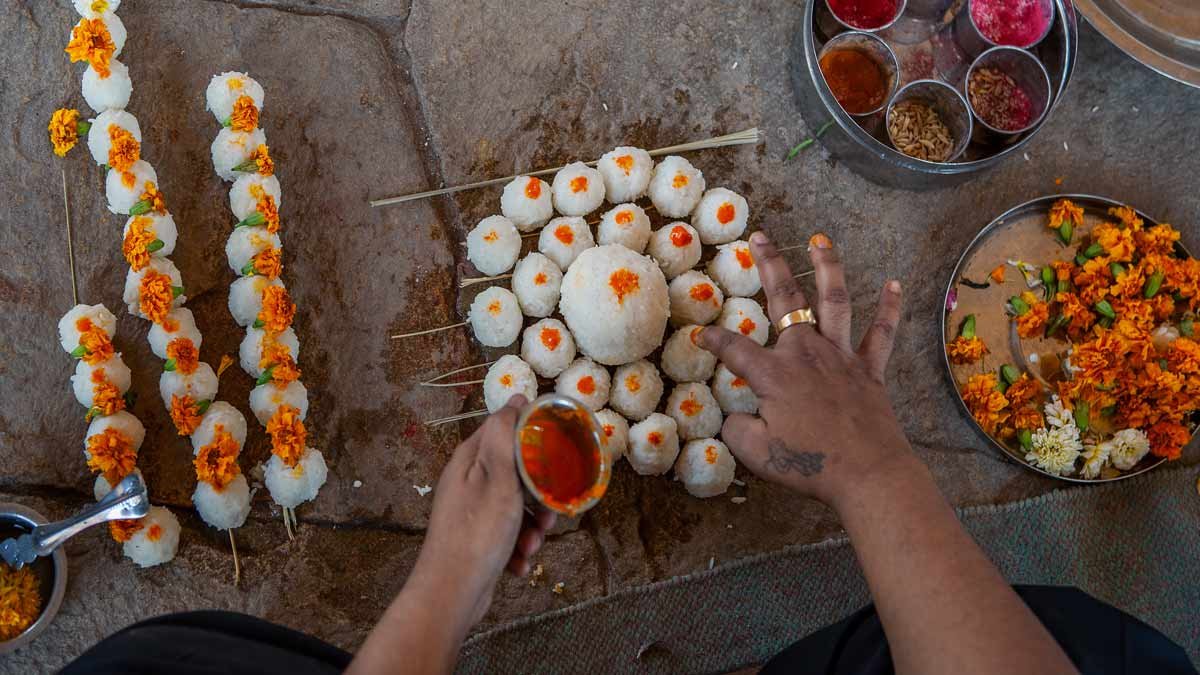
The ritual materials are arranged locally and should be included in what you are quoted.
For asthi visarjan: you arrive at the ghat in the morning. A priest performs a short sequence of prayers, with sankalp — the statement of intention, naming the deceased and the family. A boat takes you a little way out onto the river. The ashes are released, flowers are offered, and you return. It takes under an hour and it is not elaborate.
For pind daan: longer, usually an hour to two, seated at the ghat. Rice is prepared and shaped, offerings are made with water and sesame, mantras are recited. At the close, the pinda are offered to the river or to crows and cows.
Neither is theatrical. Both are quiet. Most families find them shorter and plainer than they had expected.
How we arrange this
We arrange the priest, the ghat, the boat, the ritual materials and the transport, at a price given to you in full before you commit, GST included, and settled before you arrive in Varanasi.
That last point is the whole reason we work this way. Nothing is asked for at the ghat. No one approaches you mid-ceremony. The figure does not move.
We will also tell you honestly what your family needs and what it does not. If a shorter rite is appropriate to your circumstances, we will say so, and we will not propose Tripindi Shraddh or Narayan Bali to a family whose situation does not call for it.
A Sāthi can accompany you throughout, in any of fifteen languages, which for families arriving from abroad is often the difference between following what is happening and simply sitting through it.
You can reach us at namaste@kashiandkin.com, or see our services and packages. If you are arranging this for Pitru Paksha 2026, between 26 September and 10 October, please contact us early — priests are limited and the fortnight books out.
Ritual dates and tithis depend on the local panchang and on family tradition. Confirm the timing for your ceremony with the priest performing it.