Not everybody who needs to perform these rites can come to Varanasi. A son in Toronto cannot get leave. A daughter in London has small children. A family's eldest is eighty-four and cannot make the journey. Someone has died and the thirteen days have passed while visas were being arranged.
Rites can be performed in Kashi on your behalf, with you joining by video. This page explains how that works, what it can and cannot do, and — the question most families actually want answered — how you would know it had really happened.
Is a remote pooja valid?
The honest answer is that many families accept it, some do not, and it is a question for your own tradition rather than for a website.
What can be said is this. The tradition places great weight on sankalp — the formal statement of intention, in which the person for whom the rite is performed is named along with their gotra and lineage. The sankalp is spoken by the priest, naming you and naming your ancestor, whether you are standing beside him or not. Performance by proxy has long precedent in Hindu practice, and priests in Kashi have performed rites on behalf of absent families for far longer than video calls have existed.
If this matters to you — and it should — ask the priest who knows your family. We would rather you asked first than booked uncertainly.
Who this is for
It is also used by families who come in person for the main rite and arrange smaller observances remotely in the years between.
What we arrange
We take care of the whole of it, so the only thing asked of you is to be present on a call.
The priest. An experienced Kashi purohit, matched to the rite you need and to your family's tradition.
The correct day. We work out the tithi for your ancestor from the lunar calendar and tell you when the ceremony should fall, rather than performing it on whichever day is convenient.
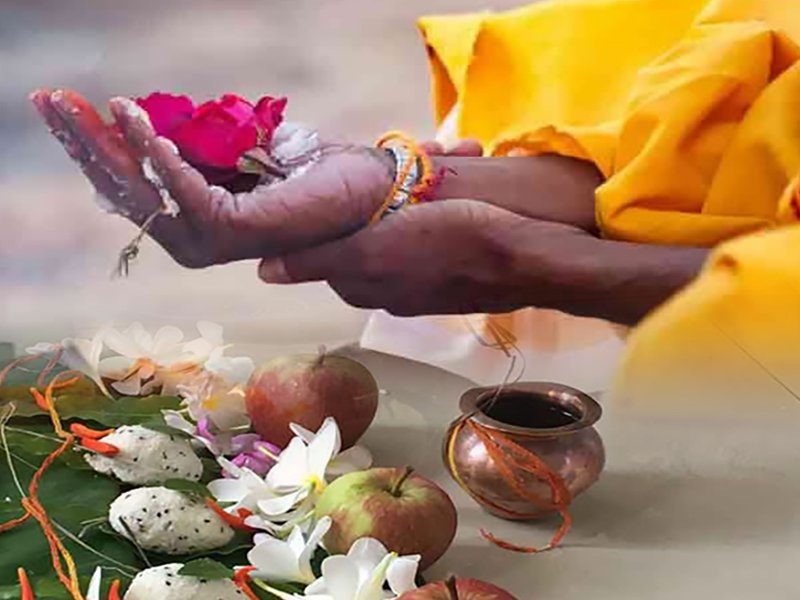
All materials. Rice, black sesame, kush grass, flowers, cloth, vessels — everything the rite requires, arranged here and included in the price.
The right site. Manikarnika, Harishchandra, Assi, Panchganga or Pishach Mochan, according to what the ceremony calls for rather than what is nearest.
Live video. You join on WhatsApp or Zoom, in your own time zone, and watch the ceremony as it is performed. Family members in different countries can join the same call.
Explanation as it happens. A Sāthi can be on the call to tell you what is being done and why, in any of fifteen languages. For families where the elders follow the Sanskrit and the younger generation does not, this is usually the difference between attending and merely watching.
A full recording afterwards, and photographs, sent to you to keep.
Prasad and sacred items couriered to your address, including Ganga jal, wherever you are.
Which rituals can be performed this way
Pind daan — the offering of rice pinda on behalf of the departed.
Tarpan — the offering of water and black sesame to ancestors.
Shraddh — the annual ceremony on the ancestor's tithi.
Tripindi Shraddh — where ancestral rites have been neglected across generations.
Narayan Bali — for unnatural or untimely death.
Rudrabhishek at Kashi Vishwanath and other temples.
Mahamrityunjaya Jaap — for health, recovery and long life.
Navagraha Shanti and Pitru Dosh Nivaran.
Asthi visarjan — immersion of ashes in the Ganga, which we can perform if the remains can be brought or sent to us.
If you are not sure which your family needs, tell us the circumstances and we will say. We will also tell you when a shorter rite is sufficient, and we do not propose Tripindi Shraddh or Narayan Bali to families whose situation does not call for them.
How you will know it actually happened
This is the part worth reading carefully, because the online pooja business has a problem.
A great many operators send families a recording of a ceremony. Some of those recordings are of a ceremony that was performed for somebody else, or performed once and sent to many people. There is no way for a grieving family in another country to tell.
Here is how to protect yourself, with us or with anybody.
Insist on live video, not a recording. A recording can be anything. A live call at an agreed hour cannot be reused.
Listen for the sankalp. The priest should say your ancestor's name, your family's gotra and the names of the living family members aloud during the ceremony. Ask in advance that he does, and listen for it. This is both the ritual heart of the rite and the thing a generic recording cannot contain.
Ask for the priest's name and the site before the day, not after.
Ask for footage that places it in time — the ghat visible, the day's conditions, something that locates it.
We do all of this as a matter of course, and we would rather you knew why it matters than took our word for it.
What we need from you
If some of this has been lost over the years, say so. There are accepted ways to proceed when a tithi or a gotra is not known, and Sarva Pitru Amavasya exists for exactly that reason.
What it costs
One figure, given in full before you commit, GST included, covering the priest, the materials, the site and the recording. Nothing further is asked for afterwards.
Families arranging these rites from abroad are particularly exposed, because they cannot see what they are buying and cannot judge whether a figure is reasonable. If you are told mid-ceremony that a further offering is required, that is not how a legitimate rite works. Nothing is spoiled by declining, and no ceremony becomes invalid because you did not extend it.
When to book
Pitru Paksha is the most significant period, running this year until Sarva Pitru Amavasya on 10 October 2026. It is also the busiest fortnight of the year and priests are limited.
Outside it, shraddh falls on your ancestor's own tithi, which recurs annually. Asthi visarjan has no closing window — families perform it months and sometimes years later, and this is neither unusual nor improper.
Tell us a week ahead where you can. For a death that has just occurred, tell us immediately and we will work to your dates.
Arrange it
Message us with the circumstances — who has died, when, where your family is, and what you think you need. We will tell you what the tradition calls for, what it will cost, and which day it should fall on.
If you are able to come to Varanasi yourself, we will say that too. Being present is better where it is possible, and we are not going to tell you otherwise in order to sell a call.
See our pooja and rituals page for everything we arrange, or our services and packages for travel to Varanasi.
Or write to namaste@kashiandkin.com
Ritual dates and tithis depend on the local panchang and on family tradition. Confirm the timing for your ceremony with the priest performing it.