Kashi Vishwanath is the reason a great many people come to Varanasi, and it is also the place where the most visits go wrong — not because of anything mysterious, but because of a queue, a mobile phone and a leather belt.
This guide covers what the different kinds of darshan are, what they cost, how to book, what you cannot carry inside, and how long it actually takes. It is written for someone planning a first visit.
What the corridor changed
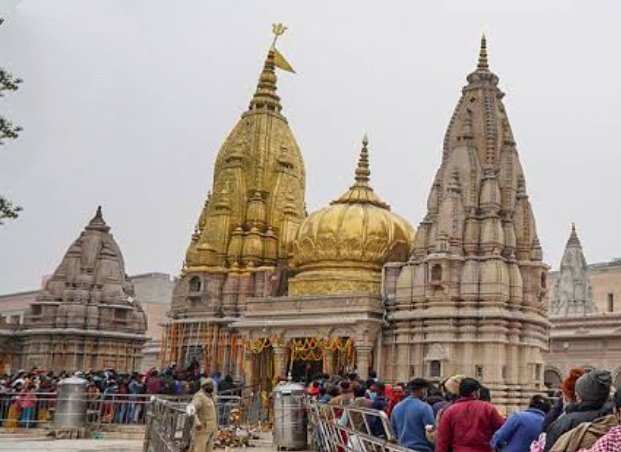
Until 2021 the temple sat buried in the lanes, reached through a warren of alleys barely wide enough for two people. The Kashi Vishwanath Dham corridor, inaugurated in December 2021, cleared a wide paved route connecting the temple directly to the Ganga at Lalita Ghat.
What this means practically is that you can now walk up from the river to the temple in the open, that the complex has proper facilities, and that the crowd is managed rather than compressed. Entry to the corridor itself is free. Most older accounts you will read online describe a temple that no longer exists in that form.
The kinds of darshan
General darshan is free, for everyone, all day. You join the queue and you move with it. On a quiet weekday morning this takes under an hour. On a Monday, a weekend, or during Shravan it can take anywhere from two to eight hours.
Sugam Darshan is the temple trust's official paid fast-track. A separate queue, a separate gate, and a considerably shorter wait. It does not give you any different access inside the sanctum and it carries no different spiritual standing — it is a crowd management measure, and the trust is explicit about that. It is the sensible choice for anyone travelling with elderly parents or small children, or on a short trip.
Sparsh Darshan permits you to touch the Jyotirlinga rather than view it from a distance. Slots are limited, it must be booked in advance, and it is suspended entirely during Shravan and around major festivals. It costs more on Mahashivratri and peak days than on ordinary ones.
Mangala Aarti is the first ritual of the day, at three in the morning, and it must be booked in advance. Reporting time is around two, for security checks. It is the smallest and stillest thing that happens in the temple, and people who have attended it tend to describe it differently from everything else they saw in Varanasi.
Rudrabhishek and other pujas can be arranged through the trust, priced according to the number of priests performing.
What it costs, and why you will see different numbers
General darshan is free. This is worth stating plainly, because a great deal of what is sold outside the temple is sold to people who do not know it.
For the paid options, be careful what you read. Sugam Darshan is currently quoted at three different prices across the travel sites that rank for this search — some say one figure, some another, some a third, and several of those pages were updated this year. Mangala Aarti is more consistently reported but has also changed.
The only reliable source is the temple trust's own portal at shrikashivishwanath.org. Check the rate there on the day you book. Any figure quoted on a travel website, including a much larger one quoted by a person standing outside the temple, should be treated as unverified.
Book only on the official site
The Shri Kashi Vishwanath Temple Trust runs one booking portal, at shrikashivishwanath.org, and an official app. No other website is authorised to sell darshan tickets.
There are a great many sites that look official, rank well, and take payments. Some are travel agents adding a margin, which is legal if disclosed. Others are not selling anything real at all.
To book: open the official portal, go to Online Services, choose your darshan type and date, enter each devotee's name, age and ID number — Aadhaar for Indian nationals, passport for foreign visitors — and pay. Keep the confirmation. Some reports say a printed copy is required at the gate rather than a phone screen, which is worth complying with regardless, since you cannot carry your phone inside anyway.
Timings
The temple opens at around half past two in the morning and closes at eleven at night. Darshan runs throughout, with a break from eleven in the morning until half past twelve for the midday aarti.
Five aartis are performed daily:
Darshan pauses during aartis, including Sugam Darshan. If you have booked a fast-track slot, check it does not fall inside an aarti window. Timings shift during Shravan and on festival days.
What you cannot carry inside
This is where most visits are delayed, and it is entirely avoidable. The following are not permitted:
Lockers and cloakrooms operate near the gates for a small charge, but the queues for them are long at busy hours. Carrying nothing at all is faster than storing something.
Photography inside the temple is not permitted, and security is thorough — there is frisking at more than one point on the way in.
Dress code
Arms and legs covered. Traditional Indian clothing is not required and Western clothing is accepted so long as it is modest. Jeans are generally fine. Shorts, short skirts and sleeveless tops are not, and you will be stopped at the gate with nowhere convenient to change.
Remember the leather rule applies to your belt. A leather belt with a metal buckle fails on two counts at once, and it is the single most common reason people are sent back at security.
Can non-Hindus enter Kashi Vishwanath?
Yes. People of all faiths and all nationalities are permitted. There is no restriction by religion.
The same dress code and the same restrictions on carried items apply to everyone. Foreign visitors should carry a passport, as identification is checked at security and is needed for booking.
When to go
Early morning, on a weekday, outside festival season is the shortest queue you will find. Between four and seven in the morning is best.
Mondays are the busiest day of the week, because Monday is sacred to Lord Shiva.
Shravan, in July and August, is the holiest month to visit and the most difficult. Queues run for hours, Mondays during Shravan are extreme, and Sparsh Darshan is suspended. If you are coming then, book weeks ahead rather than days.
Mahashivratri is the single most crowded day of the temple year.
Avoid the eleven to half past twelve window entirely, when darshan is closed.
The touts
Outside the temple you will be approached, often by someone dressed as a priest, offering to arrange immediate darshan for a substantial sum — figures in the thousands are commonly quoted.
The temple does not sell instant entry at those prices. What is being offered either does not exist or is an official ticket resold at many times its cost. The same person may offer to hold your phone, or to arrange a puja, or to take you to a shop.
The response that works is to keep walking and not engage. An answer, even a refusal, is treated as an opening.
Our guide to what to do and avoid in Varanasi covers this and the other situations where visitors are overcharged.
Getting there
No vehicle can reach the temple. Cars stop at Godowlia crossing and the rest is on foot through the lanes, or you approach from the river side through the corridor from Lalita Ghat.
Anyone who tells you they will drive you to the temple gate is not telling you the truth. Depending on traffic and the gate you are heading for, allow fifteen to twenty-five minutes of walking after your vehicle stops, and more during festivals when roads across the old city are closed.
Plan the temple as the first thing you do in the day. Going in the late afternoon means reaching the old city at its most congested hour.
Visiting with elderly parents
A great many people come to Kashi Vishwanath specifically to bring a parent, and the practical difficulties are worth planning for rather than discovering.
The walk from wherever your vehicle stops is substantial. The queue involves standing, sometimes for hours, with nowhere to sit. The temple floor is stone, often wet, and you will be barefoot on it.
Sugam Darshan earns its cost here more than anywhere. It is not an indulgence for a family bringing an eighty-year-old — it is the difference between forty minutes and four hours on their feet.
Differently-abled devotees are provided free entry and assistance. Ask at the help desk rather than joining the general queue.
Go early, when it is cooler and quieter, and do not plan a second site for that morning.
Nearby, once you are done
The corridor runs down to Lalita Ghat on the river, which is the pleasant way to leave rather than going back out through the lanes.
Kaal Bhairav Temple is traditionally visited alongside Vishwanath — Kaal Bhairav is the guardian of the city, and pilgrims have long held that a visit to Kashi is incomplete without paying respects there. Annapurna Temple adjoins the Vishwanath complex. Dashashwamedh Ghat is a short walk south for the evening aarti.
How long the whole thing takes
For planning purposes, allow two to three hours from leaving your hotel to being back in your vehicle on an ordinary day with a Sugam booking. Allow half a day for general darshan at a busy time, and most of a day during Shravan.
The darshan itself is brief. Everything around it is not.
How we help
Kashi and Kin arranges darshan as part of a day rather than as an isolated errand: the car to the drop-off point, a Sāthi who knows which gate you need and walks you there, and the timing worked out around the aarti schedule and the queue rather than against them.
Our guides work across fifteen languages. For most visitors the useful part is not the queue but knowing what is happening — what the Jyotirlinga is, why this temple among all temples, what the rituals around you mean. None of that is explained at the gate.
Prices are printed before you book, GST included, and settled before you arrive. Nothing is asked for on the ground, and nobody will offer you a shortcut for cash, because there is nothing to sell you that the temple does not already sell openly.
Our Darshan package covers the temple with transport and a guide across a single day. Our longer packages build it into a fuller stay, and you can see everything we arrange on our services page.