Is winter a good time to visit Varanasi?
Yes — but winter in Varanasi is not one season. It is three months that behave very differently, and choosing the wrong one of them is the most common way a winter trip here disappoints.
December is pleasant until the fog sets in partway through. January is the coldest and foggiest month of the year. February is, quietly, one of the best months to be in Varanasi at all, and almost nobody plans for it.
December: good early, uncertain late
The first half of December is excellent — clear mornings, comfortable days around 22°C, cold nights, and far fewer people than November. From around the middle of the month the fog begins to build, and the week between Christmas and New Year brings domestic crowds back.
If December is your month, come in the first two weeks.
January: the hard month
This is the honest part.
It is cold. Days reach the high teens, nights drop to 5 or 6°C, and occasionally lower. That sounds manageable until you are sitting still on an open boat on the river at six in the morning with the damp coming off the water, which is considerably colder than any number on a weather app.
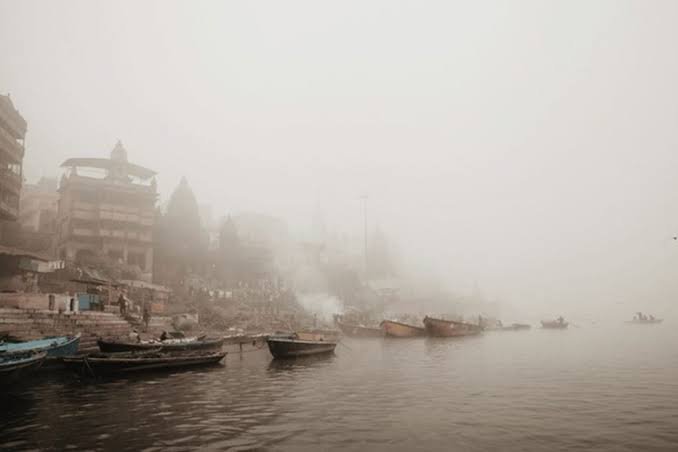
It is foggy. Dense fog forms across the plain most nights and often sits until nine or ten in the morning. On a bad day it does not lift until noon. This is the month when the sunrise boat ride is most likely to have no sunrise — you are on grey water seeing fifty metres.
Travel is unreliable. Flights into Varanasi are delayed and cancelled in fog, early morning departures worst of all. Trains from Delhi and the east run hours late. Road journeys, including the run to Prayagraj, slow to a crawl.
None of this makes January a bad time to come. It makes it a month to come with slack in your plans — a buffer day before any onward flight, two or three mornings for the boat rather than one, and an expectation that some mornings will be fog rather than light.
Some people love it. The ghats in heavy fog, with figures appearing and disappearing on the steps and the sound of bells coming through from somewhere you cannot see, are extraordinary in their own way. It just is not what the photographs promised.
February: the month nobody plans for
By February the fog has largely cleared, the cold has eased, and the days warm into the mid-twenties while the mornings stay crisp.
The light is excellent. The river is calm and low. Boating runs without interruption. The heat that arrives in April is still weeks away. And because February sits between the festival rush of November and the domestic holiday crowds of spring, the city is noticeably quieter than its reputation.
If you have freedom over your dates and want the best combination of weather, light, calm and cost, February is the answer most people who know Varanasi would give.
What winter gives you that no other season does
The food. Two of Varanasi's best dishes exist only in the cold months. Malaiyo is milk foam left out overnight under the winter sky so the dew settles on it, then whipped before dawn into a saffron-coloured cloud and sold in clay cups from carts in the early morning. It needs the cold to exist and it is gone by mid-morning. Chura matar, flattened rice cooked slowly with fresh winter peas, is the other. Neither can be had in any other season, and malaiyo cannot be had anywhere else in the world.
The mornings. Cold air is clear air when the fog is not down. A February sunrise on the Ganga is the best light of the year.
The Magh Mela. Through late January and February, the annual Magh Mela runs at the Sangam in Prayagraj, two and a half hours away — one of the largest religious gatherings on earth, and very much worth a day if your dates line up.
The quiet. Outside the Christmas week, winter is the calmest time in the city for visitors.
Winter festivals
Makar Sankranti — 14 January. A major bathing day, when the ghats fill before dawn. Varanasi also flies kites on Sankranti, and the rooftops of the old city are crowded with them through the afternoon. Khichdi is eaten and given away.
Vasant Panchami — early February. Saraswati Puja, marking the first of spring. It is kept with real enthusiasm at BHU and in the Bengali quarter, with idols of the Goddess of learning in pandals and immersion at the river.
Guru Ravidas Jayanti — 20 February 2027. On Magh Purnima, hundreds of thousands of devotees from Punjab and across the diaspora come to the Janam Asthan at Seer Govardhanpur, behind BHU.
Maha Shivratri — late February or early March. The great night of Lord Shiva, and in Kashi — his own city — it is the most important night of the year at Kashi Vishwanath. Queues run for many hours, processions move through the old city, and the temple is open through the night. It is intense and extraordinary, and the city is entirely full.
Festival dates follow the lunar calendar and are worth confirming for the specific year.
What to pack
More than you think.
A proper warm jacket, not a light layer. Thermals if you feel the cold. A hat and gloves for the early boat. A shawl or scarf, which covers your head at temples and doubles as a blanket on the river.
Many guesthouses in the old city are not heated. Ask before booking — a room without heating in January is a real problem, and it is the complaint winter visitors make most often.
Shoes you can slip off, because you will be doing it repeatedly on cold stone.
A word on air quality
The plain has poor air through the winter months, when cold still air traps everything close to the ground. It is worst in November and December and improves through February. For most people it is an unpleasantness; for anyone with asthma or a respiratory condition, or for elderly travellers, it is worth planning around.
The short version
- Early December — excellent, and quieter than November
- Late December — fog building, Christmas crowds
- January — coldest, foggiest, least reliable for travel, but atmospheric if you have slack in your plans
- February — the best-kept secret in the Varanasi calendar
How we help
Winter is the season where local knowledge changes the trip most, because the conditions vary morning to morning.
We time the boat to the fog rather than the clock, and if fog cancels a morning we reschedule within your stay or refund that portion — we tell you which before you pay, not after. We build buffer time into airport transfers in January, when delays are routine. And we will tell you honestly what your dates can deliver: if you are arriving on 5 January wanting a clear sunrise, we will say it is a gamble rather than sell you the picture.
If you are coming in February, tell us. It is the month we most often wish people would choose.
Prices are printed before you book, GST included, and settled in advance. Our Sāthi guides work across fifteen languages. See our services or packages.