The short answer: October is reliably fine and is one of the best months of the year to be on the Ganga. September is a genuine gamble, and in some years boats do not run at all for parts of it.
This is not about rough water or bad boats. It is about the district administration, which suspends boat operations entirely when the river is high — and in a monsoon year that suspension can last weeks. Most travel pages about Varanasi do not mention this, which is why people arrive in September with a boat ride booked and discover there are no boats.
Why the river rises
The Ganga at Varanasi is fed by a catchment stretching back across the plains and up into the Himalaya. Rain falling in Uttarakhand and western Uttar Pradesh takes days to arrive here, which is why the river in Varanasi often rises on a clear, bright day with no rain in the city at all.
The monsoon runs roughly June to September. The river peaks in August and early September, and the recession through late September and October is usually steady but not always quick.
The numbers that decide it
Two official marks govern what happens on the water at Varanasi:
Here is the part that matters for planning, and that almost nobody explains: boats are frequently banned long before the river reaches either mark. The district administration has suspended operations at levels around 68 metres, several metres below the danger threshold, because the current is already strong and the pilgrim numbers are large.
So checking whether the Ganga is below its danger level tells you very little about whether you will get on a boat. The ban is an administrative decision made on the strength of the current and the crowd, not a line on a gauge.
September: honestly, it depends on the year
September is the month where the answer changes from week to week.
Early September frequently still sees high water. In a heavy year the ghats are submerged, the steps are under the river entirely, the Ganga Aarti at Dashashwamedh is performed on the rooftops of adjoining buildings, and cremations at Manikarnika and Harishchandra are carried out on raised platforms and in the lanes behind. When conditions reach that point, boat movement is banned outright and NDRF teams patrol the river.
Late September is usually better. The water is receding, boats generally resume, and the river is clearing. But the timing shifts by two or three weeks between years, and there is no way to know in June what the second week of September will look like.
If you are coming in September, plan for the possibility that boating is unavailable and treat it as a bonus if it runs. Do not build your entire trip around a sunrise boat ride.
October: the good month
By October the river has usually dropped, the ban is lifted, the ghats are cleaned of silt, and boating runs normally.
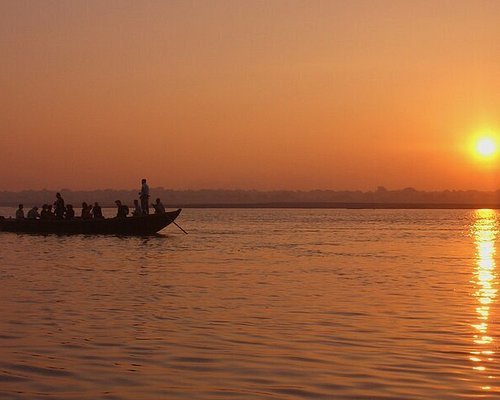
October is genuinely one of the best times to be on the water here. The air is clear after the rains, the heat has broken, the river is fuller and wider than it will be in spring, and the light in the early morning is at its best. Sharad Purnima and the run-up to the Kartik festivals fall in this period, and the city is busy without being at capacity.
Early October occasionally sees a late spell of high water if the monsoon has run long. It is uncommon, but it happens, and it is worth a check rather than an assumption.
If the boats are not running
A flooded Varanasi is not a wasted trip. It is a version of the city that most visitors never see, and some of it is remarkable.
The Ganga Aarti continues, performed on rooftops overlooking the submerged ghats, which is a stranger and more intimate thing than the usual ceremony. The temples are all open and unaffected — Kashi Vishwanath, Sankat Mochan, Durga Mandir, Annapurna. Sarnath is unaffected. Ramnagar Fort is reached by road. The lanes of the old city, the silk weavers, the food, and the whole business of the place carry on.
What you lose is the boat and the walk along the ghats, since the steps themselves are underwater.
If someone offers you a boat during a ban
Refuse.
The ban exists because the current at those levels is genuinely dangerous, the water carries debris, submerged steps and structures are invisible from the surface, and a small wooden boat has no margin. A boatman who offers to take you out anyway is not showing you a shortcut around excessive caution; he is doing something the administration has prohibited, without cover, with you aboard.
This is the one piece of advice in this article that is not about convenience.
How to check before you travel
The Central Water Commission publishes water levels for Varanasi. Local news reports the level and any boating ban within a day of it being imposed, and the district administration announces suspensions directly.
A week before you travel is the useful moment to look. A month before tells you nothing.
If you have booked through an operator, ask them the day before rather than checking yourself. They will know before it reaches the news.
What this means for booking
The practical risk in September is not danger, it is money. A boat booked and paid for in advance, for a date when the administration has banned boating, becomes a question of what your operator does about it.
Ask before you pay:
Get the answer in writing. This is a foreseeable event in September, not an act of God, and an operator who has not thought about it is telling you something.
How we handle it
We tell people the truth about their dates before they book, including when the truth is that September is a gamble. It costs us the occasional booking and saves everybody the argument afterwards.
If boating is suspended on your date, we do not keep the money for a boat that did not sail. We will either reschedule it within your stay if the ban lifts, substitute something of equivalent value, or refund that portion — and we tell you which of those applies before you pay, not after.
Prices are printed before you book, GST included, and settled in advance. That only works as a promise if it also works when things do not go to plan.
You can see the sunrise boat ride and the evening aarti boat, or our packages for the wider trip. If you are travelling in September and want an honest read on your specific dates, ask us — we would rather tell you in advance than explain at the ghat.
River levels and boating restrictions are set by the Varanasi district administration and change without notice. Confirm conditions close to your travel date.