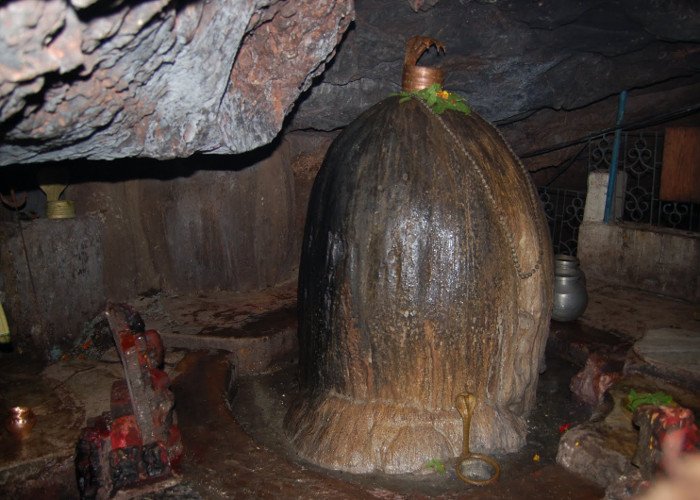
Three or four hours from Varanasi, in the Kaimur hills of Bihar, there is a cave with a Shivling in it that nobody carved.
Water has been dripping through limestone here for an unknowable length of time, leaving mineral behind drop by drop, and what has formed is a column that devotees call Gupteshwar Mahadev. Above it, algae growing over the wet stone hangs in strands that pilgrims read as the jata — the matted hair of Lord Shiva.
Almost no visitor to Varanasi has heard of it. Almost every Shaiva pilgrim in eastern Bihar has.
Why it is called Gupta
Gupta means hidden, and the name carries the story.
The demon Bhasmasura won a boon that whatever head he laid his hand upon would turn instantly to ash. Having received it, he turned on the giver and pursued Lord Shiva himself, intending to test the gift on the one who had granted it.
Local tradition holds that Lord Shiva concealed himself in this cave. Bhasmasura was eventually undone by Lord Vishnu, who took the form of Mohini and persuaded the demon to place his own hand on his own head.
The cave is where the hiding happened. Hence Gupteshwar — the hidden lord — and hence the name of the place itself.
The cave
The entrance sits partway up the eastern flank of the hill, around eighteen feet wide and twelve high, and you step down into it rather than walking in.
Inside, passages run in several directions and divide again. The floor is damp and was for a long time mud; parts have since been concreted. Several hundred feet in, the main passage reaches a ravine that holds water year-round. Sections beyond that narrow considerably and are genuinely dark.
It is a limestone cave system in the proper sense, with stalactites hanging and stalagmites rising, and it has been of interest to cavers and geologists as well as to pilgrims. The Shivling is one of those formations — which is precisely why it is venerated. Nothing shaped it but water and time.
Getting there from Varanasi
Gupta Dham lies in Rohtas district, Bihar, reached via Sasaram on the Grand Trunk Road. Varanasi is the nearest major city and the nearest convenient airport.
Figure on three to four hours each way by road to the trailhead, depending on which approach you take and the state of the last stretch. The older routes from Rehal, Panari Ghat and Ughani Ghat are difficult and involve a substantial climb on foot. A newer road near Tarachandi Dham allows vehicles further up the hill, which shortens the walk considerably.
Road conditions on the final approaches vary by season and by year, and this is not a route where a general map is a reliable guide. Confirm the current approach before you set out.
Be honest with yourself about the trek
This is the part most write-ups skip, and it matters.
Gupta Dham is not a temple you drive to and walk into. Depending on your route it involves a hill climb through forest, and then a cave that is dark, damp, slippery underfoot and narrow in places. There are bats. There is standing water. Phone signal disappears.
It is a rewarding day for anyone reasonably fit who likes this sort of thing. It is a poor choice for elderly parents, for small children, for anyone unsteady on their feet, and for anyone who dislikes enclosed spaces.
Go with someone who knows the route. This is not a place to work it out as you go.
When to go
Maha Shivratri is the great day here, when a fair is held and large crowds come. Basant Panchami draws a second fair. Through Sawan, in July and August, Shaiva pilgrims come in numbers as they do to every Shiva shrine in this region.
For a visit without crowds, October to February is the sensible window — cool, dry, and firm underfoot.
Avoid the monsoon. The approach becomes difficult, the hill route slippery and the cave wetter than it already is. This is the one season where the trip is genuinely inadvisable rather than merely uncomfortable.
What to carry
- A torch, and a spare. Do not rely on your phone
- Shoes with grip that you do not mind ruining
- Water and something to eat — there is little on the hill
- Clothes you can move in, and a change for afterwards
- A small first aid kit
Leave anything you would mind dropping in water behind.
What else is nearby
The region rewards more than a single stop, and most people who come this far make a route of it.
Rohtasgarh Fort, spread across the Kaimur plateau above the Son valley, is one of the great hill fortresses of eastern India and remarkably little visited.
Sher Shah Suri's tomb at Sasaram — a vast octagonal mausoleum standing in the middle of an artificial lake, built for the man who displaced Humayun and rebuilt the Grand Trunk Road. It is one of the finest Indo-Islamic buildings in India and there is usually almost nobody there.
Tarachandi Dham, a Shakti shrine near Sasaram, on the newer approach route.
Mundeshwari Temple at Bhabua, around 84 km from Varanasi, which has a claim to being among the oldest functioning Hindu temples in India and has been protected by the Archaeological Survey since 1915.
Taken together, this is a two or three day route out of Varanasi covering a cave shrine, a hill fort, a Mughal-era masterpiece and an ancient temple — through country that sees very few outside visitors.
Who this is for
It suits Shaiva pilgrims looking beyond the obvious shrines, travellers who have already done Varanasi and want something that is not on any standard circuit, and anyone who would rather climb a hill than queue at a temple.
It does not suit a first-time visitor with three days, a family with elderly members, or anyone whose trip is built around comfort. Sarnath and Ramnagar are better uses of a short stay.
Want this built into your trip?
There is no standard package for Gupta Dham, because almost nobody runs one. Routes change, approaches shift with the season, and how long it takes depends on where you start and what else you want to see along the way.
So we build it to order. Tell us how many days you have, who is travelling and how much walking you are up for, and we will put together a route covering Varanasi and Gupta Dham — and Rohtasgarh, Sasaram and Mundeshwari if you want them.
DM us and we will come back with an itinerary and a price. Or write to namaste@kashiandkin.com.
Everything is quoted before you book, GST included, and settled in advance — no commission stops, and nothing asked for on the road. Our Sāthi guides work across fifteen languages.
See our services or packages for the rest of what we arrange.
Routes, fair dates and access conditions in the Kaimur hills change with the season. Confirm locally before travelling.