The Ganga Aarti at Dashashwamedh Ghat is the one thing almost every visitor to Varanasi sees, and the one most of them see badly.
Not because it is overrated. Because of a structural fact that nobody mentions until you are standing there: the aarti is performed facing the river. It is an offering to the Ganga, so the priests face the water. Which means that from the ghat, you are watching it from behind.
Every good photograph you have seen of this ceremony was taken from the water or from a terrace. That is not a coincidence.
What time is the Ganga Aarti?
It starts at dusk, every single evening, and the time moves with the sunset.
As a rule of thumb:
- Winter, roughly October to March — around 6:00 to 6:45 pm
- Summer, roughly April to September — around 6:45 to 7:00 pm
It runs about 45 minutes.
Published times vary by as much as an hour between sources, because the ceremony follows sunset rather than a clock, and because different ghats start at slightly different times. Confirm for your date rather than trusting a figure you read in June.
It is held every day of the year without exception. During high water in the monsoon, when the steps are submerged, it is performed on the rooftops of the buildings behind — which is a strange and rather wonderful thing to see.
Where to watch from, honestly
From the steps at Dashashwamedh
Free, and this is where most people go.
You will be standing in a crowd of several thousand people, in the dark, unable to move much, behind the ceremony. Arrive forty-five minutes early and you get a reasonable position. Arrive at the stated time and you will see the backs of heads.
The atmosphere is genuinely something — bells, chanting, incense, a press of people all facing the same way. If you want to be inside the thing rather than looking at it, this is the choice.
From a boat
You are in front of the ceremony, at the distance it was designed to be seen from, seated, with the whole ghat and all its lamps in view. You can leave when you decide to rather than when the crowd releases you.
Boats gather in a loose mass on the water, which is part of the sight itself, and the small leaf-and-flower lamps people set adrift drift past you as they go downstream.
The trade-off is cost, and that you are slightly removed from the noise and the incense of the thing.
From Rajendra Prasad Ghat
The ghat immediately adjacent to Dashashwamedh. The aarti platforms are visible from here at an angle, the crowd is thinner, and almost no visitor knows to stand here.
Worth knowing if you want the ceremony without the full crush and do not want to take a boat.
From a terrace
Several buildings behind the ghat have rooftops, and some cafés and guesthouses sell seats for the evening. A raised view, no crowd, but a narrower angle than the boat.
The morning aarti nobody goes to
There is a second aarti, and it is the better one.
Subah-e-Banaras is held at Assi Ghat at around 5:30 in the morning — an aarti at sunrise, followed by Vedic chanting, yoga and often live classical music as the light comes up over the river.
It is free. It is uncrowded. Nobody is selling you anything. And the ghat at that hour, with the mist on the water and the city not yet awake, is the thing people actually remember about Varanasi.
If you only have time for one aarti, a case can be made for this one.
Assi Ghat also holds its own evening aarti, smaller and gentler than Dashashwamedh, which is the sensible choice for families with small children or elderly parents.
What is actually happening
Most visitors watch the whole ceremony without knowing what any of it means. It is not a light show, and knowing the shape of it changes the evening.
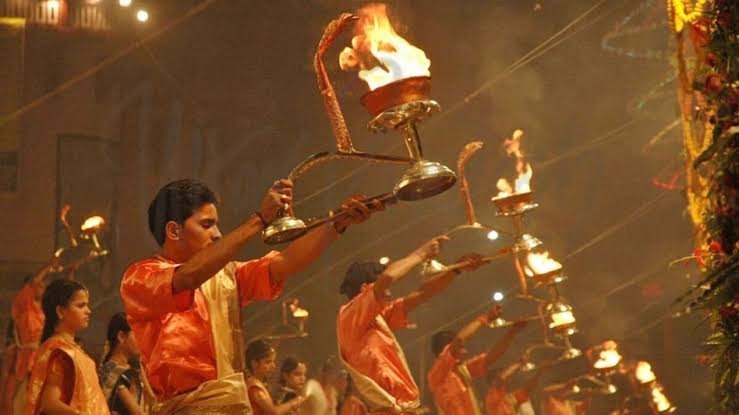
Young priests stand on raised platforms, in synchrony, and make a series of offerings to the river — understood here not as a body of water but as a goddess, Ganga, who came down from heaven and was caught in Lord Shiva's hair to break her fall before she reached the earth.
The offerings run in order. Incense. A conch, blown to open the proceedings. Then the pancha-pradeep, the tiered lamp of five flames, swung in slow circles — the five flames standing for the five elements of which everything, including the body, is made. Then camphor, a peacock-feather fan, a whisk, and finally flowers.
Bells ring throughout. The crowd joins the chanting where it knows it.
At the end, people set small lamps on leaf boats adrift on the river. That is deep daan, the giving of light, and anyone may do it.
Practical matters
Arrive early. Forty-five minutes before the stated time if you are watching from the steps. The ghat fills well before anything begins.
Your vehicle cannot reach the ghat. Cars stop at Godowlia crossing and the rest is five to ten minutes on foot through the lanes, in a crowd moving the same way.
Carry very little, and keep a bag in front of you. A dense evening crowd is where pickpocketing happens, and women should know that the crush at Dashashwamedh is also where groping occurs. The boat and the side steps both avoid this entirely.
Do not stand where you cannot move. If you are pressed in and cannot step away, step out before it gets worse.
Nobody charges for the aarti. It is a public ceremony and it is free. If someone in robes tells you there is a fee to watch, or asks for a donation towards the ceremony itself, that is not how it works.
Dress modestly — shoulders and knees covered. You may be asked to remove shoes in places near the platforms.
Expect noise. Loudspeakers, bells, hawkers, and several thousand people. It is impressive and it is not serene.
Booking a boat without being overcharged
This is the most common complaint about the aarti evening, and it follows a pattern.
A price is agreed at the steps. Once you are on the water it becomes a price per person rather than for the boat. Or the ride is shorter than described. Or a further sum is expected before you are brought back in, which is a poor moment to negotiate.
Before you step onto anything, ask: is this figure for the boat or for each person? Then ask how long, and whether anything is payable at the end. Get it in a message if you can.
A boat negotiated on the steps at dusk by a man who approached you is the version of this that goes wrong. A boat booked in advance, through your accommodation or an operator with a name and an address, is the version that does not.
Which evening to choose
The aarti happens daily, but some evenings are considerably busier.
Tuesdays and festival days draw larger crowds. Dev Deepawali, on the full moon of Kartik, is the single biggest night of the year on this riverfront — a special aarti performed at several ghats at once, with the whole crescent lit by over a million lamps. Kartik Purnima and Maha Shivratri are similarly full.
An ordinary Wednesday in February is the easiest version of the evening, and it is the same ceremony.
How we arrange it
We book the aarti boat in advance, positioned in front of the ceremony rather than behind the fleet, with the price given before you book, GST included, and settled in advance. Nothing is asked for on the water.
Your driver takes you to the nearest point a vehicle can reach and waits there afterwards, which matters most on the way out, when several thousand people leave at once through the same lanes.
A Sāthi can come with you and tell you what is being offered and why, as it happens. Our guides work across fifteen languages. For most people this is the difference between watching a ceremony and following one.
See our evening aarti boat, or our sunrise boat ride if you would rather do the morning. Our packages cover both alongside the rest of the city.
Aarti timings follow the sunset and are set locally. Confirm for your date before planning the evening around them.