Two things are worth saying at the start, because most visitors get both wrong.
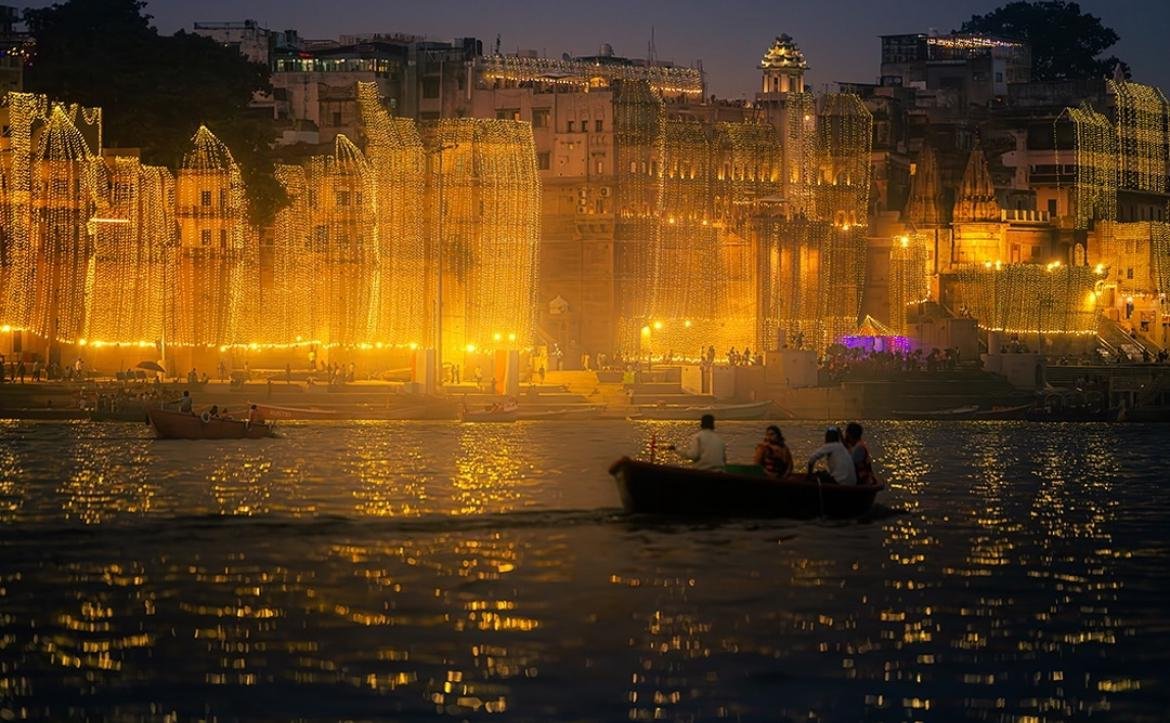
Diwali in Varanasi is not the festival where a million lamps are lit along the ghats. That is Dev Deepawali, sixteen days later. Diwali here is largely a domestic festival — homes, courtyards, families, Lakshmi Puja after dark — and if you arrive expecting the illuminated riverfront you have seen in photographs, you have come on the wrong date.
But there is one thing that happens in Varanasi at Diwali and at no other time of year, and it is a good enough reason to come.
Diwali 2026: the five days
- Friday 6 November — Dhanteras
- Saturday 7 November — Naraka Chaturdashi, or Choti Diwali
- Sunday 8 November — Diwali, Lakshmi Puja, on Kartik Amavasya
- Monday 9 November — Govardhan Puja and Annakut
- Tuesday 10 November — Bhai Dooj
Dev Deepawali follows on Tuesday 24 November 2026, on the full moon. Several travel sites are currently publishing 5 November for it, which was last year's date. Do not book flights against it.
The golden Annapurna
This is the reason to be in Varanasi at Diwali.
The Annapurna Temple stands a few steps from Kashi Vishwanath, in the lanes off Vishwanath Gali. Annapurna is the Goddess of nourishment — Kashi's own assurance that nobody in the city goes unfed — and the sanctum holds two idols of her. One is brass, and it is what you see on any ordinary day of the year.
The other is gold, and it is shown to devotees for only a few days, around Dhanteras and Annakut. For 2026 that means roughly 6 to 10 November, though the temple trust sets the exact window and it is worth confirming before you travel.
Thousands come for it. Coins are distributed to devotees at Annakut, kept afterwards in the belief that they carry the Goddess's blessing of prosperity through the year.
Expect long queues, considerably longer than at any other time. Expect them to be worth it. And go early — this is the one visit in the whole trip where the hour you arrive determines your morning.
Annakut at the temples
Annakut means a mountain of food, and on the day after Diwali the temples of Varanasi build one.
Hundreds of dishes are prepared and arranged before the deity in great heaped displays — grains, sweets, vegetables, fruit, rice — and afterwards distributed. Kashi Vishwanath, Annapurna and temples across the city all keep it, each in its own style.
It is a genuinely striking thing to see, and it is the most photographed Diwali observance in the city after the lamps.
The five days, and what actually happens
Dhanteras is the buying day. Gold, silver, and new utensils, and the markets around Vishwanath Gali, Thatheri Bazaar and Chowk are at their busiest of the year. Thatheri Bazaar is the brass and copper quarter and it is worth walking through on this day whether or not you buy anything. The golden Annapurna darshan usually opens now.
Naraka Chaturdashi, or Choti Diwali, is the smaller evening before. Lamps are lit, houses finish being cleaned, and there is an oil bath before dawn.
Diwali itself is the new moon of Kartik, the darkest night of the month. Lakshmi Puja is performed in homes at dusk, lamps are set at doorways and windows, and the fireworks begin. It is a family evening more than a public one.
Govardhan Puja and Annakut follow the next day, with the food mountains at the temples.
Bhai Dooj closes the five days, with sisters marking their brothers' foreheads and the two exchanging gifts.
What happens at the ghats
Less than you might expect, and that is the honest answer.
Lamps are set at the ghats on Diwali night and it is lovely, but it is not the illuminated riverfront of the photographs. Individual families and some temples light them. The scale is nothing like Dev Deepawali, when the whole crescent is lit end to end by ghat committees and the state.
The Ganga Aarti at Dashashwamedh continues as usual and is more elaborate than on an ordinary evening. Fireworks go up across the city and are visible from the water, which makes a boat a good place to be on Diwali night if you want the city rather than the ghats.
Kali Puja in the Bengali quarter
Varanasi's Bengali community, settled around Bengali Tola and the nearby ghats for centuries, keeps Kali Puja on the Diwali new moon rather than Lakshmi Puja.
Pandals go up, the idols of the Goddess are made locally, and the observance runs through the night. It is a completely different register from the rest of the city that evening — darker, older, and considerably more intense — and it is happening a few lanes away from the Lakshmi Puja in every other house.
Practical matters
Temple queues are the longest of the year. Kashi Vishwanath and Annapurna both. If darshan matters to you, book Sugam Darshan in advance and go at first light.
The air is bad. Fireworks across a dense city for several nights running make the air quality genuinely poor, particularly on Diwali night and the morning after. If you or anyone travelling with you has asthma or a respiratory condition, this is worth planning around rather than discovering.
It is loud. Fireworks continue late into the night on the 7th and 8th. Rooms facing quiet courtyards are worth asking for.
Shops close. Many businesses shut for two or three days around Diwali. Buy anything you need before the 8th.
Book early. November is peak season in Varanasi before you add Diwali, and this year the 8th falls on a Sunday, which means the domestic long weekend lands on top of it.
Traffic is difficult around the market areas on Dhanteras and around the temples throughout. As always, vehicles cannot approach the ghats and the last stretch is on foot.
Should you come for Diwali or Dev Deepawali?
If you want the spectacle — the illuminated ghats, the lamps in their thousands down the steps, the whole riverfront lit at once — come for Dev Deepawali on 24 November. That is the festival Varanasi is famous for, and Diwali is not a smaller version of it.
If you want the city as it actually lives — homes lit, families at puja, the markets at Dhanteras, Annakut at the temples, and the golden Annapurna shown for the only days in the year — come for Diwali on 8 November. It is quieter, far less crowded with visitors, and closer to ordinary life.
The two are sixteen days apart. Some people stay for both, which makes for a long trip but takes in the fullest month in the Varanasi calendar. Kartik is the month when this city is most itself.
How we can help
Diwali is a difficult week to arrange from outside the city. Temple timings shift, the golden darshan window is announced by the trust rather than published in advance, markets and roads are congested in different places on different days, and much of what matters is domestic rather than advertised.
We arrange the darshan timing so you are in the queue at the right hour rather than the wrong one, the transport around closures and market congestion, and a Sāthi to explain what is being observed on each of the five days — because the difference between Dhanteras, Annakut and Bhai Dooj is not obvious from the street.
Our guides work across fifteen languages. Prices are printed before you book, GST included, and settled in advance, so nothing is asked for at any temple gate. There are no commission stops at silk shops, which matters more than usual in a week when every shop in the city is selling.
See our services or packages. If you are considering both Diwali and Dev Deepawali, tell us and we will work out whether the stay in between is worth it for you — sometimes it is and sometimes it is not, and we will say which.
Festival dates follow the lunar calendar and temple timings are set by the trusts. Confirm the golden Annapurna darshan window before booking travel around it.