Dev Deepawali is a single evening in a city of narrow lanes, with somewhere over a million people trying to reach the same seven kilometres of riverfront at the same hour. It is one of the most beautiful things you will see. It is also the most logistically difficult night of the Varanasi year, and the difference between the two experiences is almost entirely a matter of where you are standing and what time you got there.
This is a guide to the evening itself. If you have not booked yet, start with our guide to when to book for Dev Deepawali instead — that is the more urgent question.
Dev Deepawali 2026 falls on Tuesday, 24 November, the full moon of Kartik.
What actually happens
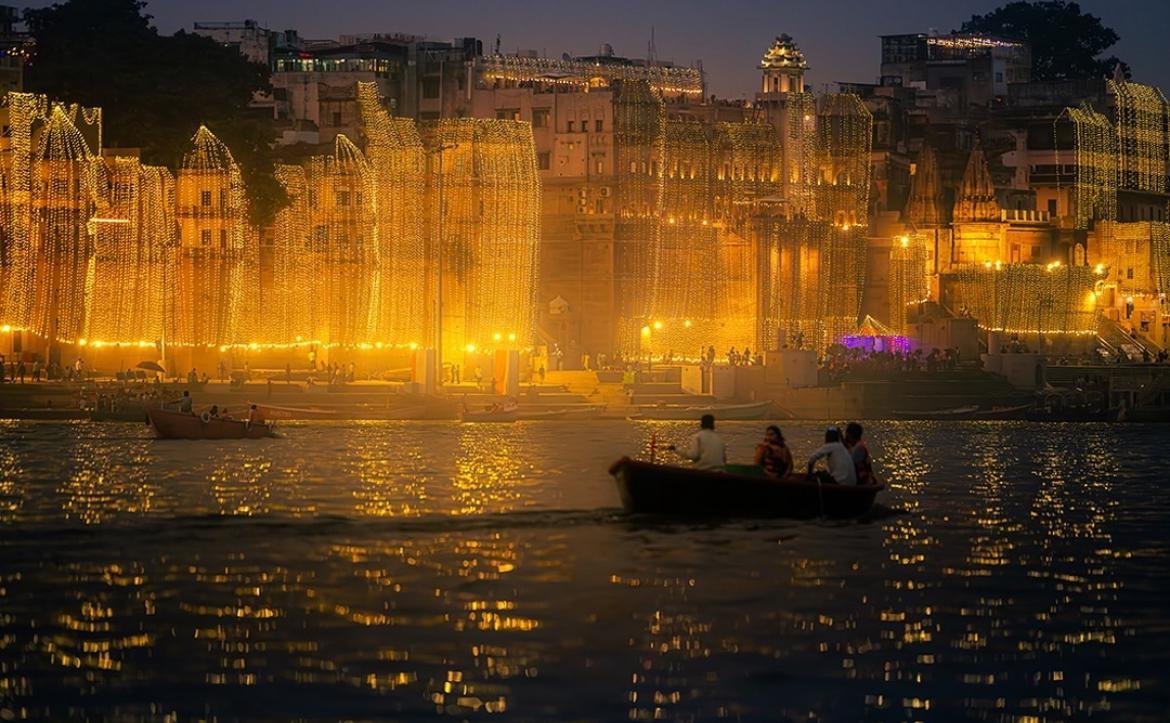
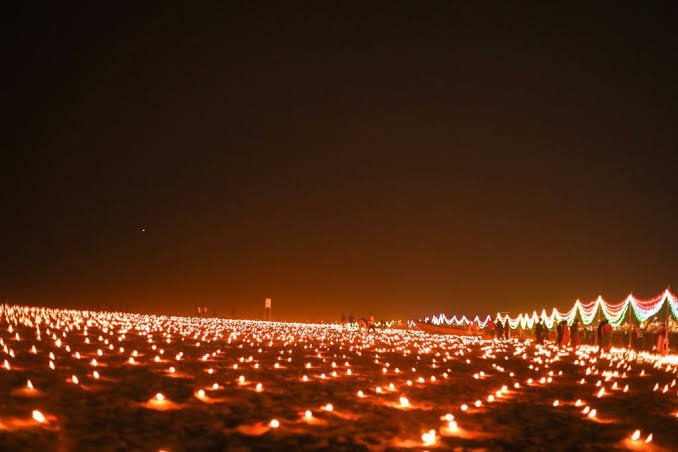
At dusk, earthen lamps are lit along the full length of the ghats — well over a million of them, some placed by the state tourism department and the rest by ghat committees, temples, families and volunteers. They are arranged in rows down the steps, so from the water the whole crescent of the riverfront reads as continuous bands of light.
A special Ganga Aarti is then performed at several ghats simultaneously rather than only at Dashashwamedh. People float small leaf boats carrying single lamps out onto the river, which is called deep daan. There is a projection and laser show at Chet Singh Ghat, another near Lalita Ghat, and a fireworks display over the sand on the far bank.
All of it happens between roughly quarter past five and half past eight. Three hours.
The shape of the evening
These were the 2025 timings. The 2026 schedule follows the same pattern but is confirmed by the district administration only a few weeks before the date, so treat this as the shape rather than the timetable.
- 5:15 to 5:50 pm — lamps lit across all the ghats
- 6:00 to 6:50 pm — special Ganga Aarti at Dashashwamedh, Sheetla, Assi and Namo Ghats
- 6:30 pm onwards — deep daan, the floating of lamps on the river
- Evening slots after the aarti — projection and laser show at Chet Singh Ghat, running in repeated sessions rather than once
- Around 7:45 pm — laser show near Lalita Ghat and the Kashi Vishwanath corridor
- Around 8:00 to 8:15 pm — fireworks over the sands opposite Lalita Ghat
The half hour when the lamps are being lit is, for many people, better than anything that follows. The light changes minute by minute and the ghats are not yet at their fullest.
Where to watch
From a boat
This is the honest recommendation, and not only because we arrange them. Dev Deepawali is designed to be seen from the river. The lamps face the water, the aarti is performed towards the water, the floating lamps are on the water, and the fireworks go up over the water.
From a boat you see the full sweep of illuminated ghats at once, you are seated, you can leave when you want, and you are not in a crowd. From the steps you see the ghat you are standing on.
The trade-off is that you must be aboard early — often by three or four in the afternoon, because after that the steps become impassable and boats need to be in position. That is a long time to sit. Bring something to eat.
From the ghats
If you are watching from land, the ghat you choose determines your entire evening.
Dashashwamedh is the centre of everything and the most crowded place in Varanasi that night. The main aarti is here. So are the largest numbers, the tightest press of bodies, and the greatest difficulty getting in or out. Go if the aarti is the thing you came for and you are prepared for the crush.
Assi Ghat at the southern end has its own aarti, considerably more room, and a calmer atmosphere. It is the sensible choice for most visitors, particularly families.
Namo Ghat at the northern end is the newest ghat in the city, built with proper facilities and open space, and it is the least crowded of the major viewing points. It also has its own aarti. If you dislike crowds, this is where to go.
Chet Singh Ghat is where the projection and laser show is staged, so it fills with people who have come specifically for that.
Panchganga Ghat is where the modern practice of lighting lamps for Dev Deepawali began, in 1985. It is narrow, fills quickly, and keeps a quieter and more devotional character than the ghats with staged events. Some people much prefer it.
Manikarnika is not a viewing point. Cremations continue that night as on every other night, and it is not illuminated for the festival.
From a terrace or a hotel
Several riverfront properties and cafés have terraces, and some sell seats for the evening. A terrace gives you a raised view without the crowd, though a narrower one than the boat. Book far ahead; these sell out as early as the hotel rooms do.
Getting there
This is where most evenings go wrong.
Vehicles cannot reach the ghats. Not on any night, and emphatically not on this one. The police close roads across the old city, and the closures are extensive, change from year to year, and are announced late. Your car will stop somewhere on the outer ring of the closure and the rest is walking — sometimes a kilometre or more, through dense crowds, in the dark.
Arrive far earlier than feels necessary. If you are watching from a ghat, be there by four. If you are on a boat, follow the boarding time you were given and do not treat it as approximate. People who set out at six do not arrive at six.
Do not plan anything else that day. Kashi Vishwanath darshan on the morning of Dev Deepawali is possible but the queues are extreme. Sarnath or Ramnagar in the afternoon is not — you will not get back across the city in time.
Getting out
The exit is harder than the entry and almost nobody plans for it.
When the fireworks end, several hundred thousand people leave at once, through lanes built for far fewer, in the dark. It takes a long time and it cannot be hurried. There is no way to arrange a vehicle to meet you closer than the closure line.
Do agree in advance exactly where you will meet your driver, and be specific — a named landmark, not "near the ghat."
Do consider waiting half an hour rather than moving with the initial surge. Sit somewhere, let it thin, then walk.
Don't count on your phone. Mobile networks in the old city are overwhelmed that evening and calls frequently do not connect. Anything you have not agreed before you set out, you will not be able to agree later.
Practical matters
Agree a meeting point with everyone in your group before you leave your hotel, in case you are separated. Groups do get separated, and the phones do not work.
Carry very little. A dense night crowd is where pickpocketing happens. Keep a bag in front of you.
Bring water and something to eat, particularly if you are boarding a boat in the afternoon. Food stalls exist but the queues are long and the good ones sell out.
Dress warmly. Late November on the river after dark is colder than the daytime temperature suggests, and you will be sitting still for hours.
Toilets are the weak point of the whole evening. Use one before you leave your hotel and moderate what you drink.
No photography at the cremation ghats, including from a boat and including that night.
If you are travelling with elderly parents or small children
Take a boat. This is not a preference, it is the practical answer.
The standing crowds are genuinely difficult for anyone who cannot stand for three hours or move quickly, and the walk in and out over uneven steps in the dark is where injuries happen. On a boat everyone is seated, nobody is jostled, and you leave when you choose rather than when the crowd allows.
If a boat is not possible, Namo Ghat and Assi Ghat are the two land options with enough room to be manageable.
Consider the surrounding days
The Ganga Mahotsav runs for several days immediately before Dev Deepawali — classical music, folk performance, boat races and craft exhibitions across Rajendra Prasad Ghat, Chet Singh Ghat and others. It is free, it is far less crowded, and most visitors miss it entirely because they arrive on the day itself.
The morning after is worth staying for. The ghats are quiet, the burnt-out lamps are still in their rows down the steps, and the ordinary sunrise boat ride is at its best.
What we arrange
Kashi and Kin puts the evening together as one booking, which on this particular night is the difference between watching Dev Deepawali and negotiating your way through it.
A place on a boat, booked in advance with the boatmen we work with, positioned for the illuminated ghats and the aarti. You are given your boarding point and boarding time when you book, not on the day.
A Sāthi alongside you. The lamps, the aarti, the deep daan and the reason for all of it on this specific full moon — none of it is self-explanatory, and there is nobody to ask on a crowded ghat. Our guides work across fifteen languages.
Pickup and drop at your hotel, which is the part we are most useful for. The drivers we work with know which approaches are open on the night, where the walking begins, and where to wait afterwards.
Everything is priced before you book, GST included, and settled before you arrive. Nothing is asked for on the ghat or on the boat.
Our guide to booking for Dev Deepawali covers what to arrange and when. You can also see our packages for longer stays around the festival, or our services for individual arrangements.