Most visitors to Varanasi never leave the riverfront, and for a first trip that is reasonable. But two kilometres south of Assi Ghat the city changes character entirely. The lanes open out, the noise drops away, and you are on 1,300 acres of tree-lined avenues laid out in a great semicircle, with a white marble temple at the centre of it taller than the Qutub Minar.
Banaras Hindu University is the largest residential university in Asia and the second reason people who know Varanasi come to Varanasi. It is also, for an hour or two in the middle of a demanding trip, the calmest place in the city.
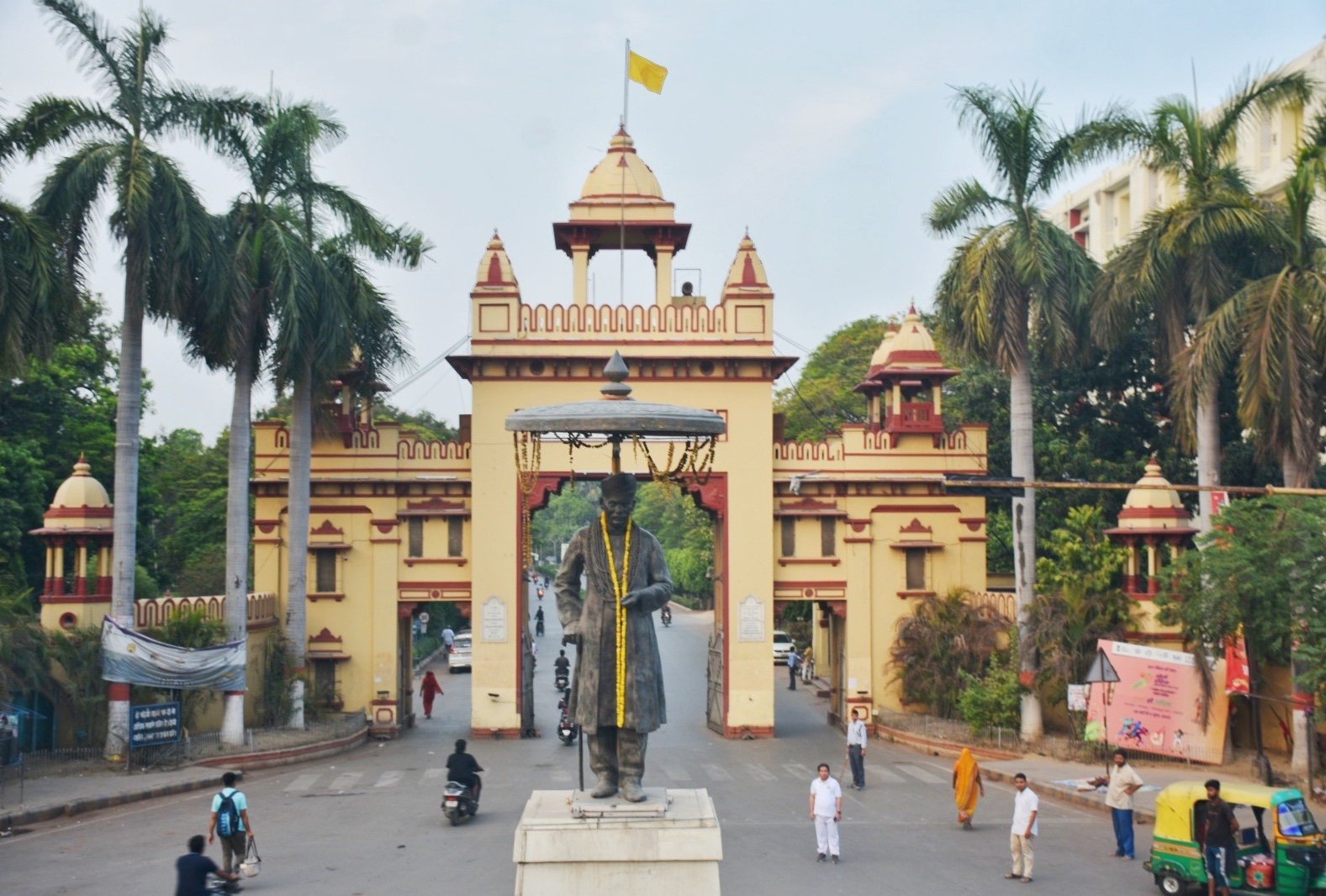
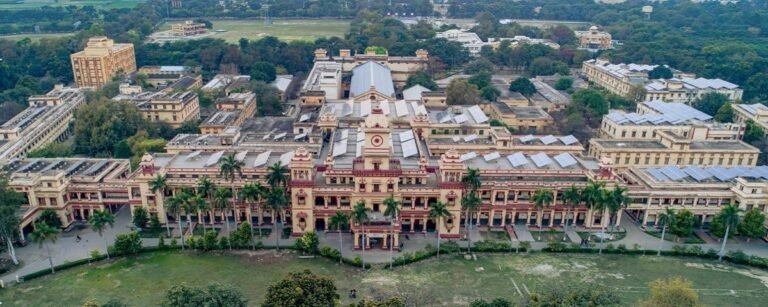
The campus covers 1,300 acres, laid out as a semicircle with roads running along its radii and arcs.
How it came to exist
BHU was founded in 1916 by Pandit Madan Mohan Malaviya — lawyer, parliamentarian, newspaper editor and one of the more remarkable figures of the independence movement.
His idea was unusual for its moment: an Indian university, at Indian scale, teaching Sanskrit and the classical tradition alongside engineering, medicine and modern science. Not a colonial college teaching Indians, and not a traditional pathshala refusing the modern world. Both, on one campus.
He had no money for it. What followed is the part of the story people in Varanasi still tell — Malaviya travelled the country for years asking for it, from maharajas, merchants and ordinary people, and became known as a beggar on behalf of education. The Maharaja of Darbhanga and the Maharaja of Benares were among the major donors. Annie Besant, whose Central Hindu College became the nucleus of the new university, was central to its founding. The foundation stone was laid in February 1916 by Lord Hardinge, then Viceroy.
At that opening ceremony, Mohandas Gandhi gave what is generally counted as his first major public speech in India, having returned from South Africa the year before. He used it to criticise the jewelled princes seated in front of him and the condition of the city's temples, and a good part of the audience walked out. It was the beginning of his public life in the country.
The campus
The plan is a semicircle. Roads run outward along the radii and around in arcs, with the temple at the centre and the main gate at Lanka.
The earliest buildings, from the first half of the twentieth century, are in an Indo-Gothic style — arcades, domes and chhatris in cream stone, deliberately Indian in an era when institutional architecture in India generally was not. The main gate is the best example.
Today the university runs three institutes, fourteen faculties and over a hundred departments, with sixty-odd hostels and students from more than thirty countries. It is a small city.
What makes it worth an hour of a traveller's time is simpler than any of that. It is green, quiet, walkable and utterly unlike the rest of Varanasi.
New Vishwanath Temple
The building at the centre of the campus, and the thing most visitors come for.
It is dedicated to Lord Shiva as Vishwanath, and was conceived by Malaviya as part of the university itself rather than as an addition to it. Construction began in the 1930s, was funded by the Birla family — which is why it is sometimes called the Birla Temple — and was completed in 1966, more than two decades after Malaviya's death.
The tower rises 77 metres, around 253 feet, which makes it taller than the Qutub Minar and one of the tallest temple towers in India. It is visible across much of southern Varanasi. The complex holds seven shrines in all, with the main sanctum to Lord Shiva and others to Lakshmi Narayan, Durga, Saraswati, Nataraj, Hanuman and Lord Ganesha. Verses from the Bhagavad Gita and other scriptures are inscribed along the inner walls.
One detail matters more than the architecture. The temple is open to people of every caste and every religion — a deliberate decision, at a time when that was not the norm, and an expression of what Malaviya wanted the university to be.
It is white marble, spacious and quiet, and after the press of the old city it comes as a considerable relief. Students sit on the steps. Nobody hurries you.
Timings: roughly 4:00 am to 12:00 pm, and 1:00 pm again until 9:00 pm. Entry is free.
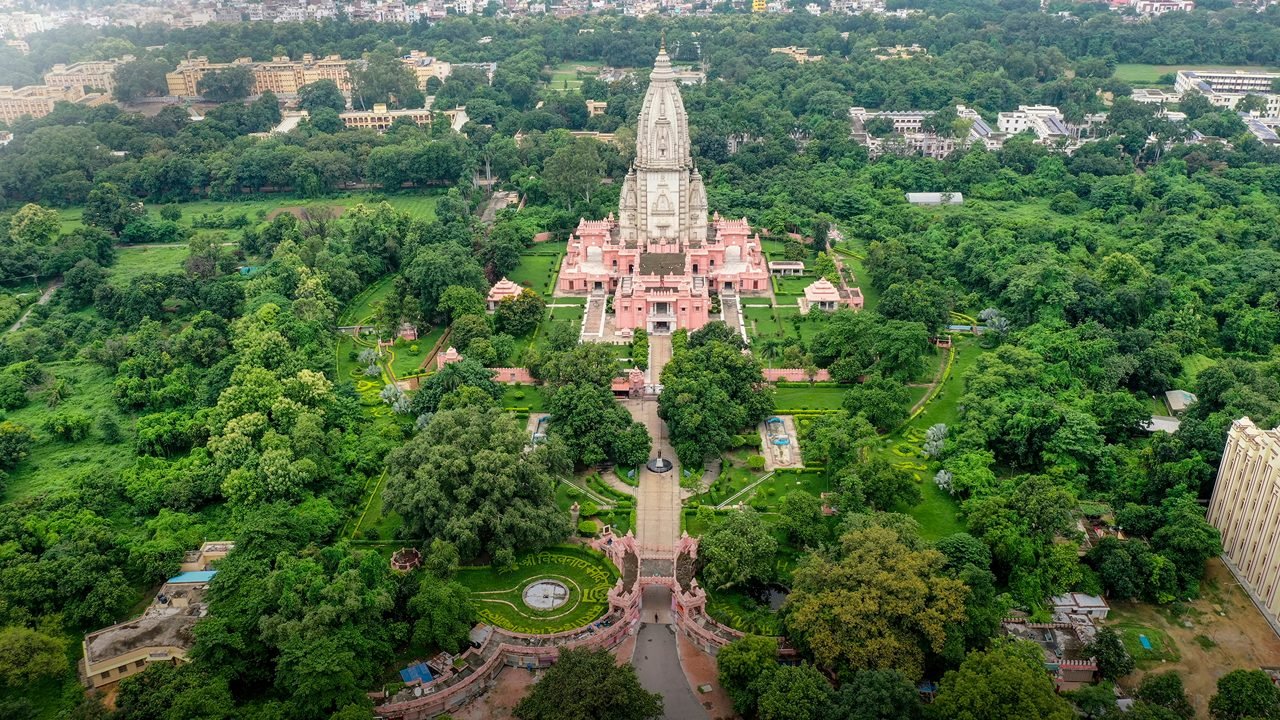
The tower stands 77 metres — taller than the Qutub Minar — and is open to people of all faiths.
Bharat Kala Bhavan
The most underrated place in Varanasi, and the one that repays a visit most.
Founded on 1 January 1920 by Rai Krishnadasa together with Malaviya, with Rabindranath Tagore as its first honorary chairman, Bharat Kala Bhavan holds over a hundred thousand objects. Miniature paintings across the Mughal, Rajput and Pahari schools. Sculpture from Gupta and medieval India. Textiles, brocades and costume. Manuscripts, coins, archaeological material, and a collection of Indian philately.
It is a serious museum by any standard and would be a major institution in any city. In Varanasi, where it competes with the Ganga, most visitors never hear of it.
Timings: usually 10:30 am to 4:30 pm, closed on Sundays and university holidays. A small entry fee applies, with a higher rate for foreign visitors. Cameras are generally not permitted inside.
Check before you go — university holidays are numerous and not always obvious from outside.
The cultural weight of the place
BHU's Faculty of Performing Arts is among the most significant institutions in Hindustani classical music, and Varanasi's own gharana tradition runs through it. If you are on campus in the evening and hear music from an open window, that is what it is.
The Faculty of Sanskrit Vidya Dharm Vijnan continues the classical scholarship Malaviya wanted preserved. The Institute of Medical Sciences and Sir Sunderlal Hospital serve much of eastern Uttar Pradesh and Bihar. The Institute of Technology became IIT (BHU) Varanasi in 2012 and is among the country's leading engineering schools.
This is the influence Malaviya was after. Not a monument, a working institution, still doing the thing it was built to do a century later.
Visiting: the practical part
Where it is. The main gate is at Lanka, on the southern edge of the city. Around 2 km from Assi Ghat, 7 km from Varanasi Junction, and 25 km from the airport.
Entry to the campus and the temple is free. The museum charges a small fee.
How long. An hour and a half covers the temple and a drive through the campus. Three hours if you want the museum properly, which you should.
Getting around. The campus is far too large to walk end to end. A vehicle can drive in and between the main points, which is the sensible approach, particularly in the heat.
What to wear. Modest clothing, as anywhere in Varanasi. Shoes come off at the temple. Comfortable footwear, because there is more walking than you expect.
When to go. October to March for the weather. Early morning or late afternoon in any season. The temple is at its best just after opening.
Remember it is a working university. Students live here. Keep your voice down, don't photograph people without asking, and stay out of departmental buildings unless you have a reason to be in them.
What to combine it with
BHU sits inside a natural half-day circuit, which is the sensible way to see it.
Sankat Mochan Temple, dedicated to Hanuman and founded by the poet Tulsidas, is very close by. Durga Kund and the Durga Mandir, and Tulsi Manas Mandir, are both a short distance away and are usually done together with Sankat Mochan.
Ramnagar Fort is across the river and reached by the bridge just beyond the campus — a short hop from BHU, and much closer from here than from anywhere else in the city.
Assi Ghat is two kilometres north, which makes BHU an easy afternoon if you are staying at that end of the riverfront.
A morning that runs Sankat Mochan, Durga Kund, Tulsi Manas, BHU and the temple, and then across to Ramnagar Fort, is one of the better half-days in Varanasi and covers ground most visitors miss entirely.
Arranging it
BHU is one of the few places in Varanasi where having a car genuinely changes the visit rather than merely speeding it up. The campus is 1,300 acres, the points of interest are spread across it, and walking between them in April is not an afternoon anyone enjoys.
We arrange the half-day circuit with a driver who can take you into and around the campus, and a Sāthi who can tell you what you are looking at — which for Bharat Kala Bhavan in particular makes a real difference, since the labelling assumes you already know. Our guides work across fifteen languages.
Prices are printed before you book, GST included, and settled in advance. Nothing is asked for on the day and there are no commission stops on the route.
See our services or packages. Our guide to the temples of Varanasi covers the wider circuit around the campus.
Timings and entry fees are set by the university and change. Confirm before you travel, particularly for the museum.