One city, three names
The city's oldest name is Kashi — usually translated as "City of Light" — and it is the name still used in prayer, in scripture, and by the pilgrims who walk its lanes. Through the medieval centuries and the British era the world knew it as Banaras (spelled Benares by the colonial administration), a name Banarasis themselves still use with affection. Varanasi, the official name, describes the city's geography: it sits between two small rivers that meet the Ganga here — the Varuna at the northern edge and the Assi at the southern one.
Three names, one continuous city. Mark Twain, visiting in 1896, famously remarked that Banaras is "older than history" — and the archaeology largely agrees with him. Settlement at Kashi goes back to roughly the 2nd millennium BCE, which places it among the oldest continuously inhabited cities anywhere in the world, in the company of Damascus and Jericho.
A short history of a very long story
By the 8th–6th centuries BCE, Kashi was the capital of one of the sixteen great kingdoms of ancient India and a celebrated centre of trade, weaving and philosophy. When the Buddha gave his first sermon around the 5th century BCE, he chose Sarnath — the deer park just ten kilometres from the city — precisely because Kashi was where the thinkers gathered. Jain tradition honours the city too: it is the birthplace of Parshvanatha, the 23rd tirthankara.
The medieval centuries were harder. The city was sacked repeatedly from the 11th century onward, and many of its grandest temples were destroyed and rebuilt more than once — the current Kashi Vishwanath temple dates from 1780, raised by Queen Ahilyabai Holkar of Indore. Most of the riverfront you see today, the great stone ghats and their palaces, was built in the 18th century by Maratha rulers and the Rajput and Bengali nobility, each dynasty adding its own ghat, its own temple, its own rest-house for pilgrims.
Through all of it, the city never stopped being itself. Tulsidas wrote the Ramcharitmanas here in the 16th century; the weaver-poet Kabir was born here a century before that; Banaras Hindu University, one of Asia's largest residential universities, was founded here in 1916. The shehnai of Ustad Bismillah Khan and the sitar of Pandit Ravi Shankar both grew out of the Banaras gharana, this city's own school of Hindustani music.
The ghats: where the city meets the river
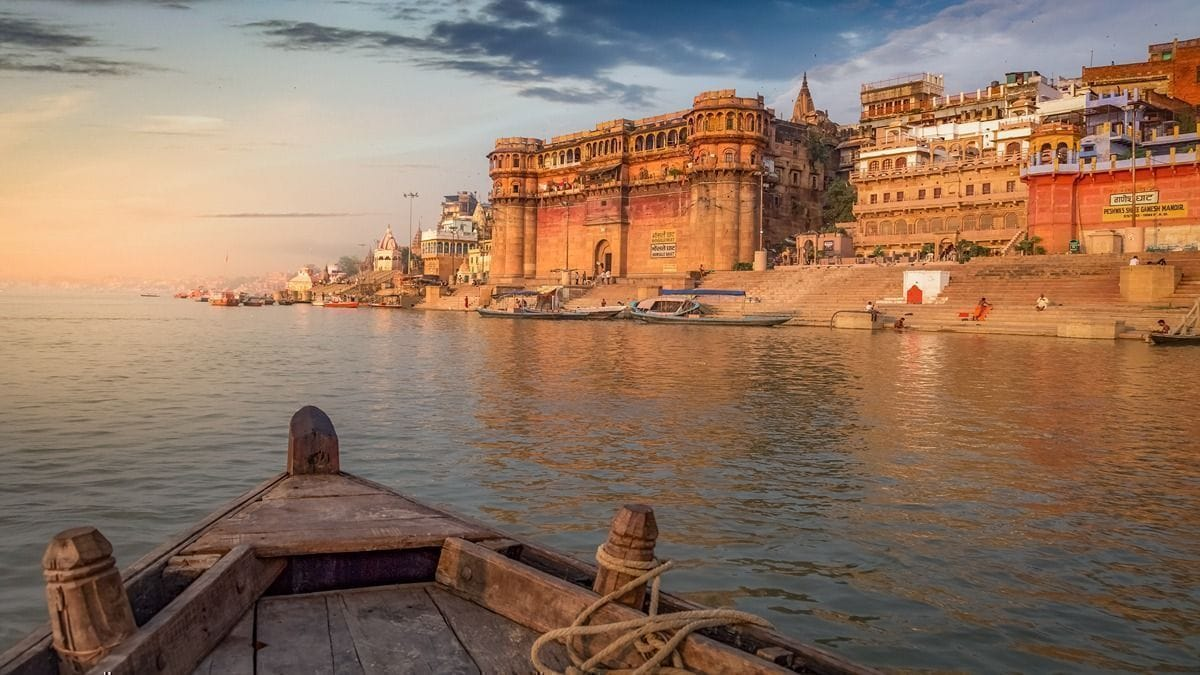
Varanasi's signature is its riverfront — an unbroken crescent of more than 80 ghats, the stone stairways that step down into the Ganga for several kilometres along the west bank. The river makes a rare northward turn here, so the city faces the rising sun across the water: this is why the dawn boat ride is not a tourist invention but the city's oldest devotional view of itself.
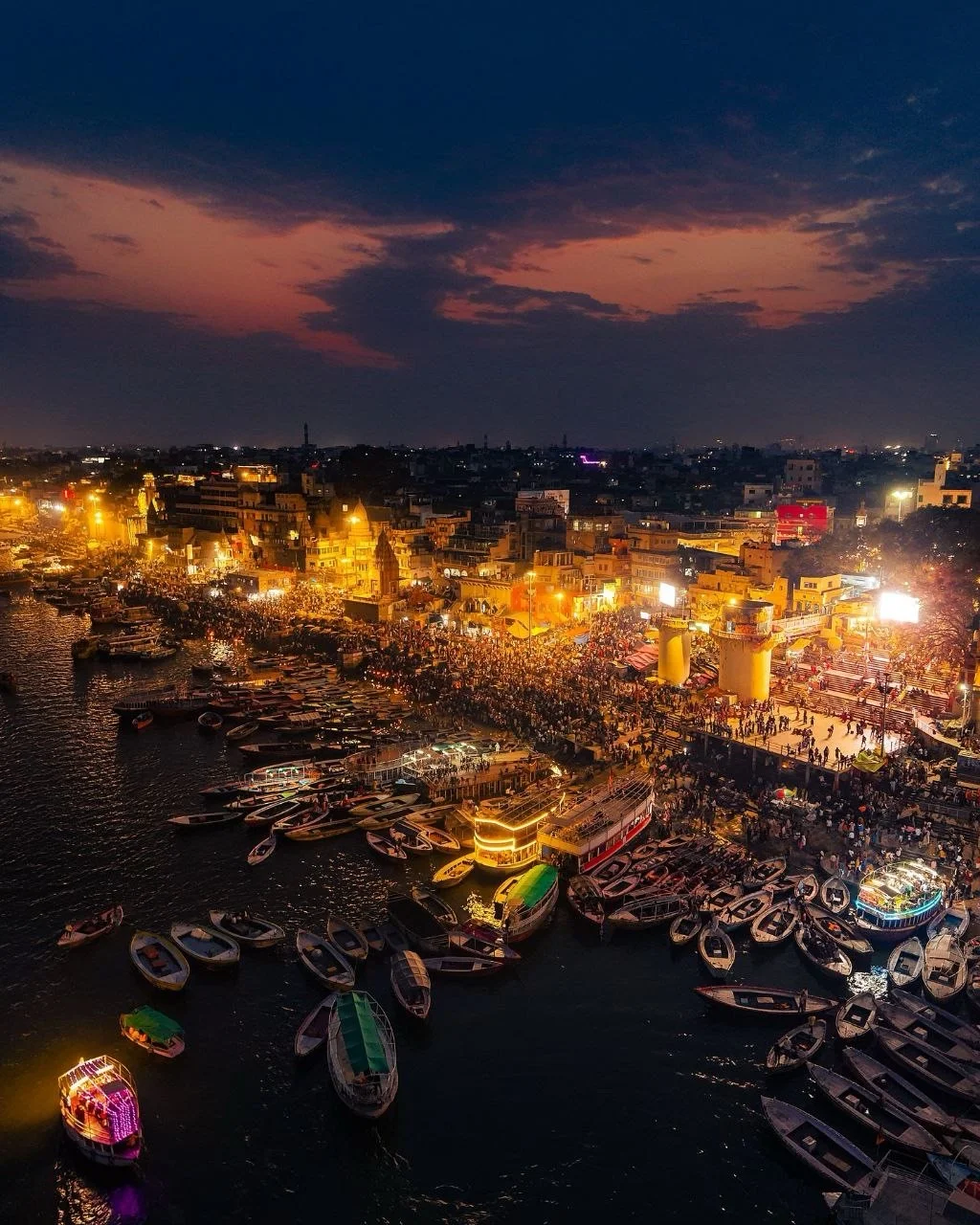
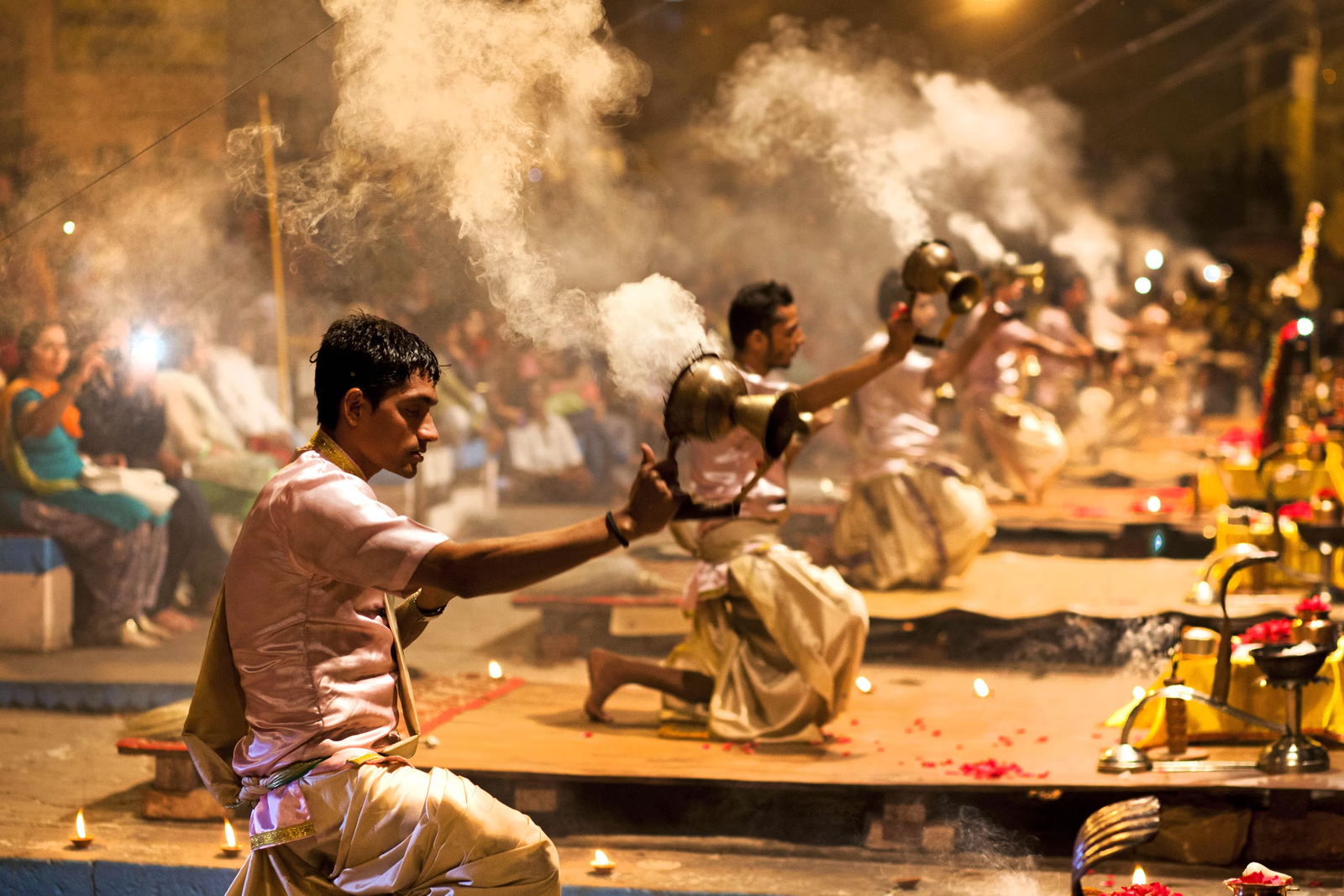
Each ghat has its own account. Dashashwamedh, the busiest, is where the evening Ganga Aarti is performed — a fire ritual offered to the river every single night. Assi, at the southern end, anchors the university quarter. Manikarnika and Harishchandra are the two cremation ghats, where the fires are said never to have gone out; Hindus believe that to die in Kashi and be cremated on the riverbank is to attain moksha — liberation from the cycle of rebirth. It is this belief, more than any monument, that explains what Varanasi means to India.
Faith, every hour of the day
The spiritual centre of the city is the Kashi Vishwanath temple, home to one of the twelve jyotirlingas of Shiva — the "pillars of light" that mark Shiva's most sacred sites. For a devout Hindu, darshan here paired with a dip in the Ganga is among the most meritorious acts a lifetime allows. Around it the city keeps hundreds of other shrines: Kaal Bhairav, the fierce guardian whom Banarasis call the city's true kotwal (police chief); Sankat Mochan, the Hanuman temple beloved by students; Durga Kund, Tulsi Manas, and small neighbourhood temples on nearly every lane.
The day has its own liturgy. It opens with Subah-e-Banaras — the fabled Banaras morning of bathers, yoga on the ghats and temple bells — and closes with the synchronised flames of the aarti. Between the two, the city simply lives: wrestlers at their akharas, chai in clay kulhads, silk looms clacking in Muslim weaver quarters that have produced Banarasi brocade for centuries, and the famous Banarasi paan folded at every corner.
Visiting the city today
Modern Varanasi is a city of roughly 1.5 million people and the spiritual capital of the state of Uttar Pradesh. It is loud, crowded, occasionally overwhelming — and, for most travellers, unforgettable. The corridor project completed in 2021 opened a broad ceremonial path from the river to Kashi Vishwanath, making the old darshan far more comfortable than it once was. Sarnath, now a UNESCO World Heritage Site, sits an easy half-day away; Ramnagar Fort and Chunar Fort round out the day-trip circuit.
Varanasi at a glance
| State | Uttar Pradesh, northern India — on the left (west) bank of the Ganga |
| Getting there | Lal Bahadur Shastri International Airport (VNS), ~25 km from the ghats; major rail junction with direct trains from Delhi, Mumbai and Kolkata |
| Best season | October–March. Dev Deepawali (November) is the city at its most luminous |
| Language | Hindi and Bhojpuri; English widely understood in tourist areas |
| Time needed | Two full days minimum; three to include Sarnath and the markets properly |
Questions people ask us
Why is Varanasi famous?
It is one of the seven sacred cities of Hinduism and among the oldest continuously inhabited cities in the world — famous for its ghats, the Kashi Vishwanath jyotirlinga, the nightly Ganga Aarti, Banarasi silk, and its own gharana of classical music.
How old is Varanasi?
Around 3,500 years of continuous habitation, with settlement dating to roughly the 2nd millennium BCE. It was already an established capital and centre of learning when the Buddha preached at Sarnath in the 5th century BCE.
Why is it called Kashi and Banaras?
Kashi ("City of Light") is the ancient and devotional name; Banaras/Benares was the everyday name for centuries and still is for locals; Varanasi, the official name, refers to the Varuna and Assi rivers that bound the city where they meet the Ganga.
When is the best time to visit?
October to March, when mornings are cool enough for the sunrise boat ride and evenings pleasant for the aarti. November's Dev Deepawali festival, when every ghat is lit with oil lamps, is the single most spectacular night of the year.
How many ghats are there?
More than 80, running in a continuous arc along the river. Dashashwamedh, Assi, Manikarnika and Harishchandra are the ones every visitor should know by name — the rest reward slow, unplanned walking.